

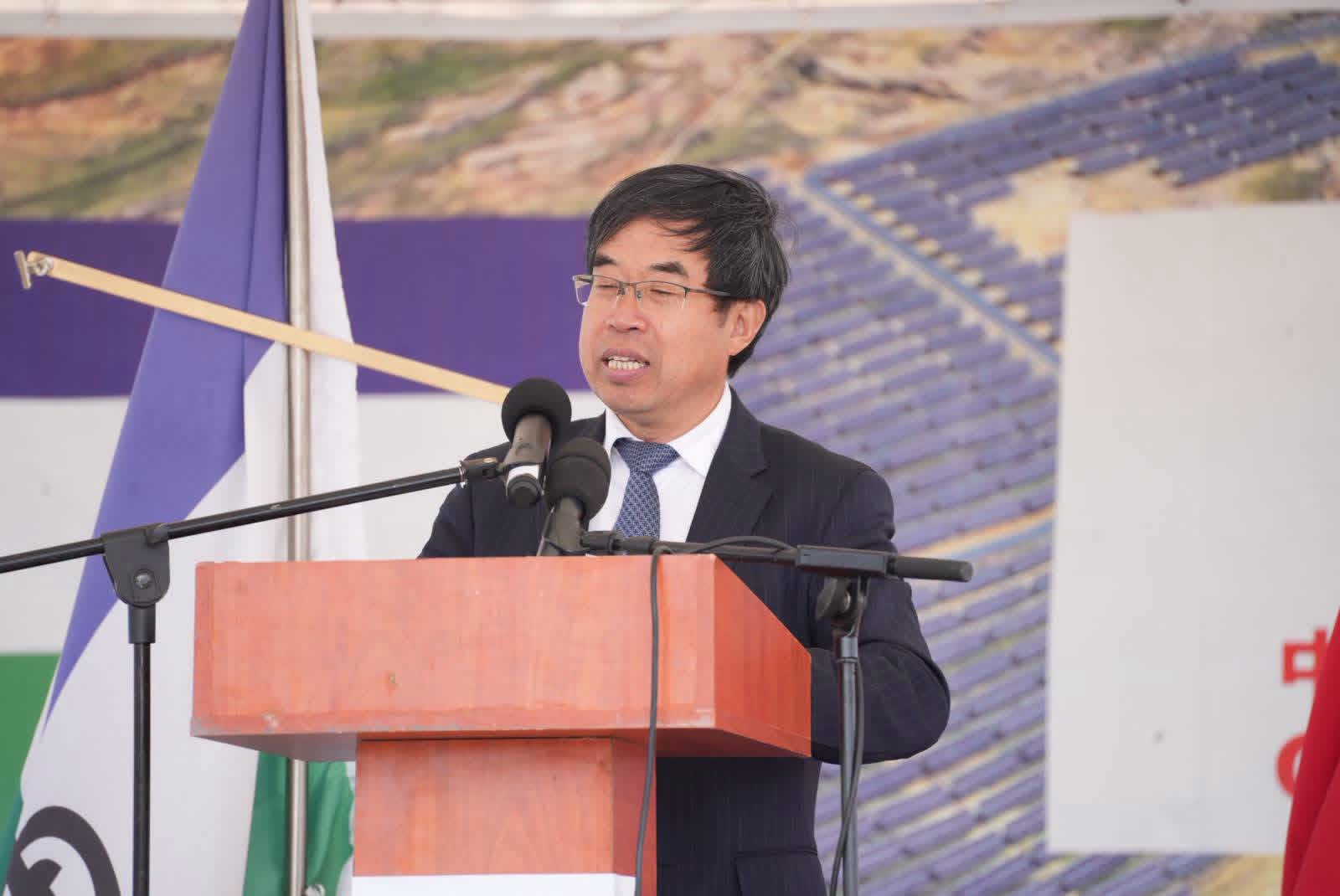
At a reception in Maseru, Ambassador Yang Xiaokun set out China’s account of the Communist Party’s record and its widening cooperation with Africa, from a new zero-tariff regime to closer ties with Lesotho.
At a reception celebrating the 105th Anniversary of the Founding of the Communist Party of China, Ambassador Yang Xiaokun introduced the Party’s historic achievements and its widening cooperation with Africa, from a zero-tariff policy to closer ties with Lesotho.
The Embassy of the People’s Republic of China in Maseru held the reception on 6 July 2026 to mark the 105th anniversary of the founding of the Communist Party of China. The gathering drew senior figures from across Lesotho’s public life, and the ambassador used it to trace the Party’s history and to set out where China and Lesotho now stand.
Ambassador Yang Xiaokun opened by paying respects to King Letsie III and to Prime Minister Sam Matekane, and to members of the Senate, the National Assembly, the judiciary, the cabinet and the political parties, alongside the Chinese community and Chinese firms in the country.
He noted that a gathering in Beijing days earlier had marked the same anniversary, at which General Secretary Xi Jinping reviewed what the ambassador called the Party’s extraordinary journey. Yang quoted Xi’s description of the Party’s 105 years as, in Xi’s words, the most magnificent epic in the millennia-long history of the Chinese nation.
“From a small political party of just over fifty members, the Communist Party of China has grown into the largest governing party in the world.”
Ambassador Yang Xiaokun
By the ambassador’s account, the Party was founded in 1921 with just over fifty members and now has more than 101 million, organised through over 5.43 million primary-level bodies. He said China had become the world’s second-largest economy and had, in his telling, completed in a few decades an industrialisation that took others far longer.

Source: figures cited in Ambassador Yang’s address. Pre-2026 points illustrative.
Yang said that since the Party’s 18th National Congress, China had followed what he called a people-centred path, and he pointed to the elimination of absolute poverty, which he said lifted nearly 100 million rural residents and met a 2030 sustainable-development target ten years early. He listed advances he attributed to that period: large public systems for education, social security and healthcare, and gains in science and technology.
On technology, the ambassador said China had led in the research and application of artificial intelligence, with large models feeding a global open-source ecosystem, and reported new work on domestic chips, the Tianwen-2 interplanetary probe, new-energy vehicle output above 16 million units, and more than 20 million charging points.
| Figure | What it is |
| 101 million | Party members, 2026 (per the ambassador) |
| US$348 billion | China-Africa trade in 2025, a record (China customs) |
| 53 | African nations with zero-tariff access from May 2026 |
| 16 million+ | New-energy vehicles, annual output (per the ambassador) |
Yang quoted Xi again, describing the Party as one that seeks happiness for the people and progress for humanity, and argued that there is no single model for modernisation. Every country, he said, has the right to a path suited to its own conditions, and modernisation need not mean westernisation.
The six qualities, in the Party’s own words
The ambassador relayed the six qualities that, in Xi Jinping’s account, explain the Party’s record.
| Quality | In the Party’s account |
| Pursuit of truth | A commitment to Marxism and to seeking truth from facts, said to keep its direction right. |
| Bond with the people | Serving the people, cast as the Party’s foundation. |
| Historical mission | The ideal of communism and settled policy lines, said to hold the initiative. |
| Reading the trend | A claimed grasp of national conditions and the times. |
| Courage to fight | A spirit of struggle and sacrifice through hardship. |
| Self-strengthening | Internal discipline: in the ambassador’s image, it takes a good blacksmith to make good steel. |
Africa, and the zero-tariff turn
The ambassador placed Lesotho within a wider China-Africa story. He said China’s Africa policy rested on sincerity, real results, affinity and good faith, and pointed to support for industrialisation, agriculture, infrastructure and training.
He set out the tariff move in stages. From 2005 China gave zero-tariff access to some products from least developed countries. That widened over time, and on 1 May 2026 it extended to cover all 53 African countries with which China has diplomatic ties.

Source: Chinese government announcements, 2024 to 2026.
The step, taken as several Western economies raised tariffs, made China the first major economy to offer such unilateral, full-coverage access. For non-LDC states it applies as a preferential rate to April 2028, alongside a proposed China-Africa economic partnership.

Source: China’s General Administration of Customs; 2025 a record.
Where Lesotho fits
Yang described China-Lesotho relations as excellent, with frequent exchanges between leaders and mutual support on core concerns. He recalled a visit earlier in the year by Wang Yi, China’s foreign minister, at which both sides spoke of raising the partnership to a higher level.
“China is ready to work hand in hand with Lesotho to deepen political mutual trust and expand practical cooperation.”
Ambassador Yang Xiaokun
On party ties, the ambassador said the Communist Party had built relations with three of Lesotho’s parties, the Lesotho Congress for Democracy, the Democratic Congress and the Revolution for Prosperity, through visits, dialogue and training. He framed these as a way to build trust and support cooperation between the two states.
He closed with a toast to the anniversary, to the friendship between China and Lesotho, and to peace and shared prosperity, ending with the Sesotho words Khotso, Pula, Nala.