



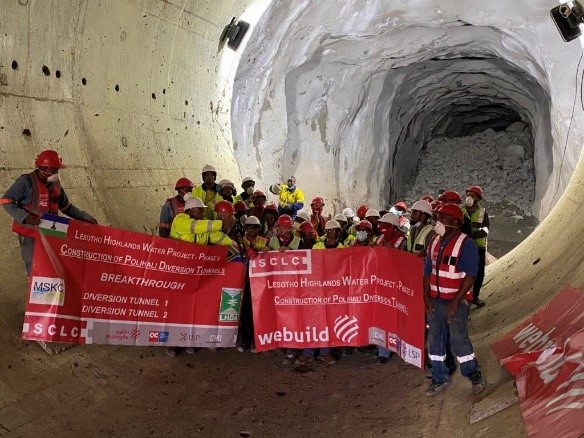
Two giant machines are now boring toward each other from opposite ends of the Maluti Mountains, a longest-ever bridge has been inaugurated by two heads of state, and cumulative water royalties paid to Maseru have exceeded M19 billion. Phase Two of the Lesotho Highlands Water Project is running ten percent behind schedule and R11 billion over its last budget estimate, but it is unmistakably moving.
On 20 April 2026, South Africa’s Minister of Water and Sanitation Pemmy Majodina, Deputy Minister David Mahlobo, and Lesotho’s Minister of Natural Resources Mohlomi Moleko gathered at the Polihali construction site in Mokhotlong to officially launch the second tunnel boring machine (TBM) on Phase Two of the Lesotho Highlands Water Project (LHWP). Two days later, on 22 April, King Letsie III and South African President Cyril Ramaphosa inaugurated the Senqu Bridge, an 825-metre extradosed structure that is the longest bridge in Lesotho and the first of its kind in the country.
The back-to-back ceremonies marked a visible acceleration in one of Africa’s most consequential cross-border infrastructure projects, a programme that has taken four decades to reach this point and which carries profound implications for water security across the region, for Lesotho’s energy future, and for the fiscal revenues on which the government depends.
“We started slowly, but I think we will finish stronger. The planned progress is about 57 percent, while the actual progress is 48 percent. This says we are about 10 percent behind schedule.”
LHDA Chief Executive Tente Tente, October 2025
Two machines boring through the mountain
The centrepiece of Phase Two is a 38.5-kilometre gravity-fed transfer tunnel connecting the new Polihali Reservoir to the existing Katse Reservoir. Because the tunnel uses gravity rather than pumping, it requires no energy to operate once complete, making it one of the most efficient large-scale water transfer systems in the world. The tunnel is being excavated by the SUN joint venture, a partnership between Vinci Construction Grands Projets, Bouygues Travaux Publics, and South Africa’s Raubex.
Each TBM measures approximately 423 metres in length and operates with a 5.38-metre diameter cutterhead, engineered to bore continuously through some of the hardest rock in southern Africa beneath mountain ranges exceeding 3,000 metres in elevation. The first machine was launched from the Katse side in January 2025 and by early 2026 had excavated more than 600 metres. The second, launched from the Polihali end in January 2026, had progressed 235.8 metres by the time of the official April ceremony. Both machines are advancing toward a meeting point deep inside the Maluti range. The LHDA confirmed that the twin-TBM approach is complemented by drill-and-blast methods in more complex geological sections.
The Polihali Dam and what it will deliver
The Polihali Dam, a concrete-faced rockfill structure 165 metres high with a crest length of 921 metres, is being built on the Senqu and Khubelu rivers in Mokhotlong District. Main works contracts were awarded in November 2022 and construction began in early 2023. Rockfill placement reached the milestone elevation of 1,977 metres by the end of November 2025. The LHDA expects the dam to reach a level suitable for water impoundment by the end of 2026 or early 2027. When full, the Polihali Reservoir will have a storage capacity of 2,325 million cubic metres and a surface area of 5,053 hectares.
Once the tunnel and dam are complete, annual water transfer capacity from Lesotho to South Africa’s Vaal River system will increase from 780 million cubic metres to 1,270 million cubic metres per year, a 63% increase, providing water security for Gauteng, the Free State, North West, Mpumalanga and the Northern Cape, home to approximately 26 million people and 60% of South Africa’s economy. Water delivery is targeted for the 2028/29 financial year.
| Key parameter | Detail |
|---|---|
| Total projected cost (2025 estimate) | R53.3 billion (~$2.9 billion) |
| Cost increase in one year (from R42.1bn) | +R11.2 billion (~+$609 million) |
| Transfer tunnel length | 38.5 km (gravity-fed) |
| Polihali Dam height | 165 metres |
| Reservoir storage capacity | 2,325 million cubic metres |
| Water transfer capacity (on completion) | 1,270 Mm³/year (up from 780 Mm³) |
| Muela Hydropower output increase | ~30% |
| Oxbow Hydropower Scheme capacity | 80.3 MW / 180 GWh/year (commissioning 2030/31) |
| Water delivery target | Financial year 2028/29 |
| Construction progress (October 2025) | 48% actual vs 57% planned |
Sources: LHDA / DWS / PMG / DA Parliamentary Question / African Development Bank. USD at approx. R18.50/$1 (South African rand, June 2026).
The Senqu Bridge and the road to Polihali
The Senqu Bridge, inaugurated by King Letsie III and President Ramaphosa on 22 April 2026, is the largest of three major crossings built as part of Phase Two’s access infrastructure, alongside the Mabunyane and Khubelu bridges. Constructed at a cost of approximately R2.4 billion (about M2.4 billion), the 825-metre extradosed structure rises roughly 90 metres above the Senqu River valley and provides a critical transport link that will remain accessible across the future Polihali Reservoir once water levels rise. Without it, communities and construction traffic in the affected sections of Mokhotlong would be cut off once the dam fills. The bridge connects to the A1 national road linking Mokhotlong to Maseru.
What Lesotho earns, and what communities say
Lesotho’s financial return from the LHWP is substantial and direct. LHDA Chief Executive Tente Tente, speaking at a media briefing in October 2025, revealed that cumulative water royalties paid by South Africa to Lesotho have exceeded M19 billion, with monthly inflows averaging between M300 million and M400 million. These royalties are deposited directly into the Consolidated Fund, from which the government finances education, healthcare and infrastructure. A recent recalculation linked to Phase Two delays more than doubled the monthly royalty payment to M298 million.
The energy dividend is also significant. The increased flow from Polihali through the existing system is expected to raise output at the Muela Hydropower Station, which currently supplies 51% of Lesotho’s electricity demand, by approximately 30%. The separately planned Oxbow Hydropower Scheme, a peaking generation facility with an installed capacity of 80.3MW on the Malibamatso River, will add further generation capacity and is currently in detailed engineering design, with commissioning slated for 2030/31.
The benefits, however, are contested at the community level. About 1,600 people from 18 communities in Mokhotlong, primarily rural, pastoralist and farming households, filed a complaint in 2025 alleging that the project’s environmental and social commitments are not being met, with the effects felt across at least 72 communities in northeastern Lesotho. The project proponents estimate that 85,000 Basotho will ultimately benefit from associated infrastructure and community development programmes.
Cost overruns and oversight concerns
The financial trajectory of Phase Two has drawn sharp parliamentary scrutiny in South Africa. A Democratic Alliance parliamentary question in April 2026 revealed that the project’s total projected cost had risen from R42.1 billion to R53.3 billion in just over a year, an increase of more than R11 billion. The original 2008 estimate had been R8 billion. South Africa’s Auditor-General cautioned Parliament against suspending funding, warning of legal consequences, but committee members raised concerns about limited local procurement, the dominance of foreign contractors, and the constraints of the 1986 treaty, which prevents South Africa’s auditing authority from directly auditing the LHDA, leaving it reliant on Lesotho’s own audit structures. A review of the governing treaty is being prepared, with both governments engaging at technical and political levels.
For Lesotho, the project’s significance extends beyond any single set of numbers. The LHWP has financed decades of national development. Phase Two will expand that foundation, and the 2029 water delivery date, affirmed as recently as April by Minister Moleko, remains the benchmark against which both governments will be measured.
By Staff Reporter | Lesotho Tribune