



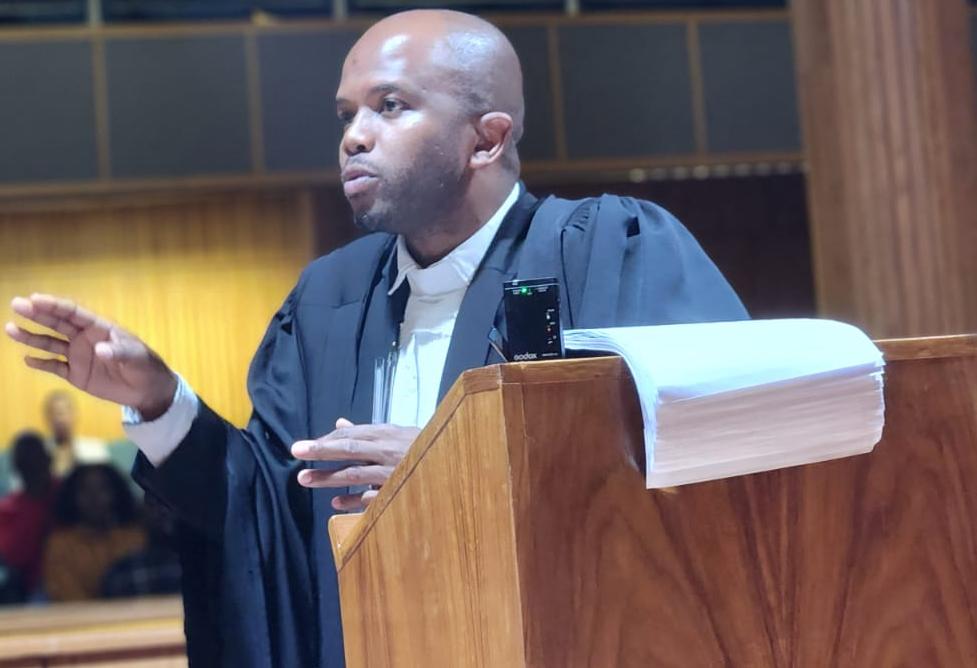
A soldier on trial for the killing of former army commander Lieutenant General Maaparankoe Mahao has told the High Court he opened fire only to save a colleague’s life, as prosecutors push back with questions about whether the entire operation was ever lawfully authorised.
Captain Haleeo Makara took the witness stand in the High Court this week to offer his account of what happened on 25 June 2015 at Ha Lekete in Mokema, the day Lieutenant General Mahao was shot and killed. Makara, one of several members of the Lesotho Defence Force facing charges linked to Mahao’s death, told the court his decision to fire his weapon was driven entirely by a need to protect the late Captain Tefo Hashatsi, who was leading the operation to arrest Mahao.
According to Makara, the situation escalated rapidly when Mahao allegedly pointed a firearm at Hashatsi. “I had to protect Hashatsi,” he told the court, insisting that his intention was not to kill Mahao but to disable him and neutralise what he perceived as an immediate threat to his colleague’s life.
“We never rehearsed shooting anyone because we did not expect what eventually happened.”
Captain Haleeo Makara, testifying before the High Court
Makara rejected suggestions from the prosecution that he could have taken cover, repositioned or issued a warning before firing. He argued that a warning shot had already been discharged by Hashatsi, making a further warning unnecessary under the circumstances. He also challenged testimony previously given by current Army Commander Lieutenant General Mojalefa Letsoela, who had suggested the arresting team could have taken up advantageous positions and waited for Mahao to react. Makara dismissed the idea as unrealistic. “We could not arrive at the scene and then start taking positions and waiting for reactions,” he said.
No rehearsal for what happened
Throughout his testimony, Makara sought to portray the shooting as a measure of last resort rather than a planned use of deadly force. He told the court that military personnel involved in the mission had rehearsed the arrest beforehand, but that those preparations had not included any scenario in which Mahao would be shot. He added that the equipment used on the day was standard issue and had been deployed in routine military operations and previous arrests of soldiers suspected of involvement in the alleged mutiny investigation.
Prosecution: shooting was the first option, not the last
Advocate Lehlohonolo Phooko, leading the cross-examination, put it directly to Makara that the shooting was not a last resort but the first option chosen by the arresting team. Phooko also questioned the legality of the entire operation, arguing that the mission to arrest Mahao had not been sanctioned by either the Prime Minister or the Minister of Defence. The question of whether the operation was lawfully authorised has become a central thread of the prosecution’s case.
The court also heard argument about the role allegedly played by former army commander Lieutenant General Tlali Kamoli, who is among the accused. The prosecution argued that Kamoli effectively endorsed the operation by failing to halt it after returning to work, by which time the arrest of soldiers suspected of mutiny had already begun. Phooko contended that an operation targeting senior military officers of Mahao’s rank could not have proceeded without Kamoli’s knowledge and approval, suggesting the accused soldiers were acting within a broader coordinated plan at the highest levels of military leadership.
What the first accused previously told the court
Captain Litekanyo Nyakane, the first accused, had earlier told the court that he participated in the operation to arrest Mahao and acknowledged that the mission resulted in Mahao being shot and sustaining injuries that led to his death. Nyakane’s admission that the shooting occurred within the course of the operation has formed part of the factual foundation on which both sides have been building their competing arguments.
In addition to murder, the accused face counts of attempted murder, theft and unlawful damage to property. Proceedings continue before Justice Charles Hungwe. Makara’s testimony has added another layer to the contest between two starkly different versions of the same event: one portraying the operation as an unlawful mission that ended in murder, the other insisting that the soldiers were forced to react to a life-threatening situation that spiralled beyond their control.
By Tholoana Lesenya | Lesotho Tribune