


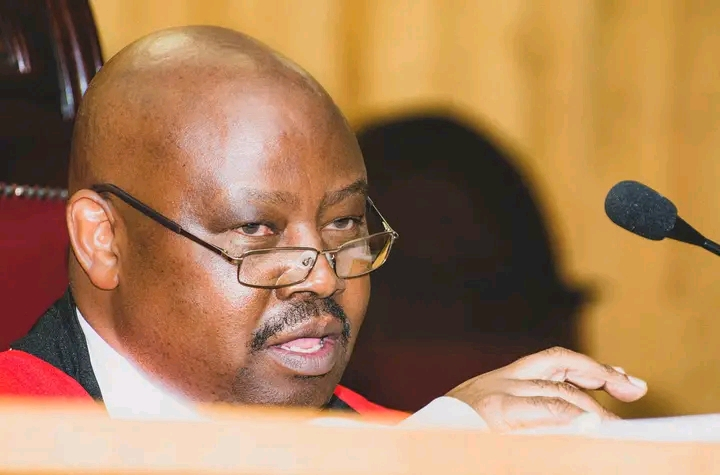
Maseru – The highest echelons of Lesotho’s judiciary are engulfed in a scandal of epic proportions, as an explosive paper trail leaked to Lesotho Tribune reveals a deepening conflict between the Honourable Chief Justice S.P. Sakoane and Justice Maseforo Mahase, the country’s most senior puisne judge.
The unprecedented correspondence lays bare startling allegations of judicial misconduct, miscommunication, and apparent procedural defiance at the Palace of Justice. What began as a procedural dispute has now escalated into a constitutional crisis, with the Chief Justice threatening to trigger Section 121(5) of the Constitution, potentially paving the way for a tribunal to investigate Justice Mahase’s conduct.
Chief Justice: “You have spurned justice and betrayed court procedure”
In a letter dated 11 June 2025, Chief Justice Sakoane accuses Justice Mahase of improperly presiding over two urgent matters — CIV/APN/0086/25 and CIV/APN/0089/25 — without being officially allocated to do so. The Chief Justice states bluntly:
“You admitted that this was contrary to the Practice Direction No.2 of 2024 but could not say why you did this.”
The correspondence goes further, citing corroborating reports from Assistant Registrars Kholoane and Marketso, and Clerk Nkoho, that the files had been moved without proper authorization, allegedly at the instruction of Advocate Fusi Sehapi — a move that bypassed the Assistant Registrar responsible for allocations.
The Chief Justice did not mince words:
“I consider that you have deliberately conducted yourself in a manner unbecoming and subversive of the administration of justice.”
Justice Mahase Hits Back: “I have been deceived”
In her written response dated 13 June 2025, Justice Mahase mounts a vigorous defense, denying all accusations of self-allocation and judicial insubordination. Instead, she blames miscommunication and outright deception by her staff and legal counsel.
“I heard the matter CIV/APN/0086/25 because I was told you had instructed that I do so,” she writes.
Mahase insists she was “on call” during the week in question and acted on the good faith word of her Clerk and Counsel Sehapi, who allegedly told her the Chief Justice had directed the matters to be placed before her. Notably, she claims to have only read through one file — CIV/APN/0089/25— and denies ever presiding over it.
On the matter of a matrimonial case, CIV/T/376/2021, which the Chief Justice says she refused to hear, Mahase explains she merely sought clarification:
“I asked both Assistant Registrar Maiketso and my Clerk to seek guidance from the Registrar. The Practice Directive is silent on urgent interlocutory applications.”
She further pleads for professional grace as she nears the end of her career:
“I am a very short way to retirement. Please allow me, Honourable Chief Justice, the time to serve this nation diligently with sincerity and dedication.”
Chief Justice Fires Back Again: “You are not on call. You were never on call.”
In a damning final salvo dated 17 June 2025, Chief Justice Sakoane categorically rejects Mahase’s version of events. He accuses her of relying on “hearsay from your Clerk” and ignoring clear court procedures.
“You were not on call in the first place. All Judges and lawyers know the Urgent Court is presided over by the Chief Justice unless advised otherwise.”
He further criticizes Mahase for seeking guidance from clerical staff on legal matters already assigned to her:
“Since when do Judges seek clarification from administrative staff on the propriety of dealing with matters they are seized with?”
Perhaps most alarming is his final warning:
“Your response is not persuasive. What remains for me is to refer the matter for deeper enquiry by an independent body in terms of Section 121(5) of the Constitution.”
This section allows for the establishment of a tribunal to investigate a judge’s conduct and could potentially result in removal from office.
What This Means for the Judiciary
Judicial insiders speaking to Lesotho Tribune on condition of anonymity describe the fallout as “the worst institutional rupture in a generation.” They warn that it risks undermining public confidence in the impartiality and integrity of the courts, especially with sensitive cases — including high-stakes matrimonial disputes and politically volatile matters — pending judgment.
One senior advocate noted:
“It is not merely about who heard what case. This is about whether there is a rule of law at all — or just rules that change based on whispers in court corridors.”
As the country awaits clarity, the larger question looms: Has Lesotho’s judiciary reached a breaking point?
What’s Next
With the Chief Justice poised to escalate the matter constitutionally, all eyes are now on the Judicial Service Commission and potential tribunal processes. Legal analysts suggest that unless resolved swiftly and transparently, this dispute could set a troubling precedent — and drag the courts into the very political controversies they are meant to rise above.
For now, the nation watches with unease as two titans of the judiciary battle it out in a saga that is equal parts procedural and profoundly personal.