


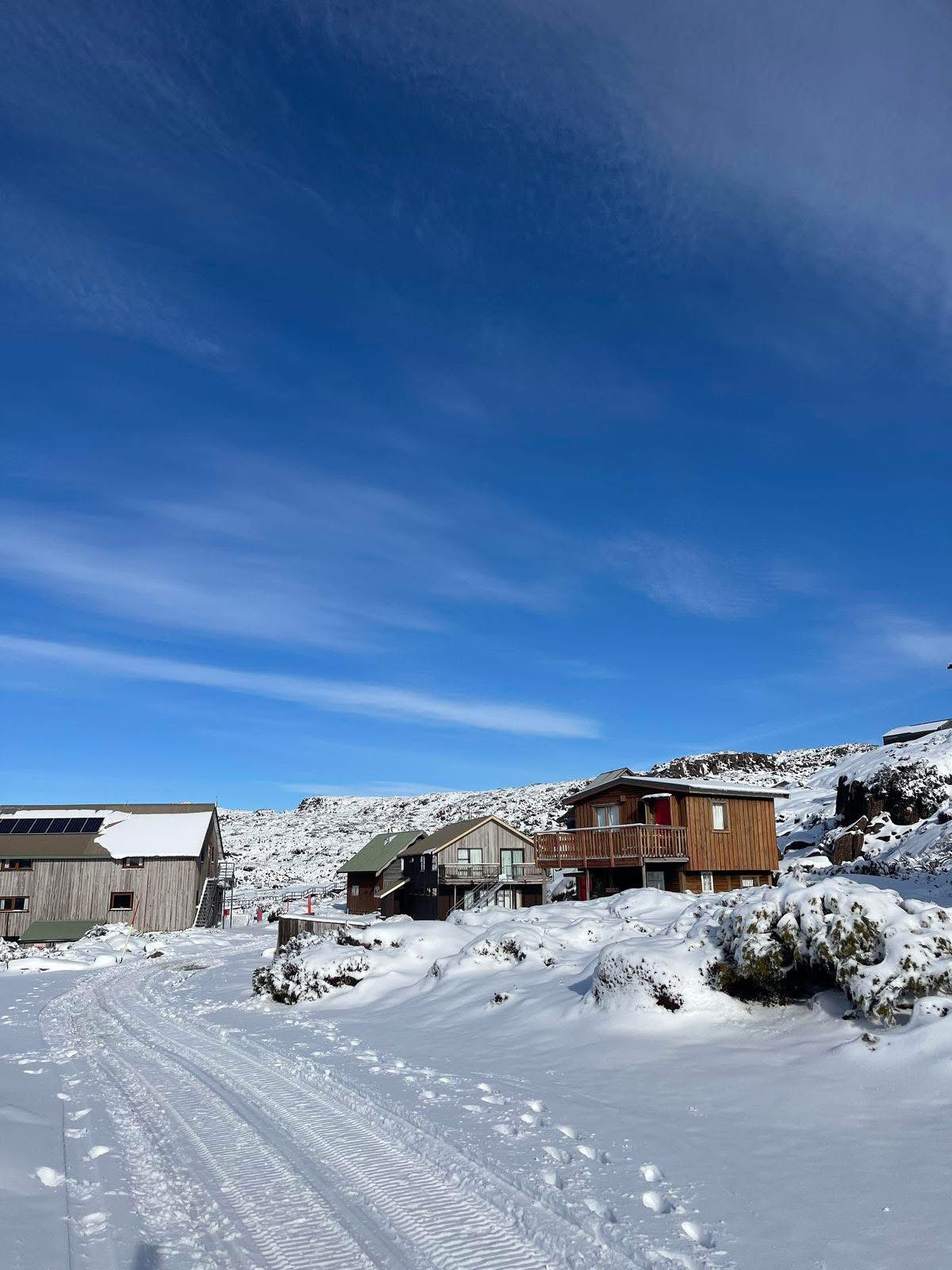
Every June, the world turns to marvel at Lesotho’s rare alpine winter. Every June, Lesotho watches the money walk back across the border.
THE EDITOR · LESOTHO TRIBUNE
Every winter, a quiet spectacle plays out across the Maloti highlands. South Africans press their faces to car windows as they cross into Lesotho, stunned by what greets them: a white, snow-draped landscape that has no business existing this far south on the African continent. They photograph it. They post it. They tell their friends. And then, overwhelmingly, they go home. The money goes with them.
This is the central failure of Lesotho’s relationship with its most extraordinary natural endowment. The Kingdom of the Sky sits on one of the most improbable gifts that geography has bestowed upon any African nation. It is the only country on earth whose entire territory lies above 1,000 metres. Its highlands receive reliable snowfall each winter. It hosts the only ski resort in sub-Saharan Africa south of the Sahara’s eastern fringe. None of this has translated into the economic transformation it should.
The numbers do not flatter us. Tourism’s total contribution to Lesotho’s GDP has long hovered around 5.5 percent, with projections that it might reach 6.1 percent by 2024 only if recovery from the pandemic held course. Lesotho’s international tourism receipts as a percentage of GDP sit at approximately 2.5 percent, according to World Bank-tracked figures. In a country whose nominal GDP sat at roughly $2.1 billion in 2023, that represents a sector punching far below its weight in an economy that can ill afford underperforming pillars.
Now compare this to nations that faced similar constraints and chose differently.
| Country | Context | Tourism % GDP |
|---|---|---|
| Rwanda | Landlocked, mountainous, comparable size | 9.8% |
| Bhutan | Small mountain kingdom, high-value model | 5–10% |
| Lesotho | Sole alpine ski destination in sub-Saharan Africa | ~5.5% |
| Sources: WTTC Economic Impact Research 2024; Rwanda Development Board; Bhutan National Statistical Bureau 2024 | ||
Rwanda, a landlocked, mountainous, post-conflict country with none of Lesotho’s alpine uniqueness, earned 9.8 percent of its GDP from tourism in 2024, according to the World Travel and Tourism Council. That figure is not an accident. It is the fruit of deliberate, relentless national strategy: an international airline anchored in Kigali, purpose-built convention infrastructure, premium gorilla trekking permits priced to maximise revenue per visitor, and an aggressive global brand built around the promise of safety and sophistication. Rwanda welcomed 1.48 million international visitors in 2024 and generated over $579 million in revenue. It treats tourism as a strategic industry. Lesotho treats it as a weather phenomenon.
Bhutan, the Himalayan kingdom to which Lesotho is often compared, contributes between five and ten percent of its GDP through tourism and does so on a deliberately controlled, high-value model that charges a daily Sustainable Development Fee precisely to ensure that every visitor leaves significant revenue behind. Bhutan’s hotels and restaurants sector grew by over 50 percent in 2023 alone, the single largest driver of its economic expansion that year. It is not lucky. It made choices.
“Lesotho is the only country in sub-Saharan Africa where a visitor can ski. That sentence, deployed correctly, is worth hundreds of millions of maloti. It remains largely undeployed.”
One ski resort. One slope. One season. One failure of imagination. Afriski Mountain Resort, perched at 3,222 metres on Mahlasela Pass in Butha-Buthe district, is Lesotho’s flagship winter attraction. At full capacity it accommodates approximately 320 people. Its skiable terrain covers 1.8 kilometres across six trails. The resort has built a recognisable lifestyle brand, hosting music events, themed weekends and slope-side festivals, and its 85 percent booking rate during the season attests to the appetite. But appetite is not the same as strategic capture.
The structural failure is one Lesotho’s planners acknowledge but have not solved: the overwhelming majority of international arrivals in pre-pandemic years were South Africans, and of those, the dominant purpose was visiting friends and family, not leisure tourism. The pattern is of day-trippers and weekend visitors who drive to Afriski, spend Saturday on the slopes, sleep at most one night in Lesotho accommodation, and return. Every rand spent on accommodation, food and activities in South Africa en route is a rand that does not contribute to Lesotho’s GDP. We host the snow. South Africa’s Clarens, Drakensberg lodges and Free State guesthouses host the spending.
A 2026 international report on snow and mountain tourism identifies Lesotho as an emerging ski destination alongside Morocco, India and Turkey. The global industry is noticing what we have. Our policymakers have been slower on the uptake.
The infrastructure indictment. Canada’s government travel advisories note plainly that tourist facilities are limited in Lesotho and that there are few gas stations outside of cities and large towns. This is the paragraph that should shame every successive Ministry of Tourism. When the Government of Canada’s advisory to its own citizens serves as a more accurate audit of our tourism infrastructure than our own development plans, something has gone profoundly wrong.
The Lesotho Tourism Development Corporation collects statistics monthly from accommodation providers, attraction operators and tour companies. The Visit Lesotho portal publishes annual arrivals and accommodation reports. These are the administrative bones of a functioning tourism system. What they do not show is a parallel infrastructure of mid-range lodges along the highland tourist circuit, a reliable road network capable of sustaining winter tourist volumes, a domestically-owned tour operator industry of scale, or a national airline strategy that makes Lesotho a destination rather than a transit corridor. Moshoeshoe I International Airport processes visitors for South Africa, not for Lesotho.
The levy of R100 per person introduced at entry points from April 2024 is, in isolation, a sensible mechanism to channel visitor spend into national tourism marketing. But a levy is a tax on the visitor. The deeper work is building the product that justifies far greater expenditure long before and long after the border post.
What deliberate nations have done. Rwanda’s lesson is not that it had better geography. It is that it built an institution, Rwanda Development Board, with a mandate, a budget and accountability for growing tourism revenue. In 2023 Rwanda earned $620 million from tourism, a 36 percent increase on 2022. Tourism employment in Rwanda reached nearly 386,000 jobs by 2024.
Bhutan went in a different direction but with equal intentionality. Facing the ecological fragility of a small Himalayan state, it chose quality over volume, capping arrivals and charging a premium per visitor that subsidises conservation and community benefit. Hotels and restaurants now contribute the single largest growth segment to its economy. The lesson is not the fee; it is the philosophy that a small mountain country can shape the terms on which the world visits it rather than being grateful for whatever arrives.
Lesotho has neither pursued Rwanda’s volume-and-value growth nor Bhutan’s value-over-volume premium model. It has largely waited.
The snow itself will not save us. There is a complacency that attaches itself to remarkable natural endowment. The assumption, half-conscious and never stated, that the snow will do the marketing, that the mountains will sell themselves. The Swiss Alps are extraordinary. So is Swiss hospitality infrastructure, Swiss rail connectivity to every ski village, Swiss pricing discipline and Swiss insistence that the visitor experience is complete from arrival to departure. The alps did not build Switzerland. Switzerland built an industry around the alps.
Lesotho’s Maloti mountains are genuinely, spectacularly unusual in the African context. The snow arrives every year. The pony trekking routes through highland villages offer a cultural experience that money cannot replicate elsewhere on this continent. Sehlabathebe National Park, one of the most remote and pristine ecosystems in southern Africa, now has new road access as of 2025 that should transform visitation. Sani Pass draws adventure travellers who arrive primed for an authentic experience. None of these assets are connected to each other by a tourism product. They are dots without a line.
“Our visitors come from the most tourism-infrastructure-rich country in sub-Saharan Africa. They know what good looks like. We have been offering them scenery and hoping it is enough.”
A programme for seriousness. This editorial does not pretend that a single article will compel a government to act where decades of audits and development plans have not. But it insists on naming the failure so that citizens, private investors and regional partners understand what is being squandered each winter.
The minimum viable seriousness looks like this: a targeted lodge development incentive along the highland circuit linking Afriski to Sani Pass to Sehlabathebe, financed through a combination of government-backed guarantees and private investment, that doubles overnight capacity for winter tourists within five years. A renegotiated air access strategy at Moshoeshoe I that treats the airport as a tourism gateway, not merely a domestic connector. A Lesotho highland tourism brand, owned and marketed by the state with private sector funding, deployed in Johannesburg, Cape Town, London and Nairobi. A minimum length-of-stay expectation built into tour operator packages, rewarded with reduced levies. And an honest accounting, published annually by the Bureau of Statistics and debated in parliament, of how much the sector earned versus how much it left on the table.
This winter, as it does each year, Lesotho’s snow will fill South Africans with wonder and our social media feeds with beautiful images. The wonder is free. The images are free. The opportunity to convert that wonder into sustained national prosperity is not unlimited. Geography has given us an asset that neighbouring nations can only envy. History will judge whether we chose to build an industry or merely enjoy the view.
This editorial represents the position of the Lesotho Tribune. GDP and tourism contribution figures draw on World Travel and Tourism Council Economic Impact Research, World Bank data, Rwanda Development Board annual reports, Bhutan’s National Statistical Bureau 2024 National Accounts, and published comparative analysis. The Tribune urges the Bureau of Statistics and the Ministry of Tourism to publish a current, standalone tourism satellite account to enable more precise domestic accountability.