


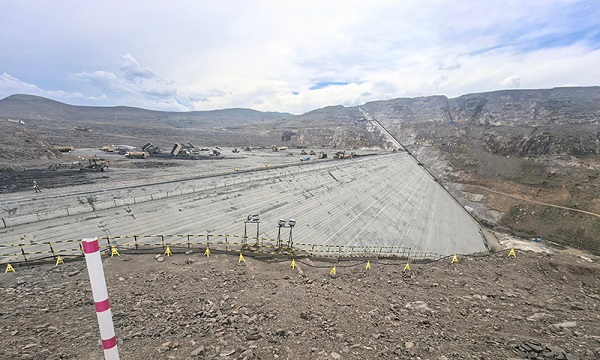
The Power Construction Corporation of China (POWERCHINA) has confirmed a major construction milestone at the Polihali Dam in Lesotho, with the dam reaching full-section fill to its design elevation of EL.1977 metres, equivalent to a structural height of 65 metres.
The achievement, reached on 6 December 2025 and formally announced by POWERCHINA later in the month, marks the transition of the region’s largest water diversion control initiative into its peak construction phase.
Located in Lesotho’s Mokhotlong District, the Polihali Dam is the centrepiece of Phase II of the Lesotho Highlands Water Project, a landmark bi-national partnership between Lesotho and South Africa aimed at strengthening long-term water security, energy resilience and regional economic development.
The project is implemented by the Lesotho Highlands Development Authority (LHDA) and is widely regarded as one of southern Africa’s most ambitious examples of transboundary infrastructure cooperation.
To mark the milestone, a high-level delegation of more than forty representatives visited the construction site, including Mokhotlong District Administrator Mr Kepa Keqe, Principal Chiefs and Members of Parliament. The delegation was accompanied by LHDA officials and members of the international supervision team, who observed the mechanised embankment filling process and concrete works on the intake tower.
Speaking during the visit, Mr Keqe described the milestone as a defining moment in Lesotho’s national development trajectory, underlining the dam’s strategic importance to both countries’ water and energy needs. He expressed confidence that timely delivery of the project would translate into lasting socio-economic benefits for communities in the highlands and beyond.
Once completed, the Polihali Dam will impound water from the Senqu River and channel it through an extensive tunnel network into South Africa’s Vaal River system. The reservoir is expected to significantly enhance water supply reliability for Gauteng Province, the continent’s most industrialised urban region, while also supporting hydropower generation within Lesotho.
Engineering experts and project stakeholders have consistently framed the Polihali development as a practical demonstration of regional partnership and shared benefit. The project reflects a governance model grounded in joint planning, consultation and mutual contribution between neighbouring states, supported by international contractors and financiers.
POWERCHINA’s role at Polihali forms part of a broader pattern of large-scale infrastructure collaboration across Africa, particularly in water and energy sectors where Chinese firms have become prominent partners in projects aligned with national and regional development priorities.
Beyond its engineering scale, the Polihali milestone has been interpreted by analysts as a signal of growing African agency in infrastructure delivery. Increasingly, African states are asserting greater influence over project design, sequencing and implementation, while engaging global partners on negotiated and strategic terms.
However, as construction accelerates, observers caution that environmental management, social safeguards and equitable water governance remain critical. Sustained transparency, community participation and ecological oversight will be essential to ensure that the project’s long-term benefits are broadly shared, particularly by highland communities directly affected by the reservoir.
If delivered as planned, the Polihali Dam is expected to enhance livelihoods across both Lesotho and South Africa through improved water availability, job creation and expanded economic activity. Its progress reinforces a growing continental commitment to cooperative, rules-based and inclusive management of shared natural resources, setting a notable precedent for future regional infrastructure initiatives.