


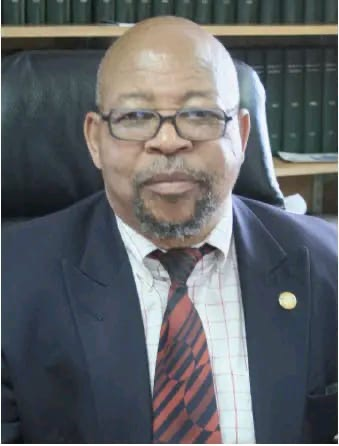
MASERU — The High Court sitting as the Constitutional Court has ruled that Justice Ts’eliso Monaphathi must be allowed to continue working and receive the full benefits of a puisne judge until he completes all the cases that are still before him.
The decision follows an application brought by Justice Monaphathi, who challenged a move by the Chief Justice to withhold his terminal benefits after he reached the mandatory retirement age.
In its judgment, the Constitutional Court made it clear that Justice Monaphathi does not have the choice to decide whether he wants to continue working or not. Instead, the court said the Constitution requires him to complete all the cases he had already started before he turned 75 years old.
The court explained that although judges are required to retire at the age of 75, the law allows them to remain in office for a limited time if it is necessary for them to finish their pending work. This includes delivering judgments and concluding cases that were already underway before retirement.
According to Section 121(1) of the Constitution, judges of the High Court must leave office when they reach the prescribed retirement age of 75. However, Section 121(2) provides that they may continue working after that age if it is necessary to complete ongoing proceedings.
The court stressed that this continuation is not optional. It is a constitutional obligation meant to ensure that cases are finalised and justice is delivered without unnecessary delays.
In its ruling, the court stated that if Justice Monaphathi chooses to continue working as required by the Constitution, he must be given all the benefits of his position, including his salary, as he had earned at the time he reached retirement age.
“Should he decide to continue as required by the Constitution, he should be entitled to a salary or the benefits he earned at the time when he attained the retirement age.”
At the same time, the court made it clear that Justice Monaphathi cannot access his pension benefits until he has completed all the cases assigned to him. This means that his retirement benefits will remain on hold until he finishes his outstanding work.
The court described the matter as “regrettable,” pointing out that many of the cases involved have been pending for years, leaving litigants waiting for justice for a very long time.
It noted that delays in delivering judgments have serious consequences, especially for people who rely on the courts to resolve disputes and protect their rights.
The judges also commented on efforts by the Chief Justice to improve the functioning of the High Court. They said these efforts should be supported, as they are aimed at addressing long-standing problems within the justice system.
The court further criticised Justice Monaphathi’s conduct, stating that he had failed to carry out his constitutional duties properly. It said his understanding of judicial independence was incorrect and could not be used to justify delays in completing cases.
The judgment also questioned his claim that he had served honourably, noting the large number of cases that had remained unfinished during his time on the bench.
According to the court, there was no convincing evidence to show that the delays were caused by a shortage of judges or a lack of resources. Instead, it suggested that the situation may have been due to other factors.
“We do not believe that the applicant accumulated all these reserved judgments and part-heard matters because of a shortage of judges.”
It added that the delays could be the result of “deliberate obstruction, laxity, unjustifiable inaction, or some other unexplained reason.”
The court placed much of the responsibility for the delays on Justice Monaphathi himself, stating that he had not shown sufficient commitment to completing his work.
During the hearing, Justice Monaphathi’s lawyer, Advocate Mocheta Makara, argued that the judge had been working under difficult conditions. He said the courts were understaffed, judges were overworked, and there were not enough resources to help them manage their workload.
Advocate Makara also told the court that the Chief Justice had failed to provide Justice Monaphathi with the support he needed to continue working after reaching retirement age, as allowed by the Constitution.
He argued that since Justice Monaphathi had already reached the age of retirement, he was entitled to receive his pension and other benefits. He also claimed that the judge had the discretion to decide whether to continue working after turning 75.
In addition, Advocate Makara said that if the Chief Justice believed Justice Monaphathi was not performing his duties properly, he should have taken formal disciplinary action or started impeachment proceedings.
He further argued that the Chief Justice did not follow the proper legal procedures under Section 151 of the Constitution, which deals with withholding a judge’s pension benefits. According to him, the Chief Justice did not have the authority to stop those benefits.
However, the application was opposed by Advocate Rudie Cronje, who argued that judges have a duty to complete their work and deliver justice to the public.
He said the public expects courts to function efficiently and that judges must honour the oath they take when they assume office.
“It can never be that a judge has the discretion to work after the age of 75.”
He emphasised that judges are required to complete the cases before them and cannot simply walk away after reaching retirement age.
He also referred to the judicial code of ethics, which requires judges to deliver judgments within a reasonable time, usually within three months.
According to him, judges must be accountable for their work and ensure that cases are finalised without unnecessary delay.
The Constitutional Court agreed with this position, making it clear that the duty to complete pending cases is not optional but a legal requirement.
The matter was heard before a panel of acting justices drawn from the region. These were Justice Mankhambira Mkandiwire from Malawi, Justice Sylvester Salufu Mainga from Namibia, and Justice David Mangota from Zimbabwe.
In conclusion, the court ordered that Justice Monaphathi be allowed to continue working with full benefits until he finishes all his pending cases. However, his pension will remain inaccessible until that work is completed.
The ruling sends a strong message about accountability within the judiciary and the importance of ensuring that justice is delivered without delay.
— Lesotho Tribune | Courts & Justice