


Business & Economy
A Bloomberg investigation has confirmed what market analysts had long feared: the global natural diamond industry is enduring its deepest crisis in modern history. For two small, landlocked Southern African nations whose fortunes are hewn from kimberlite rock, the consequences stretch far beyond the trading floors of Antwerp and Surat.
There is a particular cruelty in the timing. Just as Lesotho and Botswana had built their modern states on the promise of diamonds — sovereign wealth, public hospitals, paved roads carved into highland rock — the very gemstone underpinning those promises has entered the longest and most structurally threatening downturn in its recorded commercial history. Bloomberg reported in March that the global diamond industry is in its deepest crisis in modern times, battered by a convergence of forces: the relentless rise of laboratory-grown stones, the collapse of Chinese luxury demand, an uncertain American consumer market, and record gold prices siphoning discretionary spending away from gems.
The figures are stark and largely without precedent. Natural diamond prices have fallen more than 40 per cent from their pandemic peak. In India, where nine in every ten of the world’s diamonds are cut and polished, export demand has fallen to a two-decade low. The Surat Diamond Bourse, a $350-million complex built to house thousands of traders, has only 250 of its 4,700 offices operational since opening in 2023. De Beers, the industry’s dominant force for over a century, lost nearly $1.5 million a day last year. Parent company Anglo American has written down the business three times in as many years, slashing its book value from $9.1 billion to $2.3 billion.
At the centre of this collapse sits a technological disruptor that would have seemed fanciful a generation ago. Laboratory-grown diamonds, produced in plasma reactors within a matter of hours rather than crystallised across billions of years of geological time, are now chemically, visually and structurally indistinguishable from their mined counterparts. They are sold at steep discounts, and they are winning. By the midpoint of 2025, such stones featured in nearly half of all engagement rings sold in the United States. Synthetic diamonds now account for roughly 45 per cent of the bridal jewellery market globally.
The price trajectory reveals the structural nature of the shift. Across more than 2,000 American retail outlets, the average price of a one-carat natural diamond fell from $6,819 in May 2022 to $4,997 by December 2024. Over the same period, a comparable laboratory-grown stone dropped from $3,410 to $892. The lab-grown diamond has not merely competed with the natural stone — it has redefined what ordinary consumers believe a diamond to be worth.
“Natural diamonds cannot win in a situation where it’s all about the cheapest price.” — Paul Zimnisky, independent market analyst
Yet the laboratory revolution is only part of the diagnosis. The other wound is geopolitical and cultural, and its origins lie in Beijing.
For more than a decade, China’s expanding middle class served as the engine of global diamond growth. Chinese consumers, celebrating engagements, weddings and the conspicuous milestones of new prosperity, helped sustain price premiums that mining-dependent economies in Africa relied upon to balance their budgets. That engine has stalled. Bloomberg’s March investigation identified collapsing Chinese demand as one of the principal drivers of the current crisis, alongside laboratory-grown competition and American tariff pressures.
The shift in Chinese luxury sentiment is both economic and cultural. A 2025 consumer sentiment study found that Chinese luxury buyers are now delaying purchases and prioritising savings for health, education and retirement. Half of respondents identified repeated price increases as a deterrent to buying luxury goods. Real estate instability and youth unemployment have shaken confidence in ways that persist well beyond any single quarter. The high-net-worth traditionalist still exists in China, and demand for large, rare natural stones at the apex of the market retains some resilience. But the broad middle tier of the Chinese market, upon which the diamond industry had constructed its growth narrative, has retreated.
More damaging still, China’s younger urban consumers have been the most enthusiastic adopters of laboratory-grown diamonds. Domestic brands have repackaged synthetic stones as “new luxury,” running campaigns that deliberately sidestep the De Beers-era romance of geological rarity. Where the previous generation of Chinese buyers sought the provenance and scarcity that a mined stone promised, a significant portion of the current generation prefers the ethics, accessibility and technological modernity that a laboratory-grown gem represents.
For Botswana, the consequences have been swift and severe. Diamonds contribute roughly 25 per cent of the country’s gross domestic product and nearly 75 per cent of its foreign exchange earnings. The country that once stood as Africa’s most celebrated development success story is now confronting what its own finance ministry describes as a multi-year recession. GDP contracted by 3 per cent in 2024 and by a further 0.9 per cent in 2025. Debswana, the 50/50 joint venture between the government and De Beers, cut production to 15.1 million carats in 2025, a 40 per cent reduction from its 2023 output. By the close of 2025, Botswana’s national diamond stockpile had risen to 12 million carats, nearly double the allowable inventory level of 6.5 million carats.
The fiscal damage has been extraordinary. The government’s budget deficit reached an estimated 11 per cent of GDP in 2025, the widest in sub-Saharan Africa. Foreign exchange reserves fell 27 per cent in a single year. Moody’s and S&P have downgraded Botswana’s sovereign credit rating, citing the deteriorating fiscal position and structural over-reliance on a single commodity. In August 2025, President Duma Boko declared a national public health emergency as clinics reported critical shortages of medicines. Debswana announced the retrenchment of 1,000 workers, representing nearly 20 per cent of its staff, in a country where unemployment already exceeded 27 per cent.
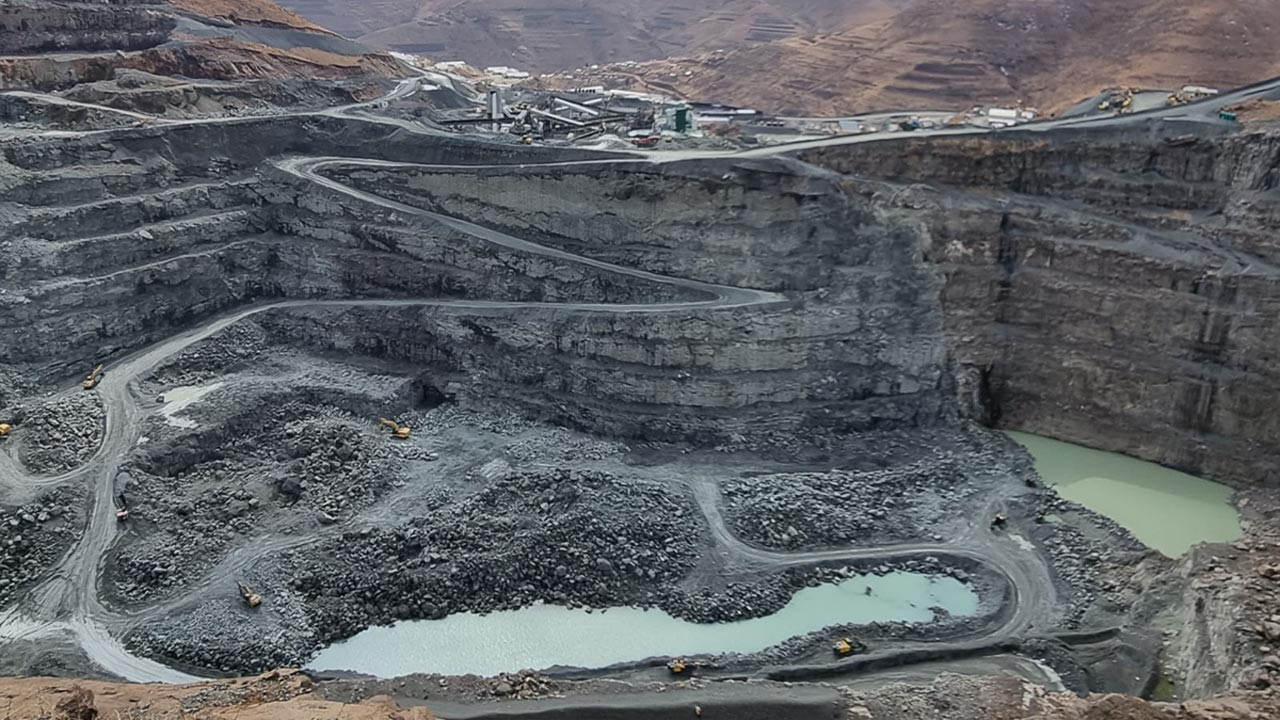
Lesotho’s exposure is no less acute, though its economy is smaller and its mines fewer. The kingdom’s diamond sector spans four main operations — Letšeng, Kao, Mothae and Liqhobong — all producing stones of exceptional size and quality from kimberlite pipes buried deep in the highlands. Letšeng is widely regarded as the highest-value diamond mine in the world by average dollar per carat. That premium positioning was supposed to insulate Lesotho from the worst of the commodity cycle. That insulation has proved thinner than anticipated.
Liqhobong, once a productive mid-tier operation financed partly by Absa South Africa, has been closed. Kao Mine, situated in the mountains of Botha Bothe district and one of the world’s leading producers of large and coloured diamonds, came within weeks of shutting down in October 2025 after its operator, Storm Mountain Diamonds, declared it needed R250 million in emergency capital to remain operational. The mine employs over 750 workers and injects roughly R1 billion annually into the local economy, 80 per cent of which flows directly to Basotho businesses and workers. If the mine were to enter care and maintenance, that economic contribution would fall below R100 million. Prices per carat fetched by Kao’s diamonds fell from between $340 and $400 to between $190 and $230 — a collapse of nearly half in just a few years.
Minister of Natural Resources Mohlomi Moleko confirmed that every mining company operating in the kingdom was struggling to move product. Sales had declined particularly sharply in Belgium, a traditional trading hub for rough stones from the region. He warned that some operations may be forced to suspend activity entirely. One mine had already begun transitioning to care and maintenance.
“We are hoping that we will continue with operations, but it is no secret that the mining industry countrywide has been experiencing market challenges wherein diamond prices are very low and that has put a lot of pressure on the mines in the country.”
The crisis carries particular weight in Lesotho because the mines are located in the highlands communities most removed from urban economic activity. In the Botha Bothe district, workers at Kao are largely drawn from nearby villages with few alternative livelihoods. A mine closure does not merely mean unemployment. It means the disappearance of the formal economy from entire mountain communities.
Storm Mountain Diamonds has framed part of its difficulty as a dispute with the Lesotho Revenue Authority over outstanding VAT refunds dating from April 2025. The company says it has sought relief within the existing legislative framework and has been met with silence. The government must balance its role as a 25 per cent shareholder in the mine against its obligations as a revenue collector — a structural tension inherent in resource-dependent states where the government is simultaneously regulator, partner and fiscal beneficiary of the same enterprise.
The broader industry is searching, with varying degrees of urgency, for a response. De Beers has reversed its earlier experiment with laboratory-grown jewellery under the Lightbox brand and refocused its entire marketing budget on promoting the differentiated value of natural stones: geological rarity, irreproducibility, provenance, and the romance of origin. There are tentative signs supporting this. De Beers raised prices for stones above five carats by more than five per cent at its February 2026 sight, as supplies in certain size categories tightened.
For Botswana, the government’s renegotiated 25-year partnership with De Beers, finalised in February 2025, represents an attempt to retain a greater share of the value chain even as total volumes decline. Under the revised terms, the state-owned Okavango Diamond Company will increase its allocation of rough production from 25 per cent to 50 per cent over the next decade. A new Diamonds for Development Fund, seeded with an initial one billion pula from De Beers, will finance diversification projects in agriculture, renewable energy and tourism.
For Lesotho, the path is narrower and the margin for policy error smaller. The kingdom has no equivalent sovereign wealth fund to draw upon, no commodity substitute of comparable scale waiting in the ground. Letšeng continues to produce rare, trophy-quality stones for which the global appetite among the very wealthiest collectors remains intact. That segment of the market — large coloured stones and extraordinary whites above 20 carats — is the one corner of the natural diamond trade demonstrably insulated from laboratory competition. Lesotho’s strategic interest lies in ensuring that its premium mines survive this downturn with infrastructure intact and marketing relationships preserved, so that they are positioned to benefit when broader market sentiment stabilises.
The diamond, as a cultural artefact and as an economic commodity, is not disappearing. What is disappearing is the unquestioned assumption that a mined stone and a laboratory stone inhabit the same market. They do not, and the divergence is now permanent. For Lesotho and Botswana, the task is to understand precisely which part of the remaining natural diamond market their stones can credibly occupy, and to govern accordingly. The era of passively collecting royalties from an industry that managed its own scarcity is over. What replaces it will require considerably more sophistication from both governments and miners.