



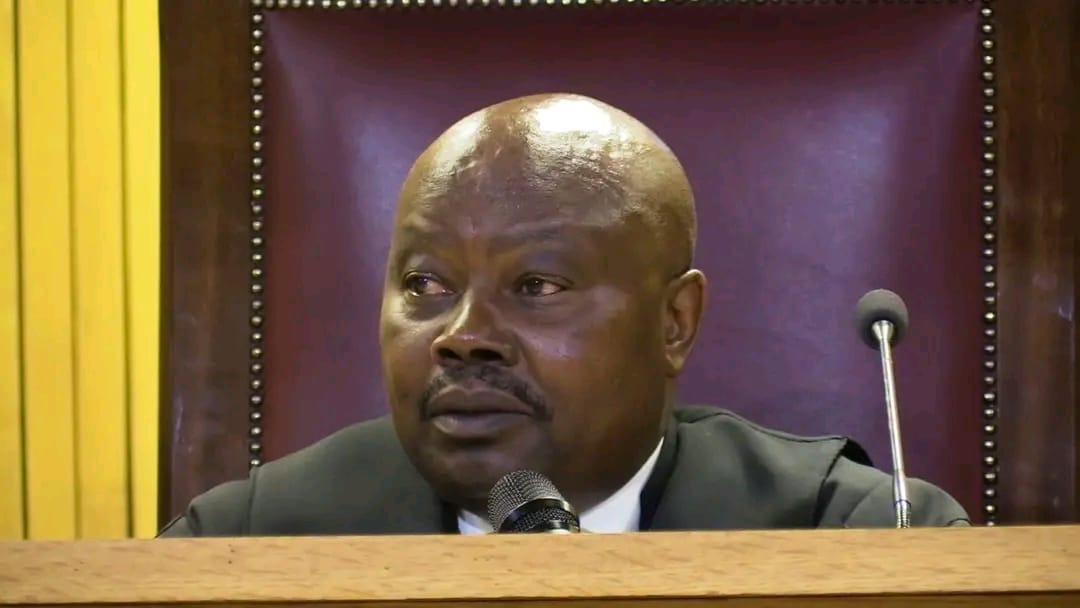
MASERU-A cloud of concern hung over the High Court this week after Chief Justice Sakoane Sakoane openly questioned the integrity of key exhibits in the long-running murder trial involving two members of the Lesotho Defence Force.
In remarks that drew sharp attention in the courtroom, the Chief Justice suggested that crucial evidence may have been tampered with, warning that such interference strikes at the very heart of justice and public trust in law enforcement.
The concerns arose during submissions by the prosecution in a case where Sergeant Tjekane Sebolai and Private Selone Ratšiu are charged with the 2014 murder of Lisebo Tang.
Tang was shot dead near the home of retired army commander Tlali Kamoli, where the two accused had been deployed on night duty. Her companion, Tšepo Jane, survived the attack with injuries. Prosecutors say the vehicle they were travelling in was also riddled with bullets.
Along the week, the focus shifted away from the shooting itself to the handling of physical evidence.
The Chief Justice noted that firearms submitted by the army to police investigators did not match the bullets recovered from the scene of the crime. In his view, this discrepancy pointed strongly to possible interference with exhibits.
“As there is evidence that the firearms submitted did not match the bullets found at the scene, this shows that the exhibits were tampered with,” he observed.
The comment immediately raised eyebrows in court.
Tampering with exhibits is a criminal offence, the Chief Justice stressed, particularly when it appears to be aimed at concealing the truth. He added that defeating the ends of justice is an even more serious matter because it undermines the entire legal process.
His remarks carried an unmistakable tone of frustration.
The court questioned why the police or the Directorate of Public Prosecutions Lesotho had not pursued further investigations to determine how the exhibits were handled and who may have been responsible for altering or switching them.
According to the Chief Justice, such gaps in the chain of custody should have triggered immediate and thorough scrutiny.
He wondered aloud why no effort had been made to trace the movement of the weapons or to obtain statements from officers responsible for submitting them.
“It seems the police did not do their work,” he remarked, suggesting that basic investigative steps may have been overlooked.
The comments painted a troubling picture of possible negligence or misconduct within the justice system itself.
Chief Justice Sakoane went further, saying the issue was not merely procedural but raised broader concerns about national security and accountability.
He emphasised that the rule of law must be upheld at all times, especially by those entrusted with enforcing it.
“It is worrying that there is a possibility that the security of the nation is in the hands of dishonest people,” he said, adding that some law enforcement officers appear not to honour the oath they took to serve with integrity.
For many in the courtroom, the statements underscored the seriousness of the matter. Evidence is often the backbone of any criminal case, and any suggestion that it has been compromised can cast doubt on the fairness of proceedings.
The trial itself centers on events from May 9, 2014.
The two accused soldiers allegedly opened fire on a vehicle near Kamoli’s residence after reportedly suspecting it posed a threat. Tang was killed in the shooting, while Jane sustained injuries.
Evidence previously presented before the court indicated that the vehicle matched the description of one mentioned in a so-called “Red Alert,” which warned of a white four-by-four allegedly involved in bombing incidents.
The accused allegedly believed the occupants might be dangerous and ordered them to exit and identify themselves. When the occupants did not comply, the soldiers reportedly treated the vehicle as hostile.
Testimony further indicated that the accused were operating under standing orders that instructed them to “capture the enemy, if it resists or flees, eliminate it.”
The defence has relied heavily on this context, arguing that the soldiers acted under perceived threat while carrying out their duties.
However, the prosecution has maintained that the force used was excessive and unjustified.
The case has already seen one accused discharged. Private Kopano Matsoso, who was initially charged alongside Sebolai and Ratšiu, was acquitted in 2020 after the court found insufficient evidence linking him to the offences.
Now, attention remains squarely on the two remaining accused.
The prosecution is being led by Advocate Motene Rafoneke, while the defence is represented by Advocate Sello Tšabeha.
Yet the Chief Justice’s concerns about the integrity of exhibits may have implications beyond the fate of the accused. If evidence was indeed tampered with, it could raise serious questions about how the investigation was conducted and whether others should face accountability.
For the families of those affected, the developments add another layer of uncertainty to a case that has already dragged on for years.
As proceedings continue, the court must now grapple not only with what happened on the night of the shooting, but also with whether the truth has been obscured by failures in the handling of evidence.