



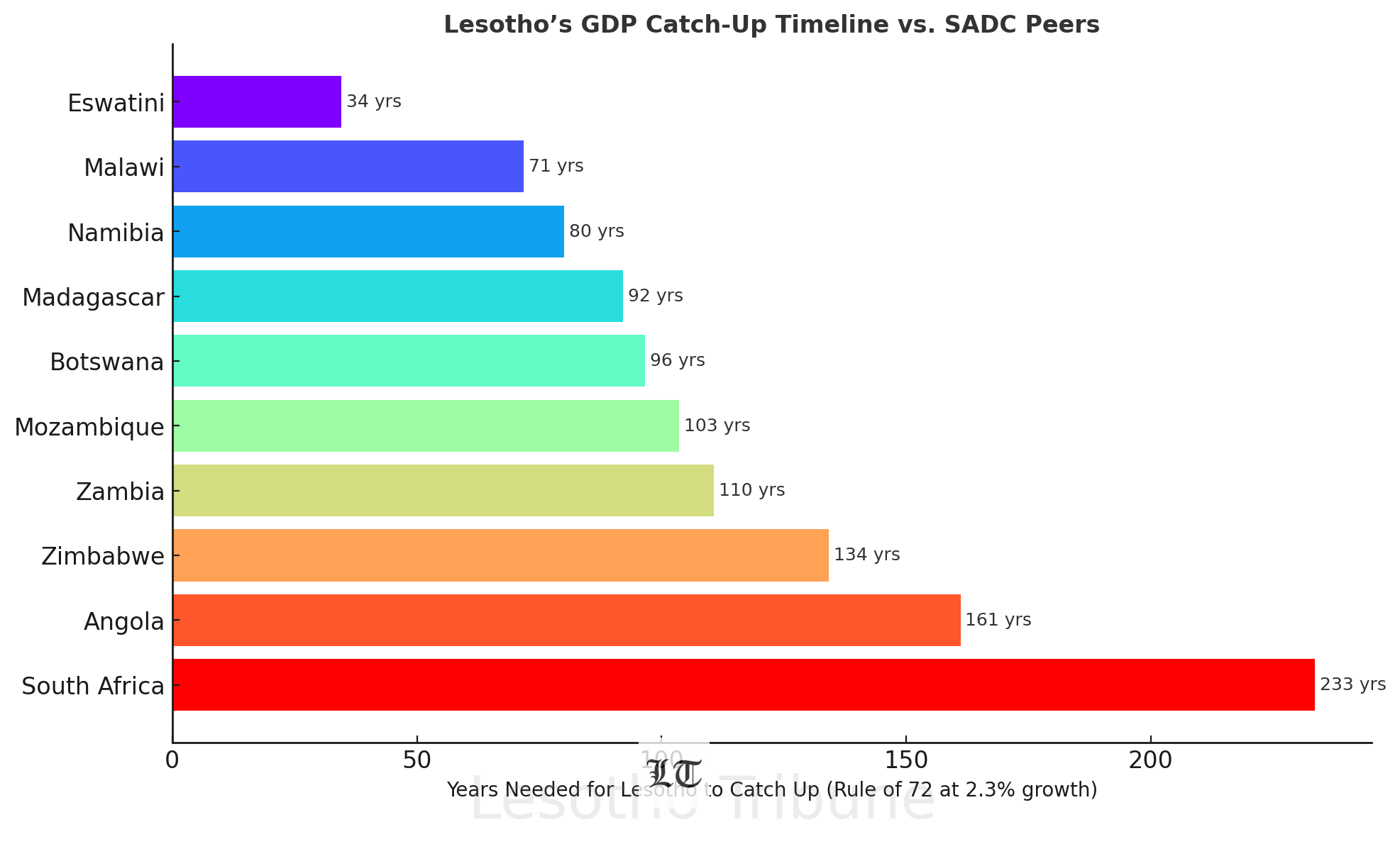
Lesotho has been left languishing at the very bottom of Southern Africa’s economic ladder. With a GDP of just $2.27 billion in 2024, it is not only dwarfed by its neighbours but also faces a timeline of stagnation that, when examined through the Rule of 72, paints a dire picture of national viability.
The Rule of 72 Exposes the Depth of the Problem
The Rule of 72 is a simple calculation: divide 72 by a country’s annual growth rate to estimate how many years it will take for its economy to double. In Lesotho’s case, the World Bank reported 2.3% growth in 2024. That means Lesotho’s economy doubles every 31 years.
At that pace, the numbers are brutal:
• To catch Eswatini (GDP $4.9bn), Lesotho would need ~35 years.
• To catch Malawi ($11bn), ~71 years.
• To catch Namibia ($13.3bn), ~80 years.
• To catch Botswana ($19.4bn), ~97 years.
• To catch South Africa ($400bn), a staggering 234 years.
And that assumes the neighbours stand still. In reality, they are also growing, which means the gap is not closing…it is widening.

A Nation Out of Time
Lesotho’s economy is smaller than many South African municipalities. It relies heavily on SACU transfers and remittances, neither of which build lasting resilience. The country has no sizeable manufacturing base, no night-time economy, and limited natural resource rents compared to Angola, Botswana, or Namibia.
The math tells the truth policymakers avoid: at current growth rates, Lesotho will not even catch Eswatini in this generation. By the time the economy doubles once, neighbours like Botswana and Namibia will have doubled as well, keeping Lesotho stuck in last place.
What This Means for Viability
A country’s viability is not measured only by its GDP. But size matters when:
• Funding state functions: defence, health, education, infrastructure.
• Attracting investment: investors want scale, stability, and consumer markets.
• Maintaining sovereignty: economic weakness forces reliance on South Africa for jobs, food, electricity, even basic imports.
If Lesotho cannot accelerate to 5–7% sustained growth, the numbers point to a future where it is a state in name but economically indistinguishable from a province of South Africa.
What Must Change
To avoid slipping into irrelevance, Lesotho needs to:
• Build an export engine beyond textiles and remittances.
• Convert construction-led booms like LHWP-II into long-term productivity gains.
• Fix the basics; power, logistics, governance to attract serious private investment.
• Put agriculture and services into regional value chains that create scale.
The Bottom Line
The Rule of 72 does not lie. At 2.3% growth, Lesotho is on a 31-year clock for a single doubling. By then, peers will have pulled even further ahead. The uncomfortable question is Lesotho still viable as a country? Is not rhetorical. It is written in the mathematics of compound growth.