


By: Pheello Mosesi
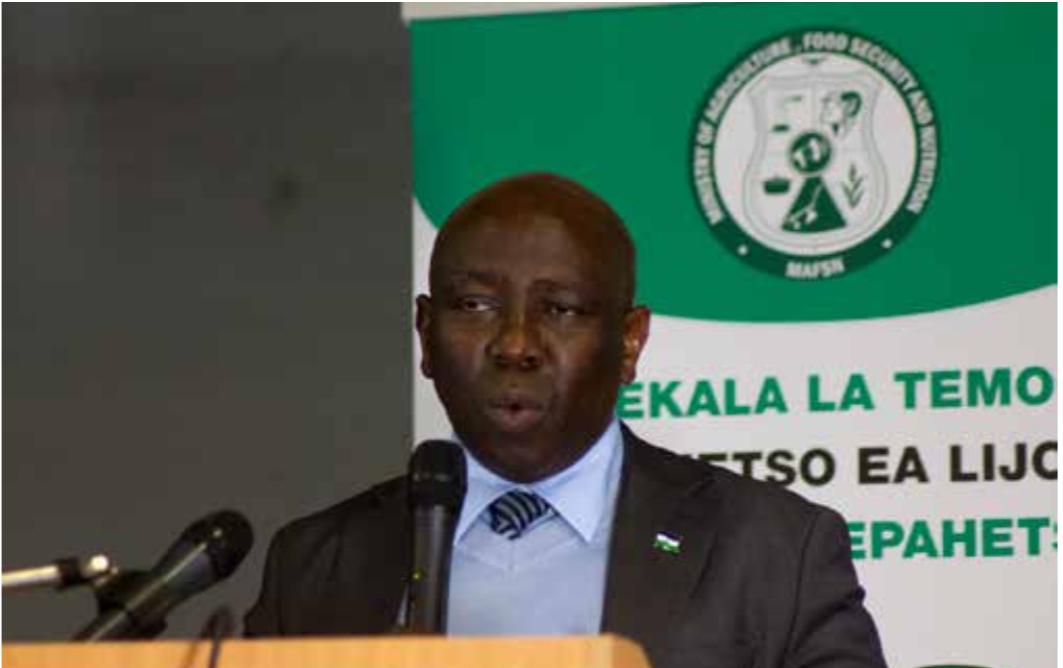
As part of united efforts to help curb unemployment in Lesotho, the Minister of Agriculture, Food Security and Nutrition, Honourable Thabo Mofosi, launched a youth Mentorship Program for 1000 Young Farmers under the Second Smallholder Agriculture Development Project (SADP II) at the Agric College in Maseru this week.
The SADP II monitored initiative is designed to foster development and sustainable job creation for young Basotho Farmers aged between 18 and 35 who are already engaged in agriculture and agribusiness, formally trained or not and those interested in the farming field. The Minister said the programme seeks to enhance the effective use of grants granted to the young farmers while boosting business performance and encouraging greater youth involvement in agriculture.
Honourable Mofosi commenced his speech by highlighting the importance of Agriculture as a business and a means of food consumption. He proceeded to indicate that unlike other countries globally, Lesotho is slowly starting to recognise the importance of agriculture.
“When we talk of Agriculture, we often label it as a cornerstone of the country. However, it goes beyond that, it is actually the cornerstone of life in general. Consumption of food is not a voluntary act but it is actually an obligatory necessity of every person,” Mofosi said in his introduction speech.
“Another fundamental angle of life in this day and age is money. We all seek out platforms that can help us earn money as businesses and companies. Agriculture is a business that does not have a lot of limitations and extended requirements, the only requirement is for a person to be active in it for production,” he added.
Mofosi said he wished for the beneficiaries of the programme to be youth driven by passion and love for agriculture, saying the aim of the ministry is to have sustainable growth through the programme.
The programme is set to incubate an intake of 1000 agriculturally active young farmers across the country with each district having a representation of 100. Key focus areas for this support are potato production, broiler chicken production, egg production and vegetable production and nursery growers for the first intake.
“We have studied where there is a higher demand in the market,” he said, adding that the selection criterion of the project is going to be very strict and selected participants of the programme will be expected to be just participants within their district programme centre.
The programme encompasses a variety of potential approaches and interventions for applicants; a combination of both theoretical and practical information. These approaches include apprenticeships which will see the applicants receiving grants. It will also include an incubation approach set for applicants who failed in the Matching Grants, therefore preparing them for their next call.
Another approach will be Farmer Field Schools and this approach is specifically designed for those who fail in the Matching Grants, hence they will be exposed to one-on-one coaching, technical training, group sessions and peer coaching by field experts.
Beyond the conference, Mofosi requested that another conference be held at a later stage of the programme where the core agenda will be to reshape and re-channel the youth’s mindset about agriculture as a business.
The programme, taking place at the highest esteemed agriculture tutoring institution in Lesotho, was graced by the attendance of District Agricultural Officers from all 10 districts, the AgricCollege lecturers, other ministry officials, media personnel and agriculture students.
Mofosi promises 1000 jobs to Basotho youth


RELATED ARTICLES