


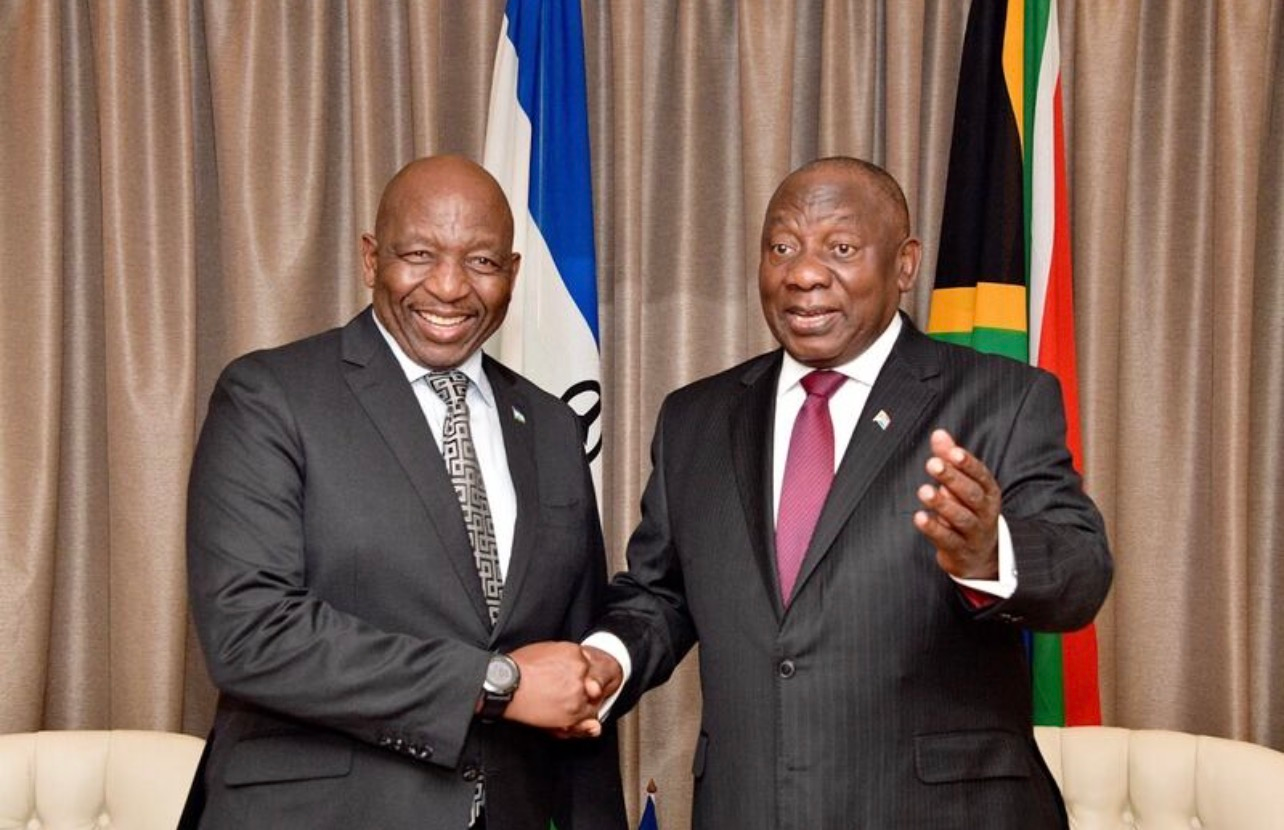
It is difficult to escape the conclusion that relations between Lesotho and South Africa have entered one of their most fragile phases in recent memory. What may appear, on the surface, to be a political allegation exchanged in a parliamentary setting carries implications far beyond the personalities involved. When South Africa’s Mineral Resources Minister, Gwede Mantashe, accuses Lesotho’s Prime Minister, Sam Matekane, of engaging with illegal miners, the damage is not confined to reputations. It seeps into the foundation of a relationship that hundreds of thousands of Basotho depend on for their daily survival.
Lesotho’s geographic reality has always defined its economic reality. Completely surrounded by South Africa, our country does not have the luxury of diplomatic distance. Every truck carrying exports, every worker crossing the border in search of employment, every litre of fuel, and every imported commodity passes through South African territory. This interdependence is not theoretical. It is lived, daily, by ordinary citizens whose livelihoods are tied, directly or indirectly, to the stability of that relationship.
It is precisely for this reason that the current deterioration in tone between Maseru and Pretoria should concern every Mosotho, regardless of political affiliation. Diplomatic relations are not abstract exercises conducted for ceremonial purposes. They are practical instruments that shape economic opportunity, labour mobility, trade access, and ultimately the welfare of citizens. When mistrust begins to define that relationship, it is ordinary people who feel the consequences long before political leaders do.
There is already a broader context that makes this moment particularly sensitive. Illegal mining in South Africa has become a deeply politicised and emotional issue, associated with violence, economic losses, and social instability. Many of the individuals involved are Basotho, driven not by criminal ambition but by economic desperation and the absence of opportunity at home. This reality has created growing frustration within South Africa and, increasingly, a narrative that associates Lesotho itself with the problem. Whether fair or unfair, such perceptions influence policy attitudes and political behaviour.
When a senior South African minister publicly links Lesotho’s head of government to such an issue, it inevitably deepens suspicion. It risks reinforcing negative perceptions about Lesotho at a time when the country can least afford reputational damage. Investors pay attention to diplomatic signals. So do employers, border officials, and policymakers. A strained relationship can translate, quietly but effectively, into tighter labour access, slower cross-border movement, and diminished economic goodwill.
The most troubling aspect of diplomatic deterioration is that its effects are rarely announced formally. There is no declaration that citizens will now suffer. Instead, the consequences emerge gradually. Border processes become less accommodating. Employment conditions become less secure. Economic cooperation becomes less enthusiastic. Opportunities that once existed begin to narrow.
Lesotho’s economy remains fragile. The government itself has acknowledged its inability to absorb the growing number of unemployed citizens into the public sector. This reality makes regional economic integration not merely beneficial, but essential. South Africa is Lesotho’s largest trading partner, its primary labour destination, and its main economic gateway to the world. Any weakening of that relationship carries direct economic risks.
This does not mean Lesotho must accept every allegation without question. National dignity requires that accusations, especially serious ones, be addressed with clarity and firmness. But firmness and diplomacy are not mutually exclusive. The priority must be to prevent political tensions from evolving into long-term diplomatic damage.
South Africa, too, carries responsibility. Lesotho’s stability is not a peripheral matter. Economic hardship and instability within Lesotho inevitably spill across borders, affecting migration, labour markets, and regional security. A cooperative relationship serves the interests of both nations.
Ultimately, what is at stake is not the reputation of individual leaders, but the economic future of citizens. Diplomatic relationships, particularly for a country in Lesotho’s position, are among its most valuable strategic assets. They sustain trade, enable employment, and provide access to opportunity beyond national borders.
The danger now is not simply the allegation itself, but what it represents. It reflects a relationship under strain, a relationship that requires careful management to prevent further deterioration. Lesotho cannot afford prolonged tension with the one country upon which so much of its economic life depends.
For ordinary Basotho, the concern is not diplomatic language or political point-scoring. It is whether they will continue to find work, move freely, and pursue livelihoods in a region that has always been interconnected.
That is why this moment demands seriousness, restraint, and above all, leadership that recognises the true stakes involved.