


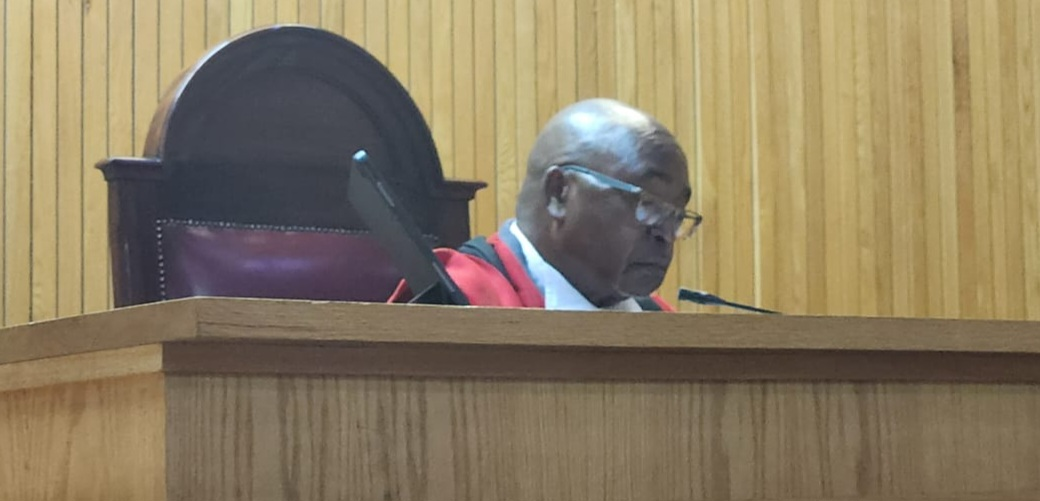
MASERU-The High Court has sent a strong message against gender-based violence, with Justice Tšeliso Mokoko declaring that courts have a constitutional duty to protect women from abuse that too often ends in murder.
Justice Mokoko made the remarks during the sentencing of former police officer Jeremane Sekhohola, who was convicted of killing his ex-girlfriend, ‘Matsepang Moleleki. The judge sentenced Sekhohola to 40 years’ imprisonment, describing the crime as brutal, calculated and deeply disturbing.
Sekhohola was found guilty this week of stabbing Moleleki to death during an incident that occurred in Berea on February 17, 2025. The court heard that the killing happened after Moleleki had reported him to his superiors following threats he made when she attempted to end their relationship.
In delivering sentence, Justice Mokoko stressed that the courts’ fundamental constitutional obligation is to uphold the right to life. He said violence against women is a grave and shocking problem that demands a firm judicial response.
“Women look up to the courts for protection,” he said. “That protection can only be meaningful if courts impose sentences that reflect the seriousness of these crimes.”
The judge’s remarks come at a time when cases of gender-based violence (GBV) continue to trouble communities across the country. In many instances, women are killed by current or former intimate partners after attempts to leave abusive relationships.
Evidence presented during the trial revealed that Moleleki had taken steps to distance herself from Sekhohola after their relationship deteriorated. When she informed him of her intention to end it, he reportedly threatened to kill her.
Concerned for her safety, she reported the threats to the Berea Police. The intervention by police was intended to resolve the dispute and ensure her protection.
However, despite that intervention, Sekhohola went on to carry out the fatal attack.
Justice Mokoko said the fact that the killing occurred in broad daylight and in public demonstrated the accused’s determination to execute his plan. The judge concluded that the attack was not a spontaneous act of anger but a deliberate and violent response to rejection.
He described the manner of the attack as particularly cruel, noting that the accused stabbed the deceased in the chest, one of the most delicate and vulnerable parts of the body.
“As a trained police officer, not an ordinary person, a high standard of behaviour was expected from him,” the judge said. “Instead, he showed no mercy.”
A significant aspect of the court’s reasoning was Sekhohola’s position as a police officer at the time of the offence.
Justice Mokoko said that as a member of the police service, the accused had a duty to protect lives and uphold the law. By committing murder, he not only violated the law but also betrayed the oath he had taken.
The judge further observed that Sekhohola’s actions undermined the authority and efforts of the Berea Police, who had intervened in an attempt to resolve the dispute peacefully.
“He disrespected the Berea Police and undermined their efforts,” the judge stated. “His conduct showed a lack of respect for the institution he served.”
The court held that when law enforcement officers commit serious crimes, the impact extends beyond the immediate victim. It damages public confidence in institutions meant to provide safety and protection.
Throughout his sentencing remarks, Justice Mokoko returned repeatedly to the broader issue of gender-based violence.
He said acts of violence against women are deeply troubling, especially when they result in the loss of life. In many cases, he noted, women leave behind young children who must grow up without their mother’s love and care.
“After they are killed, women leave behind minor children who are deprived of motherly love and forced to fend for themselves,” he said.
He emphasised that sentences imposed in such cases must serve both as punishment and deterrence.
“Public confidence in the criminal justice system has diminished,” Justice Mokoko said. “It is the responsibility of the courts to restore that trust through harsh sentences.”
He made it clear that exemplary sentences are necessary not only to hold perpetrators accountable but also to send a strong warning to others who might contemplate similar acts.
Despite the seriousness of the crime, the court considered several mitigating factors before imposing sentence.
Among them was the fact that Sekhohola surrendered himself to police after committing the offence. The court also took into account that he pleaded guilty, thereby saving the court’s time and resources.
Justice Mokoko acknowledged that these actions indicated a degree of remorse.
However, he concluded that the gravity of the offence far outweighed the mitigating factors.
“No amount of sentence can bring the deceased back to life,” he said. “However, the family of the deceased must feel that justice has been served.”
After weighing all circumstances, the court determined that 40 years’ imprisonment was an appropriate sentence.
Sekhohola was represented by Advocate Christopher Lephuthing, while the prosecution was led by Advocate Thato Lepheana.
During the sentencing phase, both counsel made submissions regarding aggravating and mitigating factors. The prosecution argued for a severe penalty, citing the brutality of the attack and the accused’s position as a police officer.
The defence highlighted the accused’s surrender and guilty plea as evidence of remorse.
Ultimately, the court concluded that the seriousness of the offence, combined with the need to deter similar crimes, justified a lengthy custodial sentence.
The judgment is likely to be seen as part of a broader judicial effort to confront gender-based violence with firmness.
Justice Mokoko’s remarks underscored the view that courts cannot remain neutral in the face of escalating violence against women.
By imposing a 40-year sentence, the court sought to affirm the sanctity of life and reinforce the message that intimate partner violence will attract severe consequences.
For Moleleki’s family, the sentence cannot undo the loss they have suffered. But the court expressed hope that the judgment would offer some measure of closure.
For society at large, the ruling stands as a reminder that the justice system carries a vital responsibility, not only to punish wrongdoing, but to protect the vulnerable and uphold constitutional rights.
As Justice Mokoko concluded, the courts must be a place where women can look for protection and find it.