


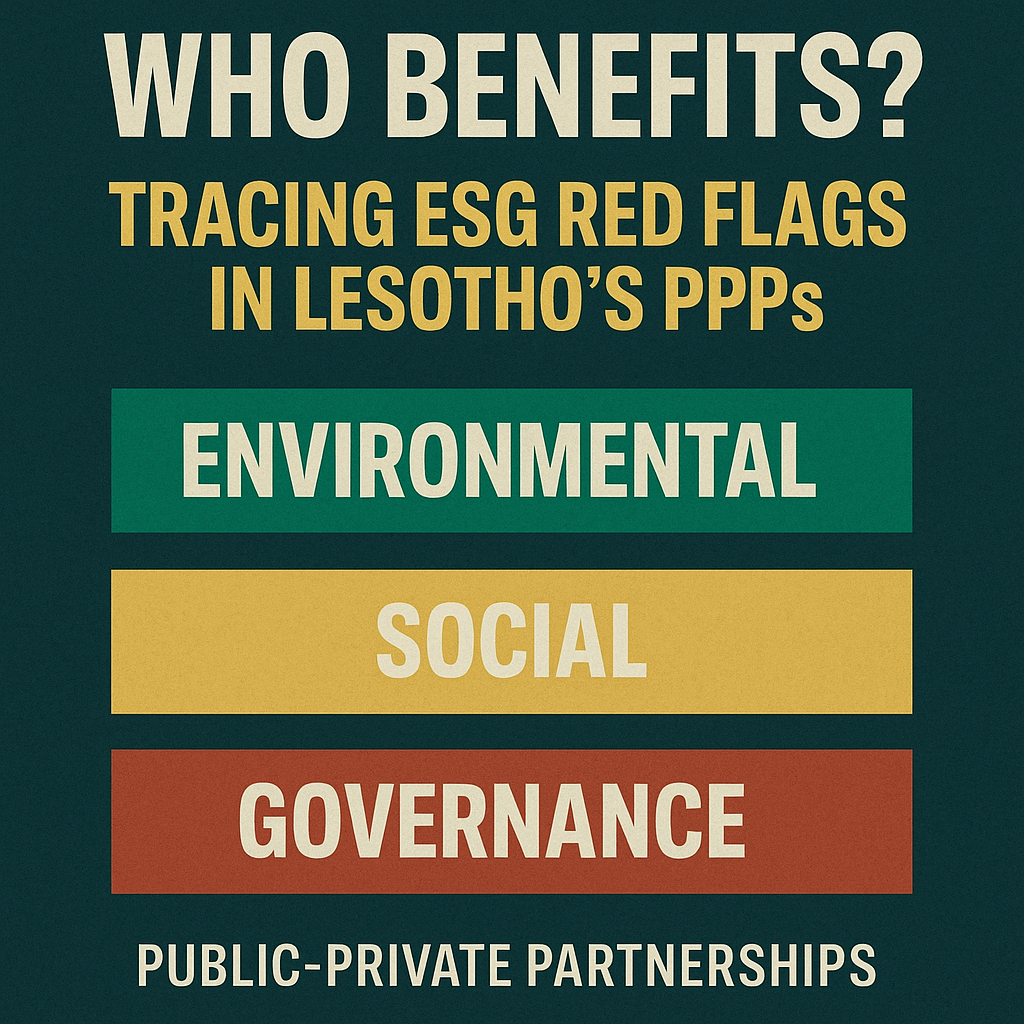
Public-Private Partnerships (PPPs) have become a cornerstone of Lesotho’s national development strategy. From healthcare to infrastructure, the government has leaned on private capital to deliver essential public services. But as the deals multiply, so do the questions. Chief among them: who really benefits?
While PPPs promise efficiency and shared risk, Lesotho’s track record suggests a troubling pattern of opaque contracts, politically connected beneficiaries, and weak oversight. ESG, or Environmental, Social, and Governance principles, now a global standard for ethical investment and public accountability, are often treated as optional or symbolic in these agreements. This failure to embed ESG into the core of Lesotho’s PPPs risks undermining public trust, worsening inequality, and locking the country into unsustainable financial obligations.
Take the Queen ’Mamohato Memorial Hospital, a flagship PPP project under the Tšepong consortium. Once hailed as a model of innovation, the project now stands as a cautionary tale. A 2014 report by the Office of the Auditor-General exposed severe cost overruns, poor contract transparency, and governance failures that left the government paying an unsustainable share of its health budget to a private operator. Where were the ESG safeguards? Who monitored social impact, equitable access, or long-term fiscal sustainability?
More recent PPP initiatives, whether in water infrastructure, road construction, or energy, continue to suffer from limited public disclosure. Communities affected by land displacement or environmental disruption are often left out of consultation processes. Social safeguards are either weak or non-existent. ESG impact assessments are rarely published, and in many cases, not conducted at all.
The “G” in ESG, governance, is arguably the most critical. Lesotho’s PPP framework lacks strong, independent regulatory institutions with enforcement power. Many tenders are awarded under questionable circumstances, often to entities linked to political elites. Conflict of interest is poorly policed. Procurement rules are routinely circumvented through exemptions or emergency clauses. This creates fertile ground for rent-seeking and public resource capture.
The private sector, for its part, is not blameless. While international ESG standards require companies to assess and disclose their environmental and social impacts, very few PPP contractors operating in Lesotho publish sustainability reports or community engagement plans. Even those that do often treat ESG as a marketing tool rather than a measurable commitment.
Meanwhile, the losers are ordinary Basotho. They are the taxpayers footing the bill for overpriced projects. They are the patients in under-resourced clinics while millions are paid out in profit guarantees. They are the farmers displaced from fertile land without compensation or recourse. They are the workers trapped in substandard jobs with no labor protections.
To turn the tide, Lesotho must embed ESG principles into the DNA of its PPP strategy. Every project must begin with a comprehensive environmental and social impact assessment, subject to public consultation. Governance mechanisms should be strengthened through independent monitoring bodies, transparent procurement systems, and legal frameworks that punish breaches of fiduciary duty.
Parliament must also play a more active role in scrutinizing PPP contracts before they are signed. Civil society and the media need better access to documents and data. International development partners funding or advising on PPPs should condition their support on full ESG compliance.
It is not enough to ask whether PPPs deliver roads, hospitals, or energy. The real question is whether they deliver value, equity, and sustainability. Without answering that, Lesotho risks deepening the very inequalities that PPPs are meant to solve.
The slogan “public-private partnership” implies mutual benefit. But in Lesotho, the balance of power is tilted. Until ESG becomes more than a checkbox, we must keep asking: who benefits?