
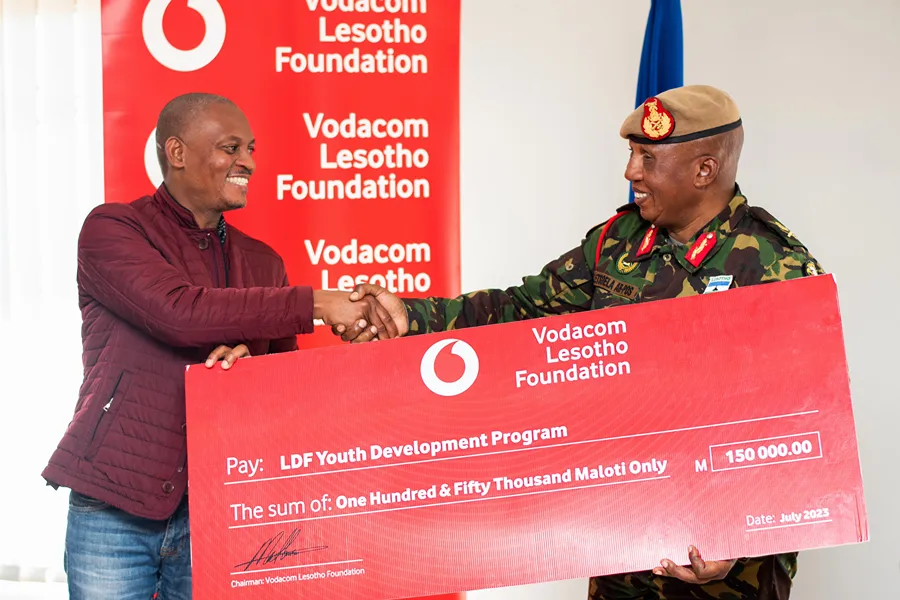
Lesotho is confronting one of its most disturbing public-interest controversies in recent years, following serious allegations of sexual abuse at the Lesotho Defence Force BOOT Camp programme, a youth initiative financially sponsored by Vodacom Lesotho.
The controversy was formally escalated this week after Machesetsa Gabriel Mofomobe, a Member of Parliament, wrote to Vodacom’s Chief Executive Officer demanding that the company suspend or reconsider its sponsorship of the programme. In his letter, dated 27 December 2025, the MP raises grave concerns about exclusion, financial accountability, and, most seriously, allegations of rape involving young female participants.
The BOOT Camp programme, run by the Lesotho Defence Force, is presented as a nation-building initiative aimed at instilling patriotism and discipline among the youth. While few dispute the value of discipline and civic responsibility, questions are now being asked about whether the programme’s implementation has fundamentally failed the very young people it claims to serve.
Exclusion dressed up as patriotism
One of the first issues highlighted is access. Participation reportedly requires a fee of M2,500, a cost that effectively excludes many youths from poor and vulnerable households. This has fuelled criticism that a programme branded as patriotic and national in character is, in practice, accessible only to families who can afford to pay.
The concern is compounded by Vodacom’s dominant position in Lesotho’s telecommunications market. Many parents whose children are excluded are themselves Vodacom subscribers, raising uncomfortable questions about a corporate-funded programme that appears to benefit a narrow segment of society.
Financial opacity raises alarms
Beyond access, there are serious governance concerns. According to the MP’s letter, there is no evidence that the BOOT Camp programme has undergone an independent audit or that audited financial statements have been made public. More troubling are reports that participation fees are deposited into MPESA accounts registered in the names of individual facilitators, rather than into an account formally registered under the LDF.
For a programme associated with a constitutional institution, this arrangement raises fundamental red flags around financial controls, accountability, and compliance with basic public-sector governance standards.
Allegations of rape force a national reckoning
The most explosive aspect of the controversy centres on allegations of sexual harassment and rape of young female participants by members of the LDF. These allegations are not speculative. The LDF spokesperson has publicly confirmed that a soldier has been arrested on suspicion of sexually harassing a BOOT Camp participant.
According to Mr Mofomobe, these matters only surfaced after he publicly demanded accountability. Following his intervention, two additional young women reportedly approached him personally, alleging that they too were raped while participating in the programme. If substantiated, the claims point to a catastrophic failure of safeguarding in an environment where minors were placed under military authority.
A crisis in a country already scarred by sexual violence
These allegations unfold against a grim national backdrop. Lesotho continues to grapple with endemic sexual violence. Official police and health sector data consistently record well over a thousand reported rape cases each year, many involving children. Experts and civil society organisations warn that these figures represent only a fraction of actual incidents, as fear, stigma, and mistrust of institutions keep many survivors silent.
In such a context, any youth programme, particularly one involving authority figures and closed environments, carries an elevated duty of care. The BOOT Camp allegations suggest that duty may have been grossly neglected.
Corporate ethics under scrutiny
In his letter, the MP calls on Vodacom to suspend or reconsider its sponsorship until all allegations are independently investigated, perpetrators are identified and held accountable, finances are transparently audited, and robust safeguards are put in place to ensure participant safety and equal access.
The appeal strikes at the heart of corporate citizenship. Vodacom publicly commits itself to ethical conduct, transparency, and respect for human rights. Its parent company, Vodafone Group Plc, makes similar commitments globally. Whether those principles extend beyond branding and into difficult local realities is now being tested.
Civilian justice, not closed doors
The MP has also written to the Prime Minister, in his capacity as Minister of Defence, calling for a Commission of Inquiry into the BOOT Camp programme. Crucially, he insists that alleged perpetrators be investigated by the Lesotho Mounted Police Service, rather than being handled internally by the military, to avoid any perception of cover-ups or conflicts of interest.
A defining moment
What began as a youth discipline programme has now evolved into a defining test of accountability for both a powerful corporation and a powerful security institution. For the young women who allege they were abused, the issue is not public relations or institutional reputation. It is justice, dignity, and protection.
For Vodacom and the LDF, the question is no longer whether the allegations are embarrassing. It is whether they will act decisively to confront them, or allow silence and delay to deepen a crisis that Lesotho can no longer afford to ignore.