



Farmer’s Corner · Corrections
The Ministry of Law and Justice wants more landowners in Mohale’s Hoek to hand over idle fields to a block farming scheme run by prison inmates. About 150 acres are already under maize. The Ministry keeps 80 percent of the harvest.
Tholoana Lesenya
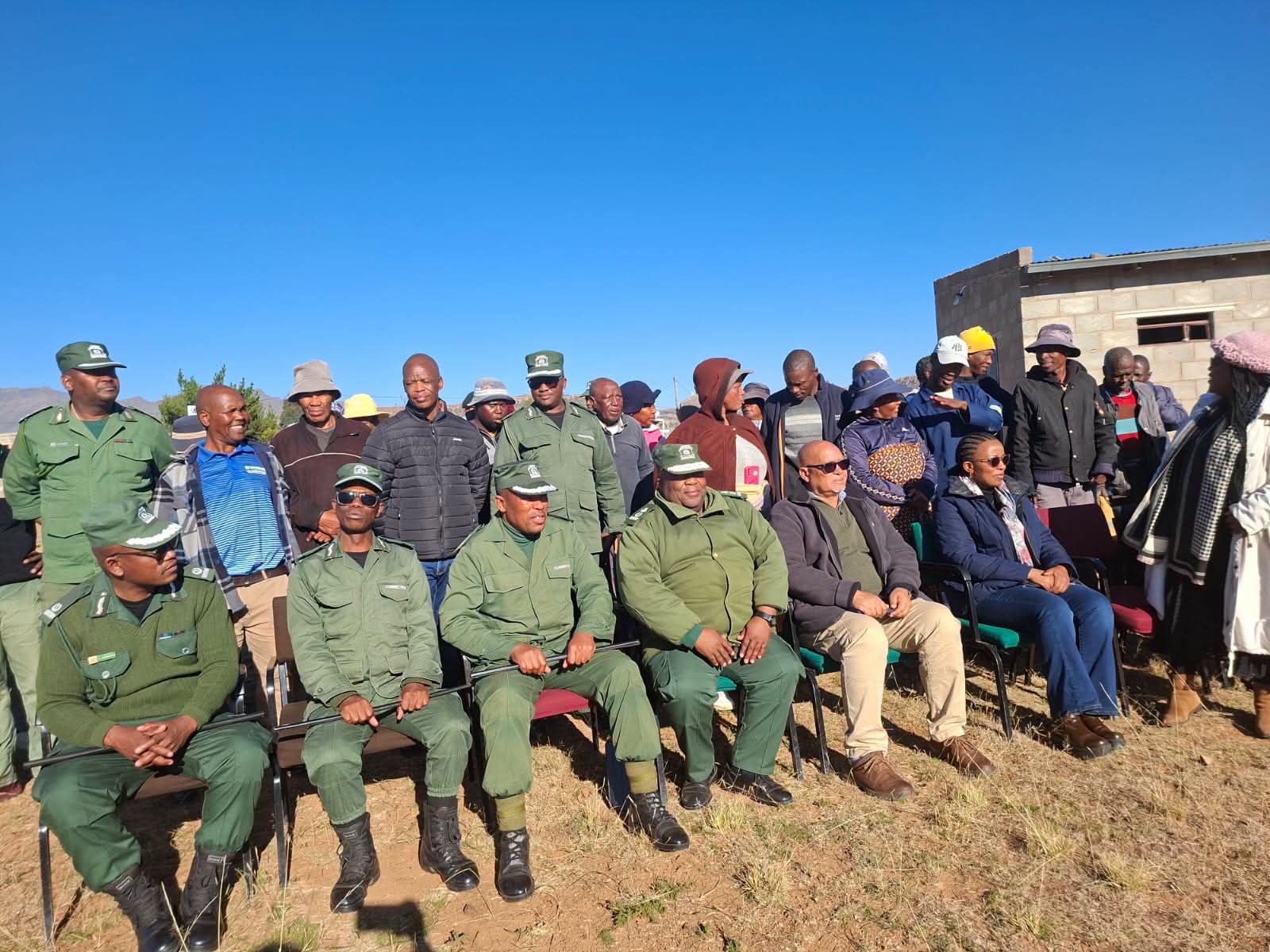
Minister of Law and Justice Richard Ramoeletsi has called on landowners in Mohale’s Hoek to join the Lesotho Correctional Services block farming initiative, telling a community meeting at Setanteng that fields which sat idle for years are now producing maize and that more land is needed to expand the programme.
The meeting, attended by farmers, prison officials and the Ministry’s Principal Secretary Relebohile Lebeta, focused on preparations for the current harvest and the terms under which maize produced by inmates on community land will be distributed.
Ramoeletsi said some farmers had initially been reluctant to join, but the results since the programme launched in 2024 had removed the grounds for hesitation. He said delays and operational problems in earlier seasons had been noted and that better planning and timely planting were expected to produce higher yields this year.
The split
Assistant Commissioner Neo Moramotse told the meeting that approximately 150 acres are currently under cultivation. Harvesting will be done by combine harvester. Under the agreed arrangement, the Ministry retains 80 percent of the maize to feed correctional facilities, with the remaining 20 percent shared among participating landowners in proportion to the acreage each contributed.
“Our goal is to ensure that families have enough food to last until the next farming season while also producing enough to sell. Agriculture should become a source of sustainable income rather than simply a means of survival.”— Minister Richard Ramoeletsi, Ministry of Law and Justice
Commercial ambitions
The Minister proposed formalising the arrangement into a commercial block farming society bringing together the Lesotho Correctional Services and local farmers. He said such a structure would allow households to produce food for their own consumption and generate income from surplus harvests. The Ministry also intends to expand into surrounding areas beyond Setanteng, increasing the total acreage available for cultivation.
Rehabilitation, not punishment
Acting Commissioner Matingoe Phamotse told the gathering that farming participation is classified as rehabilitation, not additional punishment. He said inmates are separated from their families and live under constant supervision, and that correctional facilities should focus on preparing people to return to society rather than deepening hardship.
“Our responsibility is not only to keep offenders in custody but also to prepare them to return to society as responsible and law-abiding citizens,” Phamotse said. He added that agricultural work teaches discipline, responsibility and self-reliance while giving inmates practical skills they can use after release.
Phamotse also pointed to the financial case for the programme. Food purchases consume a substantial portion of public resources each year. Because the Ministry does not own agricultural land — land allocation in Lesotho remains under the ownership of Basotho through existing land laws — partnerships with communities are the only way to grow the scheme.
Farmers urged to show up
Assistant Commissioner for the Southern Region Letlaka Banyane raised a specific concern: poor attendance by farmers during the weeding stage had forced Correctional Services to rely almost entirely on inmate labour and to borrow hoes from facilities in Leribe and Quthing. He called on participating landowners to become more actively involved in future seasons.
Representing the farmers, Phethisang Ranku praised the initiative for bringing previously unused fields back into production. He encouraged other landowners to join. The meeting also warned farmers to keep livestock out of cultivated areas, saying uncontrolled grazing damages soil and threatens future yields.
Programme at a glance
| Detail | Figure / note |
|---|---|
| Land under cultivation | ~150 acres |
| Ministry share of harvest | 80% |
| Landowner share | 20%, split by acreage contributed |
| Harvesting method | Combine harvester |
| Programme launched | 2024, Ministry of Law and Justice |