

Mohahlaula Airlines
Wednesday, July 22, 2026
Home Blog Page 19

Governance collapse in slow motion

0
Lesotho Governance Crisis: How PS Dismissals Signal Institutional Risk | Lesotho Tribune ESG Lens
ESG Lens Series — Governance & Accountability
“`

The Quiet Unravelling: How Lesotho’s Governance Architecture Is Being Dismantled One Dismissal at a Time

An ESG analysis of institutional risk in Lesotho’s public administration — and why the arbitrary removal of Principal Secretaries signals a strategic threat to investment, stability, and the rule of law across Southern Africa.

“`
“`

There is a quiet shift underway in Lesotho’s public administration. It is not written into law, not debated in Parliament, and not formally announced. Yet it is becoming visible in practice: the increasingly casual removal of Principal Secretaries (PSs), sometimes on the basis of suspicion rather than structured process.

On the surface, it may appear as decisive leadership. But through an ESG lens — particularly the “G” in Environmental, Social, and Governance — this trend signals something far more consequential: the erosion of institutional governance discipline. And once governance weakens, everything else follows.

Governance Is Not About Outcomes — It Is About Process

In strong systems, governance is not measured by who gets removed, but how decisions are made. As the Organisation for Economic Co-operation and Development (OECD) has noted in its principles of public governance, the quality of public institutions is a key determinant of long-term economic performance. This is not an abstract ideal — it is a measurable reality that shapes how capital flows, how projects are completed, and how citizens experience the state.

Principal Secretaries occupy a unique position in Lesotho’s state architecture. They are the accounting officers of ministries. They ensure continuity beyond political cycles. They anchor policy execution and fiscal discipline. Their removal, therefore, is not a routine HR matter. It is a governance event.

When dismissals begin to bypass formal disciplinary procedures, institutional oversight through bodies such as the Public Service Commission, and the foundational principles of natural justice, governance shifts from rules-based to discretion-based. That is the beginning of institutional risk.

The ESG Risk Lens: What Investors and Institutions See

“Investors are no longer satisfied with promises of stability. They want evidence of institutional resilience — systems that function regardless of who holds political power.”
— Sovereign Risk Analysts, Development Finance Institutions

Globally, ESG frameworks are used by investors, development finance institutions, and sovereign lenders to assess whether a country is predictable, stable, and investable. Within ESG, governance risk includes arbitrary decision-making, weak institutional independence, and the politicisation of administrative roles. The dismissal of senior civil servants in Lesotho without due process triggers multiple governance red flags.

Risk 1 — Institutional Fragility

If PSs can be removed at will, decision-making authority shifts from institutions to individuals, and formal structures become symbolic rather than functional. As former World Bank governance specialist Daniel Kaufmann has argued, the rule of law is not a luxury for developed economies — it is the foundation on which any other development goal must rest.

Risk 2 — Policy Discontinuity

PSs are custodians of long-term policy execution. Frequent or arbitrary removals lead to disruptions in project implementation, loss of institutional memory, and inconsistent policy direction — translating directly into execution risk and inflated costs of doing business in Lesotho.

Risk 3 — Regulatory Unpredictability

When governance becomes discretionary, rules can be bent and enforcement becomes selective. The African Development Bank noted in its 2023 governance outlook that unpredictability is the single greatest deterrent to private investment — a verdict Lesotho cannot afford to confirm.

Risk 4 — The Chilling Effect Within the Civil Service

If PSs believe they can be dismissed without due process, they become risk-averse, prioritise political survival over professional judgment, and avoid necessary but difficult decisions. The most capable public servants — those with options — quietly exit.

Governance vs Political Control: A Dangerous Convergence

There is always tension between political leadership and administrative independence. That tension is normal and, in healthy democracies, productive. But when the line collapses and administrative roles become extensions of political power, governance begins to mutate into patronage.

“Political systems that cannot separate administrative authority from partisan loyalty are systems that will eventually consume themselves.”
— Prof. Nqosa Mahao, Constitutional Scholar, Southern African Governance Reforms

Lesotho has been here before. The institutional failures that accompanied successive government collapses in prior decades were not sudden. They were the accumulated result of small, repeated deviations from process that gradually became normal. In a patronage-driven system, loyalty replaces competence, compliance replaces accountability, and discretion replaces law.

The Constitutional Contradiction

Lesotho’s governance framework is not designed for arbitrary removals. The Public Service Commission exists precisely to depoliticise appointments and discipline. Administrative law principles — recognised in Lesotho’s courts and drawn from the Kingdom’s constitutional heritage — require fairness, reason, and due process before any adverse decision affecting a public servant.

The emerging practice, however, suggests a drift toward informal power overriding formal structure. This is not merely a legal issue, though it is that too. It is a governance credibility problem. And credibility, once lost in institutional contexts, is extraordinarily difficult to recover.

ESG Implications Beyond Government

Governance failures in the public sector do not remain contained. They spill over into state-owned enterprises, public procurement systems, and regulatory bodies. If senior officials can be removed without process, procurement decisions become more vulnerable, oversight weakens, and corruption risks increase.

“Corruption is not just a symptom of weak governance. It is its logical conclusion.”
— Transparency International, Sub-Saharan Governance Trends Analysis

When the precedent is set at the top of the civil service hierarchy, it reverberates throughout every institution beneath it. In ESG terms, this elevates the sovereign risk premium, raises the cost of capital, and tightens development financing constraints at precisely the moment Lesotho needs investment to drive economic transformation.

The Long-Term Cost: Invisible, but Severe

The immediate effect of dismissing a PS may seem minimal. A replacement is appointed, work continues, headlines fade. But the cumulative effect is structural. Institutions lose authority. Rules lose meaning. Confidence erodes. Over time, the state transitions from rules-based governance to personality-driven governance.

“Countries do not fall into dysfunction overnight. They drift there, one compromised institution at a time.”
— Dambisa Moyo, Economist & Author

A Governance Reset Is Needed

If this trajectory continues, Lesotho risks embedding a precedent that will outlive any single administration. Reversal requires clarity on three fronts.

Three Pillars of Governance Recovery

  1. Reaffirm the Public Service Commission. Its institutional authority must be made visible, respected, and operationally central — not ceremonially acknowledged.
  2. Codify dismissal procedures for PSs with clarity and enforce them without exception. Ambiguity is not neutrality; it is an invitation to abuse.
  3. Restore the line between political leadership and administrative execution. Political leaders set direction. Administrative officers execute. Blurring these roles does not strengthen the state — it hollows it out.

Final Assessment

Governance does not collapse overnight. It erodes through small, repeated deviations from process that gradually become normal. The dismissal of Principal Secretaries without due process may appear tactical in the moment. It may even be defended as necessary. But through an ESG lens, it signals something deeper: a system slowly moving away from rules and toward discretion.

“A nation’s governance is only as strong as its weakest institutional safeguard.”
— Kofi Annan, Former United Nations Secretary-General

For any country seeking investment, stability, and long-term growth, that is not just a governance issue. It is a strategic risk.

“`

The true cost of a job in Lesotho 

Youth unemployment in Lesotho stands at 39 percent, the public wage bill consumes 17.8 percent of GDP, and the government’s own 2025/26 budget acknowledges that the crisis falls hardest on women. Yet the question of what it actually costs to create a formal, lasting job in the Kingdom almost never surfaces in budget speeches or investment conferences. The answer, when you triangulate from available data, is both specific and sobering.

No government agency publishes a single cost-per-job figure for Lesotho. Internationally recognised benchmarks applied to comparable lower-middle-income economies put the investment required to create one durable private-sector job at between $20,000 and $30,000, or roughly M370,000 to M550,000 at current exchange rates. In capital-intensive sectors such as manufacturing or aviation, that figure climbs higher still.

This is not the cost of a salary. It is the cost of the entire economic structure that must exist before a salary can be paid and sustained: equipment, premises, compliance costs, utilities connections, working capital buffers, and the management capacity to survive the inevitable lean months.

Lesotho can create more jobs and grow its economy by promoting private sector-led growth, encouraging investment in export industries, and implementing fiscal policy reforms, according to the World Bank’s inaugural Lesotho Economic Update released in April 2025. That report, the first of its kind produced specifically for the Kingdom, reflects sharpened international attention to precisely this problem.

Data Graphic Lesotho Tribune · Economy · 2025
The true cost of a job in Lesotho
From informal survival to durable employment — the numbers behind the Kingdom’s unemployment crisis.
Key figures at a glance
39%
Youth unemployment
Share of young Basotho without formal work
2025/26 National Budget
95%
Informal employment
Of employed youth working in the informal economy
2024 Labour Force Survey
17.8%
of GDP
Consumed by Lesotho’s public sector wage bill
2025/26 National Budget
8.2%
Sector contraction
Secondary sector shrinkage after 2023 US textile order cuts
World Bank, April 2025
90%

South Africa supplies 90 percent of Lesotho’s consumer goods and services imports, adding logistics cost, exchange rate exposure, and import dependency to every business before it earns its first maloti.

Estimated cost to create one durable job — by type
“`
Informal livelihood (stall / subsistence) M500 – M5,000
Low entry cost, but generates no tax, no pension, no skills pathway
SME / micro-enterprise (CAFI cohort) M50,000 – M150,000
Supported by M400m Inclusive Growth Fund and CAFI’s $52.5m World Bank project
Formal private sector (global benchmark) M370,000 – M550,000
$20,000–$30,000 international benchmark for lower-middle-income economies
Manufacturing / aviation (capital-intensive) M600,000+
Higher still in sectors requiring heavy plant, certification, and import infrastructure
“`
Youth employment quality (2024 LFS)
95% INFORMAL
95%
Employed youth in informal work
5%
In formal, taxable employment
37.8%
Overall youth unemployment rate
Structural headwinds to job creation
Landlocked dependency: 90% of imports transit South Africa
Unreliable, expensive electricity supply
Uncertain AGOA renewal for textile exporters
Thin domestic market demand
Weaker regional and global growth outlook
Domestic political and fiscal instability
Economy concentrated in mining and textiles only
The job-creation spectrum: cost versus durability
Cheap / temporary
Public works
Low per-position cost. No lasting economic contribution.
Moderate / scalable
SME support
Slow to build. CAFI: 50 businesses, Nov 2023.
Expensive / durable
Industrial investment
M370k–M600k+ per job. Taxable, scalable, lasting.
Sources: World Bank Lesotho Economic Update (April 2025) · ILO-supported 2024 Labour Force Survey · 2025/26 National Budget
Lesotho Tribune

What makes the local number worse than the global average is a layered set of structural disadvantages that economists sometimes call the “landlocked tax.” South Africa accounts for 90 percent of Lesotho’s consumer goods and services imports, making it the dominant source of nearly everything a business needs to operate. That dependency adds logistics cost, import dependency, and exchange rate exposure to every business before it has earned a single maloti of revenue.

Electricity remains unreliable and expensive. Domestic market demand is thin. The outlook for private investment and job creation remains constrained, with risks rising from weaker regional and global growth, uncertain AGOA renewal, and domestic political and fiscal instability. The result is that creating a job in Lesotho costs more, takes longer, and carries higher failure risk than in comparator economies.

Here is the distinction that most policy discussions blur. A formal private-sector job in textile manufacturing, commercial agriculture, financial services, or aviation requires M300,000 to M600,000-plus in foundational investment. These are productive, taxable, scalable positions. They build a revenue base for the state and a skills base for the workforce. They are also fragile: they depend on market access, reliable inputs, and a functioning regulatory environment.

An informal livelihood, a street stall, subsistence plot, or piece-work arrangement, can be established for a fraction of that. But it generates little tax, no pension, no training pathway, and no durable contribution to national output. It is survival, not development.

Lesotho’s own 2024 Labour Force Survey, published in July 2025, found that 95 percent of employed youth are in informal work and 37.8 percent face unemployment. This is the most precise domestic evidence yet of the structural trap: employment statistics look tolerable on the surface, but the quality of what sits beneath them is deeply inadequate.

Creating a job is the easier half of the challenge. Keeping it alive is harder. A business in Lesotho must generate monthly revenue that comfortably exceeds wages, overheads, input costs, and taxes, month after month, across a small domestic market, against imported competition that travels 90 percent of its supply chain through a neighbouring country’s infrastructure. Most businesses in Lesotho never reach that equilibrium.

Lesotho’s private sector is largely concentrated in mining and textile and apparel manufacturing, leaving the economy acutely exposed when either sector encounters headwinds. The textile sector, which for decades was the largest private employer, suffered from reduced orders in the US market in 2023, causing the secondary sector to contract by 8.2 percent. Thousands of garment workers felt that contraction immediately.

The 2025/26 budget’s M400 million Inclusive Growth Fund aims to lower barriers to credit and promote SME growth, while a shift toward vocational training and entrepreneurial support seeks to address the unemployment crisis. These are credible directions. But they operate against structural headwinds that budget allocations alone cannot resolve.

The World Bank-supported CAFI project, backed by $52.5 million, is designed to improve the business environment and strengthen the resilience of micro, small, and medium enterprises. The first cohort of 50 incubated businesses began their programme in November 2023. Early results from sectors including ICT, fashion, agriculture, and media are encouraging, but the scale remains far smaller than the need.

Not all job-creation spending produces the same return. Public works programmes are cheap per position but temporary. Training schemes cost little but their value evaporates if the market cannot absorb graduates. SME support is scalable but slow. Industrial investment is expensive per job but durable.

Lesotho’s challenge is not simply the absence of jobs. It is the absence of the economic ecosystem that makes durable jobs possible: reliable infrastructure, affordable credit, skilled labour, and sufficient domestic and export demand. Without that ecosystem, even well-capitalised job-creation initiatives fail to hold.

The World Bank’s April 2025 Economic Update recommends saving increased SACU revenues and water royalties to rebuild fiscal buffers, improving public investment management, and channelling more resources toward capital investment while controlling recurrent public spending. That is the right framework. Whether the political will exists to subordinate short-term consumption pressures to long-term productive investment is a question Lesotho has been deferring for a generation.

The cost of that deferral is measured, ultimately, in the number of Basotho who cannot find work worth having.

This article draws on the World Bank’s inaugural Lesotho Economic Update (April 2025), the ILO-supported 2024 Labour Force Survey, and the 2025/26 national budget analysis.

Lesotho handed $143 million roadmap to end preventable maternal deaths and gender-based violence by 2030

Lesotho receives $143m blueprint to end maternal deaths and GBV by 2030 | Lesotho Tribune
Health & Economy

The fight against maternal mortality and gender-based violence is reframed not as charity but as economic strategy, as the United Nations hands Lesotho a multi-million dollar blueprint with a stark warning: inaction costs far more than intervention.

The Government of Lesotho has received a multi-million dollar economic roadmap that frames the fight against maternal mortality and gender-based violence not merely as a moral duty, but as a high-yield financial necessity for the nation’s survival.

At a high-level Investment Case handover on Friday, the United Nations Population Fund (UNFPA) revealed that while Lesotho has slashed maternal deaths by 50 per cent in the past year, the kingdom remains the third-most dangerous place in the region to give birth, trailing only South Sudan and Somalia.

To bridge the gap between Lesotho’s progress and its ambitions, the government was presented with a $143 million (M2.35 billion) blueprint to achieve “Three Zeros” by 2030.

The Three Zeros Framework · 2030 Target

What Lesotho has committed to eliminating

  • 01Zero preventable maternal deaths
  • 02Zero unmet need for family planning
  • 03Zero gender-based violence

Gareth Mackerty, an economist with UNFPA East and Southern Africa, broke the diplomatic silence on the cost of inaction. For every $1 (M16.40) spent on maternal and child health, Lesotho will see an economic return of $7.90 (M129.56), the investment case argues.

Even more striking is the economic potential of ending child marriage. With 13 per cent of Basotho girls currently married before age 18, eliminating the practice could inject an additional $570 million (M9.35 billion) into Lesotho’s economy by 2050, by keeping girls in school and transitioning them into the productive labour force.

Despite the optimistic financial projections, health officials presented a sobering account of the silent killers currently stalking the country’s clinics.

Post-partum haemorrhage (PPH), uncontrolled bleeding after childbirth, was identified as the leading cause of maternal death, responsible for 33 per cent of all fatalities recorded in 2025.

The ministry’s own figures show that the absolute number of maternal deaths fell from 44 to 21 in a single year, a reduction that health officials acknowledged but refused to celebrate.

“We have brought the number of deaths down from 44 to 21 in one year. But until that number is zero, we are still failing our sisters.”

Dr Sekhobe, Ministry of Health representative

The investment case also earmarks $21 million (M344.40 million) specifically to combat GBV, which remains Lesotho’s most pervasive social crisis. With 86 per cent of women reporting a lifetime experience of violence, the strategy shifts funding decisively from reaction to prevention.

Experts at the launch emphasised that by investing in the Respect Framework to stop violence before it happens, the government will significantly reduce the secondary burden on an already overstretched healthcare system.

The UNFPA has provided the data and the strategy. The burden of proof now lies with the Lesotho government to reflect these priorities in the upcoming national budget.

Lesotho has the roadmap and the economic justification. The only remaining question is whether the political will exists to fund a future where no woman dies giving life and no girl is forced into marriage before her time.

Source: UNFPA Investment Case handover, Maseru, April 2026. All maloti conversions at the prevailing exchange rate of M16.40 to $1.

Lesotho Tribune · lesothotribune.co.ls Health & Economy · April 2026

Lesotho Athletes Are On the Rise on the Global Stage

0
Basotho athletes shine at Hezekiel Sepeng Invitational as Ramakongoana eyes Boston Marathon podium

Sport · Athletics

From the sprint tracks of Potchefstroom to the roads of Boston, Basotho athletes are competing with intent and pushing for podiums on the international stage.

“`

Maseru – The country’s athletics contingent has been on the move in recent days, with competitors and their coaches travelling across continents to test themselves against elite international athletes. From the speed tracks of South Africa to the long roads of the United States, Basotho athletes continue demonstrating both depth and ambition on the international stage.

In Potchefstroom, three of our short and middle distance specialists lined up at the Hezekiel Sepeng Invitational Meet on Wednesday, April 8. The meet, which is also classified as a World Athletics Continental Challenger event, attracted high-calibre competition from across the region and further afield.

Maqabang Tsibela competing at the Commonwealth Games

Maqabang Tsibela  ·  Women’s 800m  ·  4th place, 2:02.92

First representing Lesotho was Maqabang Tsibela, who competed in the women’s 800m and delivered a strong performance to finish fourth, clocking 2:02.92. She crossed the line just two seconds behind Prudence Sekgodiso, the former world indoor champion who claimed top position. Tsibela’s run places her firmly among the region’s competitive middle-distance athletes as the season gathers momentum.

Mamakoli Senauoane racing at the Maseru 2026 International Meet

Mamakoli Senauoane  ·  Women’s 400m  ·  3rd place, 52.57

Next up in the women’s 400m, Mamakoli Senauoane continued her upward trajectory by securing third place in a tightly contested race, clocking 52.57 against a strong field that included elite athletes from South Africa and Bahrain. Her podium finish shows growing consistency. After the race she made clear that her focus is now on lowering her personal best and potentially rewriting the national record.

Mojela Koneshe sprinting at an ASA athletics meet

Mojela Koneshe  ·  Men’s 100m  ·  3rd place, 10.20

Sprinter Mojela Koneshe rounded off Lesotho’s participation on the tracks with another podium finish, taking third place in the men’s 100m final with a time of 10.20. The margins were razor-thin. Koneshe will be aiming to dip below that mark in upcoming meets as he searches for a new season best and looks to surpass the form he displayed last year.

“Whether on the track or over the marathon distance, Basotho athletes are not only competing internationally but doing so with intent.”

While the sprinters were making their mark in South Africa, elite long-distance runner Tebello Ramakongoana was en route to the United States, where he is set to compete in one of the sport’s most iconic races. The Boston Marathon, now in its 130th edition, takes place on Patriots’ Day, Monday, April 20, 2026. Renowned as one of the oldest and most demanding marathons on the international calendar, the race presents both a physical and tactical challenge for elite runners.

This will mark Ramakongoana’s second appearance at the event. In his debut last year he impressed with an eighth-place finish, recording a time of 2:07:19 against a world-class field. That performance established him as a serious contender, and this year he returns with significantly higher ambitions. With experience on the course and confidence from his previous showing, he has his sights set firmly on challenging for top honours and potentially stepping onto the podium.

Taken together, these performances and upcoming challenges reflect a promising period for athletics in Lesotho. Basotho athletes are not only competing internationally but doing so with intent, pushing for podium finishes and personal bests across every discipline.

“`
Athletics Lesotho Sport Boston Marathon Potchefstroom Hezekiel Sepeng

Nine in ten demand automatic DCEO probe for every public servant dismissed on suspicion of corruption

Public opinion: Should dismissed public servants face DCEO investigation? | Lesotho Tribune
Politics · Corruption Tracker

A Lesotho Tribune reader poll on fighting corruption in the public service reveals near-unanimous demand for automatic referrals to the Directorate on Corruption and Economic Offences when government employees are dismissed on suspicion of graft.

Source: Lesotho Tribune Facebook reader poll, April 2026. Results are indicative of reader sentiment and do not constitute a scientific survey.

The poll, posted by the Lesotho Tribune as part of its ongoing series on fighting corruption in the public service, drew 51 responses and produced a striking consensus: 46 respondents, representing 90 per cent of participants, backed automatic referrals to the Directorate on Corruption and Economic Offences for every dismissed public servant facing corruption suspicions.

Only three respondents, or 6 per cent, said referrals should proceed only when strong evidence exists. Two respondents, representing 4 per cent, said dismissal from public office was sufficient punishment and that further investigation was unnecessary. No respondent selected the “not sure” option.

“The public is saying dismissal is not enough. They want to see a full legal process, not just a quiet exit from government.”

The results reflect a broader mood of impatience with accountability gaps in the Lesotho public service. The DCEO, which is mandated to investigate corruption and economic offences, has faced persistent criticism over the pace of prosecutions involving government officials. Critics argue that dismissal without referral allows corrupt officials to escape criminal accountability and, in some cases, to be re-employed in the private sector or by local authorities.

The poll question asked specifically about automatic referral, a procedural step that does not presuppose guilt but ensures that a dismissal triggers formal scrutiny. Proponents of automatic referral point to comparable mechanisms in South Africa, where Section 34 of the Prevention and Combating of Corrupt Activities Act obliges certain office-holders to report corruption to the police, a provision that has been inconsistently enforced but which sets a statutory expectation of disclosure.

Whether Lesotho’s Public Service Act requires or could be amended to require automatic DCEO referral on dismissal is a question the Tribune will pursue with the Ministry of Public Service in a follow-up report. Readers wishing to contribute further views on public service accountability are invited to participate in the Tribune’s ongoing Facebook polls.

UNICEF Trains Journalists on Children Welfare

0
UNICEF trains Lesotho journalists to decode the national budget for children

Education & Health · Maseru

A one-day workshop on public finance helped reporters translate complex budget language into stories that show how government spending decisions affect children’s lives.

“`

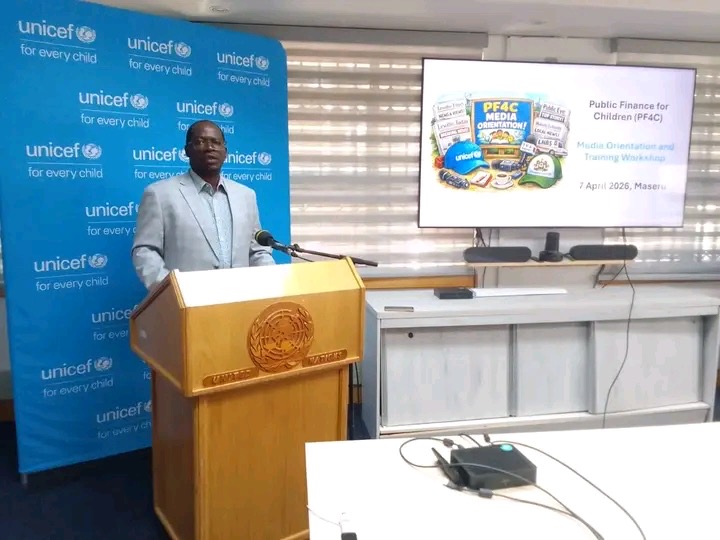
MASERU – UNICEF held a one-day training workshop for journalists to help them better understand how the national budget affects the lives of children.

The workshop, called Media Orientation on Public Finance for Children (PF4C), brought together media professionals from across the country. The aim was to break down complex budget language so journalists can report on it more clearly.

“Budgets use difficult terms, but they decide how much money goes to schools, clinics, clean water, and social support. When journalists understand these details, they can show the public how budget choices directly affect children.” Bob Muchabaiwa, UNICEF Public Finance Specialist

Muchabaiwa led the session and explained that budget documents are often inaccessible to ordinary readers, yet the decisions inside them determine funding for education, health care, nutrition programmes, social protection, and clean water and sanitation. When those allocations are cut or increased, children and their families feel the effects first.

Journalists at the training said the session gave them practical tools to connect budget figures to everyday life. Relebohile Nts’onyane, one of the participants, said big numbers in budget speeches are difficult to translate into stories people can relate to. “This training helps us take complex budget data and write it in a way that makes sense to our readers and listeners,” she said.

Nts’onyane added that stronger budget reporting supports public accountability. When communities understand how money is spent, she said, they can ask whether children’s needs are being met in their villages and towns.

UNICEF is the United Nations agency responsible for protecting children’s rights worldwide. It works with governments, civil society organisations, and the media to improve child welfare. Thursday’s workshop is part of a broader push to promote transparency around public spending for children, and organisers said further training sessions for the media are planned.

“`
UNICEF Lesotho Public Finance Children Media Training

China Cancels Lesotho’s M214m loan, Eases Country’s Debt Burden

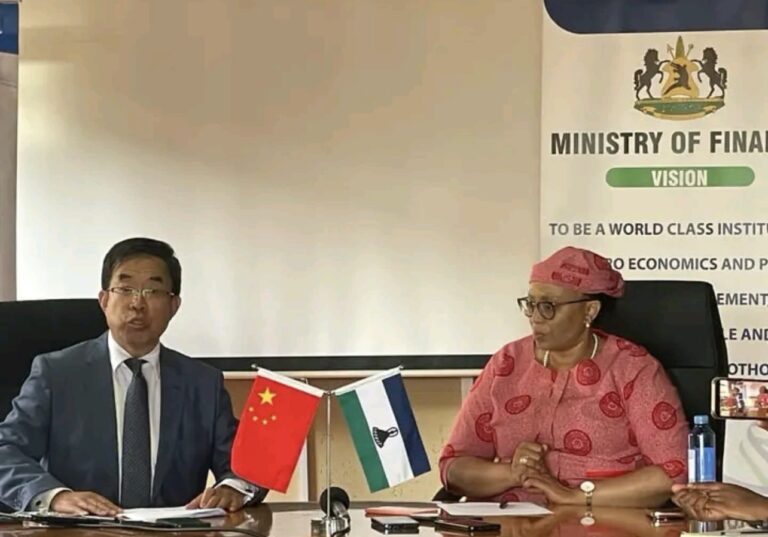
MASERU – Lesotho and China have intensified their alliance after signing an agreement to cancel part of Lesotho’s debt. The deal was signed on Thursday in Maseru.

Finance and Development Planning Minister Dr. Rets’elisitsoe Matlanyane signed on behalf of the Lesotho government while China’s Ambassador to Lesotho, Yang Xiaokun, signed for the Chinese government.

Under the new protocol, China will disregard two interest-free loans worth a total of M214.466 million. The loans were supposed to be paid back by the end of December 2024.

Minister Matlanyane explained that the first loan, M119.805 million, was given in 2011 under the Economic and Technical Cooperation Agreement. It was used to renovate the Manthabiseng Convention Centre. The second loan, M95.804 million, was given in 2012 for the JUNCAO Mushroom Cultivation Project, which teaches farmers how to grow mushrooms using grass technology to improve food security and create jobs.

The Minister said the waiver is good news for both the government and people of Lesotho. “This decision gives us important relief,” she said. “It will help us manage our public debt better and support our plans to keep government spending under control.” Lower debt means the government can use more money for services like health, education, and roads.

Ambassador Xiaokun said the loan cancellation follows a promise made by President Xi Jinping. Last year, President Xi announced that China would cancel all interest-free government loans due by the end of 2024 for the least developed African countries that have diplomatic ties with China. Lesotho is one of those countries.

“This signing shows the principles that guide China’s work with Africa,” the Ambassador said. “We respect the sovereignty and independent choices of African countries. We do not interfere in their internal affairs.” He added that Chinese companies have created more than 1.1 million jobs in Africa over the past three years.

Lesotho and China have worked together for many years on different projects. China has helped build several major facilities in the country, including the State Library, the New Parliament Building, and the Maseru District Hospital.

Officials from both countries said the loan waiver is another sign of the strong friendship and cooperation between Lesotho and China. They hope to continue working together on development projects that benefit the people of Lesotho.

Government suspends all passport services across Lesotho

Passport services across all of Lesotho’s ten districts have been abruptly suspended, with authorities citing “grave challenges” at the country’s central production centre and every passport office in the network.

A memorandum dated 2 April 2026 and issued by the Principal Secretary in the Ministry of Local Government, Chieftainship, Home Affairs and Police confirms that the passport production centre and all affiliated offices have been temporarily closed until further notice. The directive was addressed to senior officials including the Director of Passport Services, the Director of Finance, and the heads of passport offices across the country — a scope that signals a system-wide disruption rather than an isolated technical fault at a single location.

The ministry has not disclosed the precise nature of the difficulties, but officials indicate that a technical team is working around the clock to restore operations. Despite those efforts, authorities concluded that the challenges were serious enough to warrant a full halt of all processing activities, including new applications, renewals, and document collections.

The suspension comes without a stated timeline for restoration, leaving an indeterminate period during which Basotho requiring travel documentation will have no recourse through official channels. The impact is expected to be felt most acutely by those with imminent travel plans for medical treatment, business, or cross-border movement — circumstances that rarely accommodate administrative delays.

Officials have not indicated whether emergency provisions will be made available for citizens with urgent and documented travel needs, nor whether the department intends to issue further public guidance. With no end date attached to the closure, passport backlogs are expected to accumulate and may pose a secondary challenge once services resume.

“Operations at the passport production centre and all related offices have been temporarily closed until further notice.”

— Principal Secretary, Ministry of Home Affairs, 2 April 2026

The Lesotho Tribune has sought clarification from the Ministry of Home Affairs on the cause of the disruption, the estimated duration of the closure, and whether emergency travel documentation measures are being considered. No response had been received at the time of publication.

What this means for Basotho

  • →  No new passport applications can be submitted or processed
  • →  Renewals and document collections are frozen indefinitely
  • →  No emergency provisions for urgent travel have been announced
  • →  A backlog is expected to accumulate before services are restored

Legalising Murder: Israel’s Shift from Control to Elimination

Opinion

By Ambassador Hanan Jarrar

Israel has crossed a line it has long approached but never formally declared: legalising the killing of prisoners. By passing a law permitting the execution of Palestinian detainees, what they once carried out in the shadows with impunity now stands codified in law. In a system where Palestinian conviction rates in military courts are consistently reported by human rights organisations and legal experts to exceed 95%, often reaching as high as 99%, the death penalty is not a measure of justice, but a guarantee of death.

To understand the gravity of this moment, one must first understand the scale and function of imprisonment in the Palestinian context. Detention has never been merely a legal measure; it has been a central instrument of control. One in five Palestinians (20%) has been arrested or detained by Israeli authorities since the 1967 occupation of the West Bank, Gaza, and East Jerusalem. This system of mass incarceration falls most heavily on Palestinian men, with estimates indicating that nearly two in every five (40%) have been arrested and charged over the course of their lives. An entire generation marked by detention.

At the heart of this system lies administrative detention, a practice that allows individuals to be held without charge or trial, often on secret evidence, for renewable periods of six months. In reality, this means indefinite imprisonment without due process. Under the current trajectory, and in the shadow of this new inhumane law, such detention risks being extended in prison time, and in consequence, transforming from prolonged incarceration into the possibility of state-sanctioned execution.

Since October 2023, conditions within Israeli prisons have deteriorated dramatically. The findings of Francesca Albanese, the United Nations Special Rapporteur on the situation of human rights in the Palestinian territories, point to widespread and systematic abuses against Palestinian men and women in Israeli prisons: rape, torture, sexual violence, humiliation, solitary confinement without access to family, and deliberate medical neglect. These violations form part of a broader pattern made possible by sustained international inaction. Impunity is not incidental; it is enabling.

Therefore, the newly approved law must not be understood as something abnormal, but as a continuation. For years, proposals to formalise the execution of Palestinian prisoners have circulated within the Israeli parliament, repeatedly amended, repeatedly delayed. The intent has not changed; it is the timing that has. At a moment when global attention is diverted by expanding regional tensions and shifting geopolitical priorities through the US-Israeli war against Iran, this far-right government has seized the opportunity to advance a measure that would have once provoked immediate international outrage. The silence is not accidental. It is being relied upon.

Palestinians know too well that execution has never been confined to courtrooms. Field executions, extrajudicial killings carried out with impunity, have long been a feature of life under occupation. What this law does is remove any remaining ambiguity. It provides legal cover for what has already been practised, the systematisation of murder within governance structures.

For those in South Africa and across the African continent, this moment should resonate deeply. The use of detention and imprisonment to suppress resistance is nothing new. Under apartheid, political prisoners were jailed, and executions were carried out by the state between 1961 and 1989. Yet South Africa ultimately chose a different path, abolishing the death penalty in 1995 as part of its commitment to human dignity and constitutional justice.

Today, a new shift is occurring: the law is being repurposed to authorise the destruction of life rather than protect it.

Figures such as Marwan Barghouti and Ahmad Sa’adat, widely regarded as central voices in Palestinian political life, now face a risk that echoes beyond their individual cases. Their standing, comparable in many respects to that of Nelson Mandela, Ahmed Kathrada and other South African freedom fighters during the struggle against apartheid, underscores what is truly at stake. This is not only about prisoners. It is about leadership, resistance, and the future of a people.

More than 9,000 Palestinian prisoners are currently held in Israeli detention. This law places them under a new and immediate threat. It converts imprisonment into a pipeline to execution, governed by a discriminatory and politicised system.

Such a measure could not have been adopted in a vacuum. It is the product of a broader failure of international institutions that have not held Israel accountable, and of governments that have chosen silence over principle. The credibility of the international legal system is now on trial as much as the lives of those it has failed to protect.

The response must therefore be clear and decisive. Parliaments across the world must urgently reconsider their relations with the Israeli parliament. This includes imposing sanctions on its members, suspending its participation in international parliamentary bodies, and supporting efforts to isolate an institution that has moved to legitimise racism and killing under the guise of law.

The State of Palestine calls for the boycott of this legislative body as a necessary step to uphold the most basic principles of international law and human dignity.

History will not remember this moment for the arguments made in defence of such a law. It will remember who acted, and who remained silent, as the legalisation of death took its place on the statute books.

About the author

Hanan Jarrar is the Ambassador of the State of Palestine to South Africa, Namibia, Lesotho and Malawi.

Lesotho Tribune — Opinion — International Affairs — Information Liberates

Court orders retired judge to finish cases, withholds pension until work is done

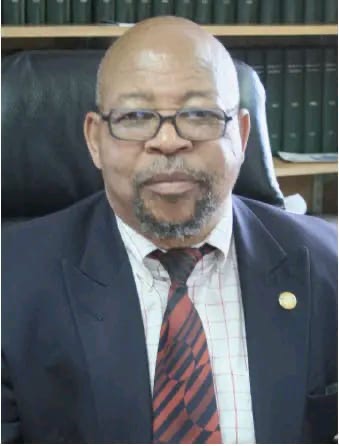
MASERU — The High Court sitting as the Constitutional Court has ruled that Justice Ts’eliso Monaphathi must be allowed to continue working and receive the full benefits of a puisne judge until he completes all the cases that are still before him.

The decision follows an application brought by Justice Monaphathi, who challenged a move by the Chief Justice to withhold his terminal benefits after he reached the mandatory retirement age.

In its judgment, the Constitutional Court made it clear that Justice Monaphathi does not have the choice to decide whether he wants to continue working or not. Instead, the court said the Constitution requires him to complete all the cases he had already started before he turned 75 years old.

The court explained that although judges are required to retire at the age of 75, the law allows them to remain in office for a limited time if it is necessary for them to finish their pending work. This includes delivering judgments and concluding cases that were already underway before retirement.

According to Section 121(1) of the Constitution, judges of the High Court must leave office when they reach the prescribed retirement age of 75. However, Section 121(2) provides that they may continue working after that age if it is necessary to complete ongoing proceedings.

The court stressed that this continuation is not optional. It is a constitutional obligation meant to ensure that cases are finalised and justice is delivered without unnecessary delays.

In its ruling, the court stated that if Justice Monaphathi chooses to continue working as required by the Constitution, he must be given all the benefits of his position, including his salary, as he had earned at the time he reached retirement age.

“Should he decide to continue as required by the Constitution, he should be entitled to a salary or the benefits he earned at the time when he attained the retirement age.”

At the same time, the court made it clear that Justice Monaphathi cannot access his pension benefits until he has completed all the cases assigned to him. This means that his retirement benefits will remain on hold until he finishes his outstanding work.

The court described the matter as “regrettable,” pointing out that many of the cases involved have been pending for years, leaving litigants waiting for justice for a very long time.

It noted that delays in delivering judgments have serious consequences, especially for people who rely on the courts to resolve disputes and protect their rights.

The judges also commented on efforts by the Chief Justice to improve the functioning of the High Court. They said these efforts should be supported, as they are aimed at addressing long-standing problems within the justice system.

The court further criticised Justice Monaphathi’s conduct, stating that he had failed to carry out his constitutional duties properly. It said his understanding of judicial independence was incorrect and could not be used to justify delays in completing cases.

The judgment also questioned his claim that he had served honourably, noting the large number of cases that had remained unfinished during his time on the bench.

According to the court, there was no convincing evidence to show that the delays were caused by a shortage of judges or a lack of resources. Instead, it suggested that the situation may have been due to other factors.

“We do not believe that the applicant accumulated all these reserved judgments and part-heard matters because of a shortage of judges.”

It added that the delays could be the result of “deliberate obstruction, laxity, unjustifiable inaction, or some other unexplained reason.”

The court placed much of the responsibility for the delays on Justice Monaphathi himself, stating that he had not shown sufficient commitment to completing his work.

During the hearing, Justice Monaphathi’s lawyer, Advocate Mocheta Makara, argued that the judge had been working under difficult conditions. He said the courts were understaffed, judges were overworked, and there were not enough resources to help them manage their workload.

Advocate Makara also told the court that the Chief Justice had failed to provide Justice Monaphathi with the support he needed to continue working after reaching retirement age, as allowed by the Constitution.

He argued that since Justice Monaphathi had already reached the age of retirement, he was entitled to receive his pension and other benefits. He also claimed that the judge had the discretion to decide whether to continue working after turning 75.

In addition, Advocate Makara said that if the Chief Justice believed Justice Monaphathi was not performing his duties properly, he should have taken formal disciplinary action or started impeachment proceedings.

He further argued that the Chief Justice did not follow the proper legal procedures under Section 151 of the Constitution, which deals with withholding a judge’s pension benefits. According to him, the Chief Justice did not have the authority to stop those benefits.

However, the application was opposed by Advocate Rudie Cronje, who argued that judges have a duty to complete their work and deliver justice to the public.

He said the public expects courts to function efficiently and that judges must honour the oath they take when they assume office.

“It can never be that a judge has the discretion to work after the age of 75.”

He emphasised that judges are required to complete the cases before them and cannot simply walk away after reaching retirement age.

He also referred to the judicial code of ethics, which requires judges to deliver judgments within a reasonable time, usually within three months.

According to him, judges must be accountable for their work and ensure that cases are finalised without unnecessary delay.

The Constitutional Court agreed with this position, making it clear that the duty to complete pending cases is not optional but a legal requirement.

The matter was heard before a panel of acting justices drawn from the region. These were Justice Mankhambira Mkandiwire from Malawi, Justice Sylvester Salufu Mainga from Namibia, and Justice David Mangota from Zimbabwe.

In conclusion, the court ordered that Justice Monaphathi be allowed to continue working with full benefits until he finishes all his pending cases. However, his pension will remain inaccessible until that work is completed.

The ruling sends a strong message about accountability within the judiciary and the importance of ensuring that justice is delivered without delay.

— Lesotho Tribune | Courts & Justice

Independent business & current affairs journalism · Lesotho Subscribe — M85/month
| Independent business & current affairs journalism · Lesotho