Mohahlaula Airlines
Tuesday, July 21, 2026
Home Blog Page 4

The workers are coming home. Is anything ready for them?

The country is arguing about whom to expel. The harder question is who is coming home, and whether anything here is ready for them.

Every Basotho worker driven out of South Africa this year is a person arriving somewhere. That somewhere is here. While the political class debates retaliation at Polihali, the more consequential event is quieter and already under way at the border posts: Basotho are coming home, and home is a country that has spent a century arranging itself around their absence.

For generations Lesotho has run on an export it rarely names as one. Not water, not diamonds, not wool. People. Basotho men went to the South African mines, Basotho women to South African kitchens, and the money came back as remittances that fed households in every district. The 1986 census found nearly half of adult men working across the border. The country did not solve unemployment. It exported it, and lived on the wages.

That arrangement is now closing, not by Lesotho’s choice. South Africa has arrested more than 5,000 people for immigration offences in a single week and driven thousands more out through mob threat and official raid. The Lesotho Exemption Permit that regularised many Basotho is precarious. The pipeline that carried the surplus workforce south is narrowing, and the workers are turning around.

A returning worker is not a crisis. A returning worker with no field to plant and no wage to earn is.

Consider what waits for them. One tenth of Lesotho’s land is arable. Home-grown cereals cover less than a third of what the country eats, and the rest is bought from the same South Africa now sending its labour back. A returnee who left a mine wage for a rural village is not returning to a farm that can absorb him. He is returning to a food bill his family already struggles to pay.

This is the failure the expulsion argument hides. For thirty years Lesotho treated the border as a pressure valve. As long as the young could leave and the money could return, no government had to build an economy that employed people at home. The valve is being welded shut from the other side, and the room behind it is filling up.

The honest response is not a counter-expulsion. It is preparation. Count the returnees and know where they are landing. Point them at the sectors that can still grow here, wool and mohair, conservation farming on the land that is arable, the trades that the water project and its towns need. Treat remittance dependence as the structural weakness it always was, rather than a permanent feature of national life.

None of that is quick, and this page will not pretend it is. But the alternative is to keep staging the wrong argument. A South African engineer at Polihali is not the reason a Mosotho miner is coming home with a packed bag and no plan. The reason is that Lesotho never built the thing that would have let him stay in the first place.

The people at the border are Basotho. They are not a problem to be managed at the gate. They are the workforce this country always had and never used. Whether their return becomes a burden or a beginning depends on what is built to meet them, and there is very little time to build it.

Flagship objectives of Young Basotho Professionals, corroborated by China development initiatives and Lesotho government policy at the YBPF AGM

THE Young Basotho Professionals Forum held its maiden Annual General Meeting and Strategic Planning Workshop on the 29th and 30th of June 2026.

The event gathered emerging professionals, practising professionals, young entrepreneurs, graduands and graduates about to enter the workforce in Lesotho’s ailing job market, exploring themes that included, inter alia, leadership, national development (youth unemployment, job creation), international collaboration, national cohesion, national psyche, philosophy and peace.

The Young Basotho Professionals Forum (YBPF) workshop also reflected on issues of national identity and patriotism, as well as high mettle and consciousness in socio-politico-economic affairs, both geopolitically and nationally. The workshop aimed to hone a generation of leaders and promote an active citizenry that values dialogue, unity, innovation and accountable governance, in order to achieve a peaceful society in which Lesotho is at peace with itself, its neighbours and the international community.

Among the facilitators, mentors and contributors of the workshop were Associate Professor Makhulu Makumane, Dr Khosi Mahlakeng and Thabo Qhesi, whose contributions spanned a plethora of topics and themes meant to equip delegates with solution-development tools and to inculcate forgotten virtues and values that will be instrumental to the work of the forum as a think tank and to the delegates’ personal development.

As the Bible will have it, that “all things work together for good”, fate also had it that, on the eve of the 105th anniversary of the Communist Party of China (CPC), the officiation of the main ceremonies comprised His Excellency Yang Xiaokun, Ambassador of the People’s Republic of China to Lesotho, as the main guest speaker, who, in his opening, outlined that his remarks contained three themes encapsulating the following topics: 1. The Global Civilization Initiative; 2. Full Zero-Tariff Treatment for All African Diplomatic Partners; and 3. The White Paper on Equitable Global Governance and the Global Governance Initiative.

In consolidation of these three themes, His Excellency Yang Xiaokun said:

“What I shared with you today ultimately addresses three fundamental questions: how can civilizations coexist peacefully; how can development opportunities be shared more fairly; and how can global governance become more just and equitable?

China’s answer is clear: through dialogue rather than confrontation, through cooperation rather than exclusion, and through shared development rather than zero-sum competition.

The Global Civilization Initiative promotes mutual respect and mutual learning among peoples. China’s expanded opening-up, including full zero-tariff treatment for African partners, creates new opportunities for common development. The Global Governance Initiative and the recently released white paper contribute Chinese wisdom and Chinese solutions to building a more just and equitable international order.

As an important member of the Global South and a longstanding supporter of multilateralism, Lesotho has an important role to play in promoting peace, development and global governance reform. We highly value the important role that our think tanks and academic institutions play in fostering mutual understanding, generating policy ideas and strengthening international cooperation.

I sincerely hope that the YBPF will continue to leverage its intellectual strengths to deepen research and dialogue on issues such as exchanges among civilizations, South-South cooperation and global governance reform, and contribute more wisdom and insights to strengthen the China-Lesotho strategic partnership and build a more peaceful, prosperous and equitable world.

China stands ready to strengthen exchanges and cooperation with think tanks, universities and academic institutions in Lesotho. We welcome more scholars, researchers and young intellectuals from Lesotho to engage in exchanges with China and to jointly explore solutions to the common challenges facing humanity.”

In this powerful keynote speech, His Excellency Ambassador Yang Xiaokun also mentioned two noteworthy dates to conjure with. The first is 1 July 2026, the Communist Party of China’s (CPC) 105th anniversary. He invited attendees to reflect on the monumental transformation since the CPC’s establishment in 1921. For 105 years the CPC has led the Chinese people and has achieved great feats across every facet of human endeavour, including balanced economic development, improved living standards, poverty eradication, employment generation, cutting-edge technological advancements and ecological conservation. These achievements underpin the ideological pragmatism of the CPC’s socialism with Chinese characteristics.

On the second noteworthy date, Ambassador Yang spoke to the issue of the General Assembly resolution A/RES/78/286, adopted to declare 10 June as the International Day for Dialogue among Civilizations. He described the date and resolution as a significant step towards the implementation of the GCI.

The President of the Young Basotho Professionals Forum, Mr Lesolle Phalatsi, in his opening remarks, outlined the vision and mission of the organisation: that its mandate and core value offering is to become Lesotho’s most robust, people-centred and research-based think tank, one that focuses on mentoring and honing the youth to become active, conscious and conscientious citizens who are self-reliant and independent, while fostering the same within Lesotho to bring about economic growth, improved living standards, poverty eradication, employment generation, peace and harmony.

The AGM was also graced by the presence of the Minister of Labour and Employment, Honourable Ts’eliso Mokhosi. Minister Mokhosi noted that the coming into being of the YBPF is a significant step and a blessing, more especially as the nation is seized with a youth employment crisis, culminating in the recent multitudes of Basotho crossing the border back home, fearing for their lives in South Africa. He strongly emphasised that the Young Basotho Professionals Forum is indeed the answer to the economic problems faced by Lesotho, not only unemployment but also underemployment. The Honourable Minister encouraged the YBPF to form strategic partnerships and cooperation, and humbly exhorted the Chinese diplomats and Chinese communities in Lesotho to find possibilities and areas of cooperation in order to sharpen the human capital and capacity of the YBPF as an organisation.

The ensuing panel discussion on the Global Civilization Initiative and Global Development Initiative, as President Xi’s thoughts, was conducted in a robust yet warm atmosphere, in which delegates, experts and attendees interacted in dissecting the thoughts.

To wrap up the proceedings, the meeting received a comprehensive and informative presentation on Full Zero-Tariff Treatment for All African Diplomatic Partners (53 African nations).

This article was contributed by the Young Basotho Professionals Forum.

Pirates Star Relebohile Mofokeng Seals R56 Million Contract 

Relebohile Mofokeng, 21, has left Orlando Pirates for Belgian champions Union Saint-Gilloise on a four-year deal, after his World Cup football for Bafana Bafana drew European interest.

RELEBOHILE Mofokeng has signed for Union Saint-Gilloise, the reigning Belgian champions, on a four-year contract that runs until 2030, with the club holding an option to extend it by a further year. Union reportedly paid €3 million (about R56 million, or US$3.4 million) for the 21-year-old.

Mofokeng had already made his name at Orlando Pirates in the Premier Soccer League. It was his football at the FIFA World Cup that drew European clubs to him.

The deal Detail
Player Relebohile Mofokeng, 21
From Orlando Pirates (South Africa)
To Union Saint-Gilloise (Belgium)
Reported fee €3 million (about R56 million / US$3.4 million)
Contract Four years, to 2030, with an option for one more

He played for Bafana Bafana at the tournament as an attacking player, with close control, creativity and the ability to open up packed defences. Union Saint-Gilloise decided he had the quality for their squad.

Against strong opposition he played with composure. South Africa did not go far in the tournament, but the team earned praise for its displays, and Mofokeng was among its better performers.

Union Saint-Gilloise, based in Brussels, has a record of signing young players and giving them a platform. As Belgian champions, the club offers Mofokeng a chance to compete for domestic titles and, potentially, in European competition.

The transfer is the next step for a player who had become one of Orlando Pirates’ most influential. He moves to one of Europe’s respected development leagues.

Mofokeng joins Union Saint-Gilloise at the start of the season, where expectations will be high.

LDF honours 16 fallen soldiers at Remembrance Day service

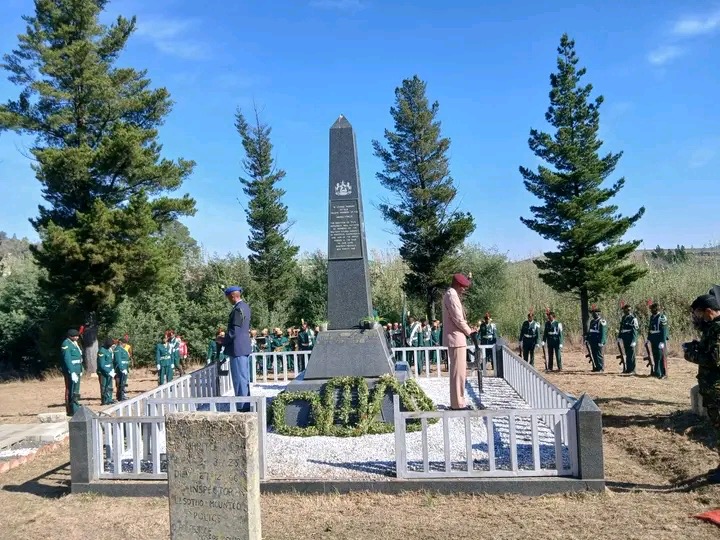
The Lesotho Defence Force honoured 16 fallen members at its annual Remembrance Day service, with tributes, prayers and the laying of wreaths at Khutsong Military Cemetery.

THE Lesotho Defence Force (LDF) gathered at Khutsong Military Cemetery, Ratjomose Barracks, today to remember soldiers who died while serving the nation.

The annual Remembrance Day prayer service was attended by senior government officials, military leadership and families of the fallen soldiers. The ceremony included prayers, tributes and the laying of wreaths for servicemen and women who died in the line of duty.

Speaking for the Ministry of Defence, Permanent Secretary Mpopo Ts’oele said it is the nation’s duty to remember its heroes.

“A country that forgets those who served and died for it risks losing its moral foundation.”
Mpopo Ts’oele, Permanent Secretary, Ministry of Defence

Ts’oele commended the LDF for its role in keeping peace and stability in Lesotho. He said the government would support the force with the equipment, food and uniforms it needs, and called for closer cooperation between military leadership and government structures to strengthen the institution and help the public understand its work.

The LDF Commander, Lieutenant General Mojalefa Letsoela, said Remembrance Day is a time to reflect on the lives of soldiers who died in service. This year the force is honouring 16 members. Letsoela said their sacrifice shows the courage of all LDF personnel who have lost their lives on duty.

He spoke about the 1998 Katse incident as one of the painful chapters in the force’s history. “Events like September 22, 1998 remain part of our collective memory. They remind us why unity, discipline and service must always come first,” he said.

Letsoela said the LDF once marked Army Day on June 30 with public displays, parades, sports and open days at Setsoto Stadium. Those events were later stopped, he said, and the focus shifted to solemn commemorations for fallen soldiers.

“The sacrifices of our fallen members are engraved in the memory of this institution and of the nation,” Letsoela said. “Peace and stability do not come by chance. They require continuous commitment and vigilance.”

The Chief of Staff, Major General Ramanka Mokaloba, said the force has protected Lesotho and supported national development and regional cooperation. He recalled how the LDF assisted other defence forces in the region in its early years, and pointed to periods of political instability, including the events of 1998, as reasons to strengthen national security systems and give the military adequate support.

Speaking for the families of the fallen soldiers, Sekhoane Motseki thanked the force for including them in the commemorations each year. “We appreciate that our loved ones are remembered and honoured,” he said. “It means a lot to the families to know that their sacrifice is recognized by the nation.”

The LDF observes Remembrance Day and Army Day every year on June 30, to honour soldiers who died in service and to reflect on the history of the force. The service ended with prayers, a moment of silence and the laying of wreaths at the graves at Khutsong Military Cemetery.

Wool exports near clearance after foot-and-mouth curbs

The agriculture minister told farmers that Lesotho’s wool and mohair are free of foot-and-mouth disease and that a certificate allowing exports is expected within days, as growers pressed for local testing labs and a dedicated farming fund.

WOOL and mohair from Lesotho are free of foot-and-mouth disease, and a certificate allowing exports to resume is expected within days, the Minister of Agriculture and Food Security, Selibe Mochoboroane, has told farmers.

Mochoboroane was responding to farmers’ concerns at the Leadership and Accountability Summit. Lesotho declared a state of disaster in March after foot-and-mouth disease was found in the highlands of Qacha’s Nek and Butha-Buthe in February. The government quarantined affected areas, banned livestock markets and animal movement without veterinary approval, and culled animals in some areas.

The outbreak put the country’s leading agricultural export at risk. After the disaster was declared, China and South Africa required Lesotho to prove its wool and mohair were free of the disease before they would take the product. Mochoboroane said Lesotho had provided that proof and a protocol had been signed. The wool and mohair already at the Port Elizabeth auction floor, and the clip harvested since, were free of the disease, he said.

He said a certificate permitting the movement of wool and mohair to export markets was expected before the end of the week.

Wool and mohair Figure
Share of agricultural exports About 60 percent
World mohair ranking Second, after South Africa
Annual value About M900 million (US$55 million)
National flock About 2 million sheep
Rural population supported More than a quarter
Main auction markets Port Elizabeth and Durban

Sources: Minister of Agriculture and Food Security; International Trade Centre.

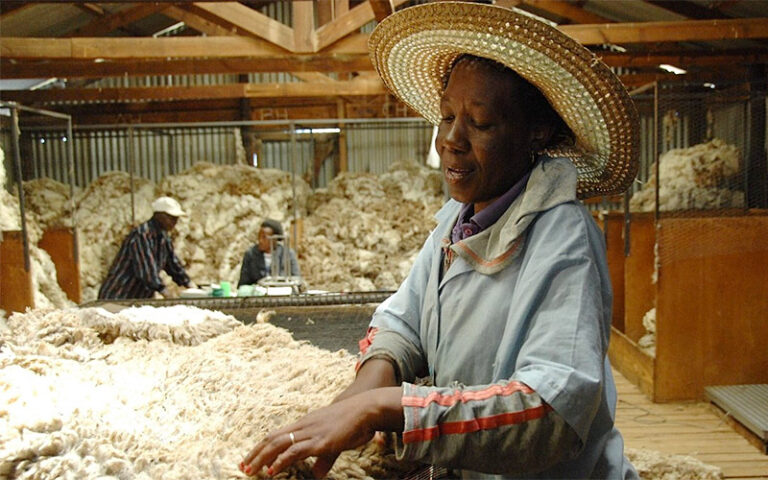
Wool and mohair are the main source of cash income in the highlands and foothills, where sheep and Angora goats have been kept since the 1800s. The two fibres account for about 60 percent of Lesotho’s agricultural exports, and the country is the world’s second-largest mohair producer after South Africa. Mochoboroane said the industry brings in about M900 million (about US$55 million) a year from a national flock of some two million sheep.

He urged farmers to raise more sheep and goats, and said processing the fibre before export would earn the country more than selling it raw.

Farmers used the summit to press for change. A farmer from Quthing, Teboho Nkau, asked when the government would overhaul how the wool and mohair trade is run, and when it would upgrade the Tele Bridge border post used to move the fibre to market. Another farmer asked when Lesotho would build its own laboratories to test wool and mohair, rather than depend on facilities abroad.

Farmers also raised the yearly delay in seeds and fertilisers. Mochoboroane said supplies would arrive earlier this year and that the government wanted fertiliser sold at a uniform price.

“We are working towards availing seeds and fertilisers by the 1st August 2026.”
Selibe Mochoboroane, Minister of Agriculture and Food Security

There were also calls for a dedicated farming fund. Tsikoane Peshoane said the Public Financial Management Act allows the finance minister to set up funds, as was done for roads and petroleum, and proposed an agricultural development fund to regulate the sector. Mochoboroane agreed that the country needs an agricultural fund.

Once issued, the certificate would clear the harvested clip to move to the Port Elizabeth and Durban auction floors, where Lesotho’s wool and mohair are sold.

Government to build classrooms and toilets at 52 primary schools

The government will build new classrooms and latrines at 52 primary schools across all 10 districts, with the work due for handover between July and August 2026.

MORE Basotho children will soon learn in better classrooms with proper toilets after the government announced plans to build new infrastructure at 52 primary schools across the country.

The Minister of Education, Professor Ntoi Rapapa, made the announcement this week. He said the project is part of the government’s plan to strengthen basic education and fix infrastructure problems that many schools face.

New classrooms and latrines will be built at 52 primary schools in all 10 districts of Lesotho. Rapapa said the work is scheduled to start soon, and the government expects to complete and hand over all the projects between July and August 2026.

District Schools
Thaba-Tseka 10
Mohale’s Hoek 8
Butha-Buthe 6
Maseru 5
Mafeteng 5
Mokhotlong 4
Leribe 4
Berea 4
Quthing 4
Qacha’s Nek 2

Schools named by the minister include Thaba-Phechela Primary School in Constituency No. 48, Mafeteng; Hloahloeng Primary School in Constituency No. 64, Mohale’s Hoek; and Thaba-Putsoa Primary School in Constituency No. 40, Maseru. The Ministry of Education will publish the full list of 52 schools in the coming weeks.

Rapapa said many primary schools in rural and urban areas struggle with overcrowded classrooms and poor sanitation, which makes it hard for children to learn and for teachers to teach.

“Every child deserves to learn in a classroom that is safe and dignified.”
Professor Ntoi Rapapa, Minister of Education

He said building more classrooms will reduce overcrowding, and that new latrines will make schools cleaner and safer, especially for girls.

“This major infrastructure project is about improving learning conditions in our primary schools,” he said. “When learners and teachers have safe, functional and accessible facilities, education outcomes improve for all Basotho children.”

Rapapa said the project is part of the government’s investment in basic education, and that good infrastructure is the foundation of quality learning.

The Ministry of Education said it will work with district education offices, community leaders and school management teams to complete the projects on time and meet the needs of each school. Once finished, thousands of learners are expected to use the new classrooms and sanitation facilities.

Mofomobe calls for expulsion of South Africans from Polihali

0

The BNP leader accused the South African government of complicity in the expulsion of Basotho and other foreign nationals, and urged Lesotho to remove more than 2,000 South Africans working on the Polihali water project.

BASOTHO National Party leader Machesetsa Mofomobe has called on the Lesotho government to expel more than 2,000 South Africans working on the Polihali water project, in response to the removal of Basotho and other foreign nationals from South Africa.

Mofomobe made the call at a press conference in Maseru on Wednesday, where he addressed the media on the treatment of Basotho migrants across the border. He accused the South African government of complicity in the expulsions and said Pretoria bore responsibility for the pressure now falling on foreign residents.

He said Lesotho should respond by removing South African nationals employed at Polihali, the Phase II dam of the Lesotho Highlands Water Project. The project, valued at close to M50 billion (about US$3 billion), is built under a 1986 treaty between the two countries and supplies water to South Africa’s Gauteng province. Mofomobe put the number of South Africans working on the project at more than 2,000.

His remarks come during a wave of deportations and anti-migrant action in South Africa. South African authorities reported more than 5,000 arrests for immigration offences in a single week in mid-June, and thousands of migrants have left the country in recent weeks.

The departures have followed both official enforcement and threats from anti-migrant groups. Rights groups and news organisations have reported the destruction of migrant homes, mob attacks, and the death of a Malawian man near Pietermaritzburg. Nigeria and Ghana have arranged transport to repatriate some of their nationals.

Basotho are among the largest migrant communities in South Africa, with a long history of labour migration to its mines, farms and households. Many live and work there under the Lesotho Exemption Permit. Money sent home by Basotho workers is a significant source of income for households in Lesotho.

South Africa’s government has linked its enforcement campaign to unemployment, which stood at about 32 percent early in 2026, and to public anger over undocumented migration. It has said its operations are conducted within the law.

Mofomobe leads the BNP in opposition, and his call is a demand on the government of Prime Minister Sam Matekane rather than a statement of policy. The government has not announced any move to remove South African workers from Polihali.

Polihali is central to the water relationship between the two countries. It is the second phase of a scheme that has channelled water from the Lesotho highlands to South Africa for close to four decades, in exchange for royalty payments to Lesotho.

Labour Court sets aside recall of Tokyo diplomat

The Labour Court reviewed and set aside the recall of ‘Mampoi Keta, a Third Secretary at Lesotho’s Tokyo mission, after finding that the wrong official chaired her misconduct inquiry, and ordered the disciplinary hearing to start afresh.

THE Labour Court has set aside the decision to recall a Lesotho diplomat from the Tokyo mission, ruling that her misconduct inquiry was chaired by the wrong official and ordering the disciplinary hearing to start afresh.

‘Mampoi Keta, a Third Secretary at Lesotho’s mission in Tokyo, was found guilty of misconduct in April over the overpayment of her own salary and told she would be recommended for demotion. The Principal Secretary of the Ministry of Foreign Affairs and International Relations then recalled her from foreign service with effect from 19 May 2026. Keta brought the recall on review under case number LC/REV/56/2026.

The court reviewed, corrected and set aside the recall and ordered that the disciplinary hearing begin de novo, meaning afresh. It made no order as to costs. The judgment was delivered on 30 June 2026.

Date Event
9 Feb 2026 Suspended pending investigation
3 Mar 2026 Served with notice of disciplinary hearing
23 Mar 2026 Disciplinary hearing held
14 Apr 2026 Found guilty; demotion recommended
19 May 2026 Recall from Tokyo to take effect (stayed by the court)
30 Jun 2026 Recall set aside; hearing to restart

The court found that the chairperson of the disciplinary hearing was appointed contrary to the Codes of Good Practice 2008. Section 8(3)(a) makes it mandatory for a public officer’s inquiry to be chaired by the head of that officer’s section. The hearing was instead chaired by the Deputy Principal Secretary of the Ministry of Public Works and Transport, an official from a different ministry who was neither Keta’s head of section nor her supervisor.

The Principal Secretary argued that Keta’s head of section, the Ambassador at the Tokyo mission, was conflicted and could not preside. The court found that claim unsupported. The Ambassador had filed no affidavit, the minutes of the hearing recorded no conflict or recusal, and the ministry did not explain how the conflict arose. Where the Code makes the appointment mandatory, the court held, the head of section should have presided and formally recorded any reason for standing down.

“Where the provision is mandatory, the head of section ought to have presided over the matter and then formally noted the reasons for recusal.”
Labour Court, LC/REV/56/2026

The court also found that the recommendation was wrongly routed. The chairperson recommended that Keta repay the money and be demoted from Third Secretary, not that she be dismissed. Under section 8(6) of the Code, a recommendation goes to the head of department only where dismissal is proposed. Handing the demotion recommendation to the Principal Secretary, as head of department, was irregular.

On other grounds the court sided with the ministry. It found no inconsistency in how Keta’s case was handled compared with another officer who had also been overpaid, and declined to consider a challenge to her earlier suspension because she raised it only in reply, months after the suspension took effect.

Keta was represented by Adv T. Lesupi. The respondents, the Principal Secretary and the Attorney General, were represented by Adv T. Mohloki.

The effect of the ruling is that Keta’s disciplinary hearing must be held again from the start. The recall falls away, and the outcome of the first inquiry is undone pending the fresh hearing.

Independent business & current affairs journalism · Lesotho Subscribe — M85/month
| Independent business & current affairs journalism · Lesotho