


Science & World
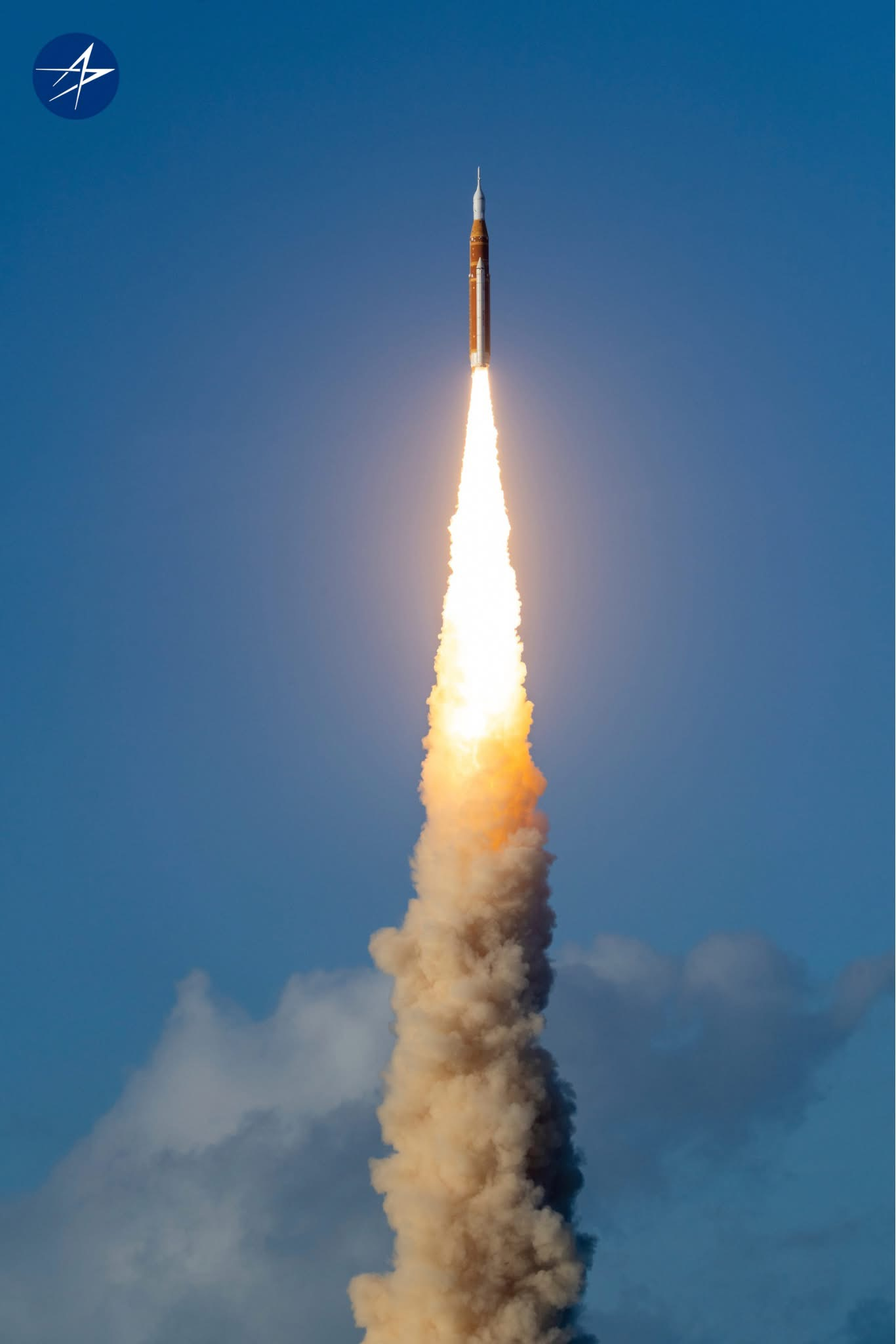
NASA’s Artemis II mission lifted off on 1 April 2026, carrying four astronauts on a 10-day journey around the Moon and back. It is the most significant human spaceflight in over half a century — and a test run for everything that comes next.
On the evening of 1 April 2026, a rocket carrying four human beings left the surface of the Earth bound for the Moon. It was the first time in 54 years that astronauts had departed Earth orbit. The moment was noted in mission control with a single, precise sentence: “Today, for the first time since Apollo 17 in 1972, humans have departed Earth orbit.”
“`The mission is called Artemis II. It will not land on the Moon. It will fly around it — passing within roughly 8,000 kilometres of the lunar surface at its closest approach — then use the Moon’s gravity to slingshot the spacecraft back toward Earth. The astronauts will splash down in the Pacific Ocean off the coast of California, approximately ten days after launch.
That may sound modest. It is not. Artemis II is the first crewed flight of NASA’s Space Launch System and the Orion spacecraft. Every system, every sensor, every lifegiving mechanism aboard has never before been tested with humans inside. The mission’s purpose is precisely to learn what works, what fails, and what must be improved before NASA attempts to land astronauts on the Moon in a future mission.
“`The crew
Four astronauts, one unprecedented flight path
The composition of the crew is itself a statement. Victor Glover becomes the first Black astronaut to fly to the Moon. Christina Koch becomes the first woman. Jeremy Hansen becomes the first Canadian, and the first non-American, to depart Earth orbit. These are not incidental facts. They reflect a deliberate broadening of who space exploration belongs to.
The journey
What has happened, and what comes next
The mission
Why this flight matters beyond the spectacle
Artemis II is, officially, a test flight. It does not carry scientific instruments to land on the Moon. It does not attempt a lunar landing. What it carries is more consequential: four human lives, and every system required to keep them alive in one of the most hostile environments in the known universe.
“`The spacecraft is named Integrity by the crew. It is built around the Orion capsule, developed jointly by NASA and the European Space Agency. The European Service Module — supplied by the ESA — provides propulsion, power, water, and oxygen. Its four solar array wings stretch nearly 19 metres tip to tip. Behind the human capsule sits the launch abort system, designed to pull the crew clear of a failing rocket in 300 milliseconds.
The flight path itself is deliberately conservative. Rather than entering lunar orbit — which would require a second burn and consume more fuel — Artemis II uses what is called a free-return trajectory. Gravity does most of the work. The spacecraft is flung around the Moon and gravity pulls it back to Earth naturally, minimising the consequences of any system failure. If the engine fails on the far side of the Moon, the crew still comes home.
That caution is deliberate and earned. During the uncrewed Artemis I mission in 2022, engineers discovered unexpected damage to the Orion heat shield during reentry. For Artemis II, the capsule will hit the atmosphere at a steeper angle than its predecessor, reducing the time it spends in the most extreme heat. Eight parachutes and a set of airbags will slow and stabilise the descent before splashdown.
“`The context
The road to Artemis III and beyond
Artemis II is not the end. It is the second step in a programme that aims to establish a sustained human presence on and around the Moon for the first time in history. Artemis I, in 2022, was an uncrewed test of the same spacecraft. Artemis III — currently in planning — is intended to be the first crewed lunar landing since Apollo 17, with astronauts targeting the Moon’s south polar region, where water ice has been confirmed in permanently shadowed craters.
“`The strategic importance of that target goes beyond geology. Water ice can be processed into hydrogen and oxygen: rocket fuel and breathable air. A self-sustaining lunar outpost — part of NASA’s Gateway programme — would allow astronauts to live and work on the Moon for extended periods, and serve as a staging point for eventual crewed missions to Mars.
The programme is also a race, though NASA is careful not to frame it that way. China’s lunar crewed programme has made steady progress. The gap between the two programmes has narrowed considerably over the years of delays that preceded Artemis II. What happens next, and how quickly, will partly define who shapes the norms and governance of cislunar space in the coming decades.
Also aboard Artemis II as secondary payloads are several CubeSats — small satellites from Germany, South Korea, Saudi Arabia, and Argentina. They will study the effects of space radiation on hardware, monitor space weather, and assess how the deep-space environment affects electrical systems bound for future lunar missions. The mission is, in this sense, already international.
“`Why this matters for Africa and Lesotho
Commander Wiseman, speaking from orbit, described seeing Africa from the Orion capsule as the spacecraft reoriented toward the Moon: a continent visible from pole to pole, in a single frame, from a spacecraft beyond Earth orbit. It was a reminder that the history being made in space is not separate from the world below it.
The Artemis programme represents more than a flag planting. The technologies being developed — radiation-hardened electronics, closed-loop life support, long-duration power systems, advanced reentry materials — have direct applications in communications satellites, weather monitoring, and remote sensing systems that serve the African continent. South Africa’s National Space Agency and several other African institutions have observer status in international space governance bodies shaped in part by missions like this one.
More broadly, the question of who goes to the Moon, under what governance, and for whose benefit, is a political question with consequences for every nation on Earth — including landlocked ones with no launch capacity of their own. Lesotho has no astronaut on Artemis II. But the decisions made on this mission will shape the rules of space for the next generation of people who will be born here.
Tribune note
This article was written on 3 April 2026, two days after launch. The Artemis II mission is ongoing. The crew is currently en route to the Moon aboard the Orion spacecraft Integrity. Updates will be published as the mission progresses through its lunar flyby and return to Earth.