


CAPE TOWN, South Africa (AP) — The United States sent five immigrants it says were convicted of serious crimes to the African nation of Eswatini, the U.S. Department of Homeland Security said — an expansion of the Trump administration’s largely secretive third-country deportation program.
The U.S. has already deported eight men to another African country, South Sudan, after the Supreme Court lifted restrictions on sending people to countries where they have no ties. The South Sudanese government has declined to say where those men, also described as violent criminals, are after it took custody of them nearly two weeks ago.
In a late-night post on X Tuesday, Homeland Security Assistant Secretary Tricia McLaughlin said five men — citizens of Vietnam, Jamaica, Cuba, Yemen and Laos — had been deported to Eswatini. She said they were all convicted criminals and “individuals so uniquely barbaric that their home countries refused to take them back.”
The men “have been terrorizing American communities” but were now “off of American soil,” McLaughlin added.
McLaughlin said they had been convicted of crimes including murder and child rape and one was a “confirmed” gang member. Her social media posts included mug shots of the men and what she said were their criminal records and sentences. They were not named.
The Eswatini government said Wednesday the men, which it referred to as “prisoners” and “inmates,” were being held in isolated units in unnamed correctional facilities in Eswatini but were considered to be in transit and would ultimately be sent back to their home countries.
In a series of posts on X, the Eswatini government said it would collaborate with the United States and the U.N. migration agency to facilitate their return home and ensure “due process and respect for human rights is followed” as part of their repatriation. The government gave no timeframe for that to happen.
Four of the five countries where the men are from have historically been resistant to taking back some citizens when they’re deported from the United States. That issue has been a reccurring problem for Homeland Security even before the Trump administration. Some countries refuse to take back any of their citizens, while others won’t accept people who have committed crimes in the United States.
Lesotho Promised to take detainees in
President Donald Trump has not been particularly kind to the small African nation of Lesotho. His administration’s dismantling of the United States Agency for International Development hit the nation of about 2.3 million people hard, by cutting millions of dollars of funding for public health and other programs. In March, he ridiculed the country during his address to Congress, alleging that the United States had spent $8 million “to promote LGBTQI+” in a country “nobody has ever heard of.” And then last week, he dropped the hammer: A 50-percent tariff on all imports from the country—which was tied for the highest in the world, before Trump paused the implementation on Wednesday afternoon.
In announcing the 90-day reprieve—which will keep 10-percent tariffs on much of the world and a 125-percent surcharge on Chinese imports—Trump boasted that “more than 75 countries” had expressed their willingness to negotiate with the White House. Lesotho, at least, was one of them. According to a State Department memo obtained by Mother Jones, high-ranking Lesotho officials scrambled to cut a deal in the days following Trump’s Rose Garden tariff announcement. The memo, sent out Monday from the US Embassy in Maseru, detailed the government’s efforts to stay on the good side of an American president who has inexplicably put the country in its crosshairs.

On a list of American companies the country was eager to do business with, one name stood out. Musk’s satellite telecommunications company, Starlink, has been trying to break into the market in Lesotho for a while—Musk even met with prime minister Sam Matekane in New York last year. While Musk has been stymied by regulators in some other African countries—most notably South Africa—the Lesotho government had good news on that front.
“To demonstrate opportunities for U.S. businesses, the [government] is finalizing a licensing agreement for Starlink, with the goal of having a signed agreement by April 15,” the memo stated. “Deputy Prime Minister Nthomeng Majara and others stated the deal is essentially complete.” (SpaceX, Starlink’s parent company, did not respond to a request for comment.)
The memo also played up Lesotho’s willingness to help out on military matters. In addition to previous partnerships in the region, “an advisor close to PM Matekane” told the chargé that his government would consider sending troops to the war-torn Democratic Republic of the Congo “to support peacekeeping operations there, particularly as the United States seeks access to minerals,” according to the memo.
“In a further demonstration of their commitment to the United States,” it continued, “the Foreign Minister said Lesotho would explore accepting third country national…deportees from the United States”—that is, foreign nationals deported by the United States who aren’t accepted by their home countries. The Wall Street Journal reported last week that at least six other countries were in talks with the Trump administration about accepting deportees, including nearby Eswatini.
Third-country removals raise concerns
Trina Realmuto is a lawyer with the National Immigration Litigation Alliance and one of the lawyers litigating a key case challenging the Department of Homeland Security’s efforts to remove people to third countries without notice or giving them the opportunity to raise concerns over persecution or torture. Third countries are ones not specifically listed on the final order of removal issued by an immigration judge and usually not the country a deportee is from.
Realmuto said part of the administration’s goal with flights like the one to Eswatini is to send a message that people could be punished by being sent to “far-flung countries.”
“It’s disturbing that we don’t know what the exchange was to get Eswatini to accept these individuals. We don’t know if there were diplomatic assurances and, if so, what they said. We don’t know if these individuals were given notice,” Realmuto said. “It’s all done in secrecy.”
A July 9 memo to U.S. Immigration and Customs Enforcement staff lays out the agency’s policy governing when and how ICE can send someone with a final order of removal to a “third country.”
If the United States has received assurances that the State Department deems credible from the third country that people the U.S. sends there won’t be tortured, ICE can send them without any further procedures.
If the U.S. hasn’t received those assurances, ICE can still send the person there but first has to notify them, in a language the person understands, telling them where they’re going. Time between notice and deportation is generally 24 hours, but can be as little as six hours.
ICE doesn’t have to ask if they fear being sent there. If the person raises concerns on their own, they’re interviewed by an asylum officer and must show it’s more likely than not they’ll be persecuted or tortured there.
“It’s an impossible standard to meet, especially if the person is not knowledgeable about the country,” Realmuto said.
Eswatini is an absolute monarchy
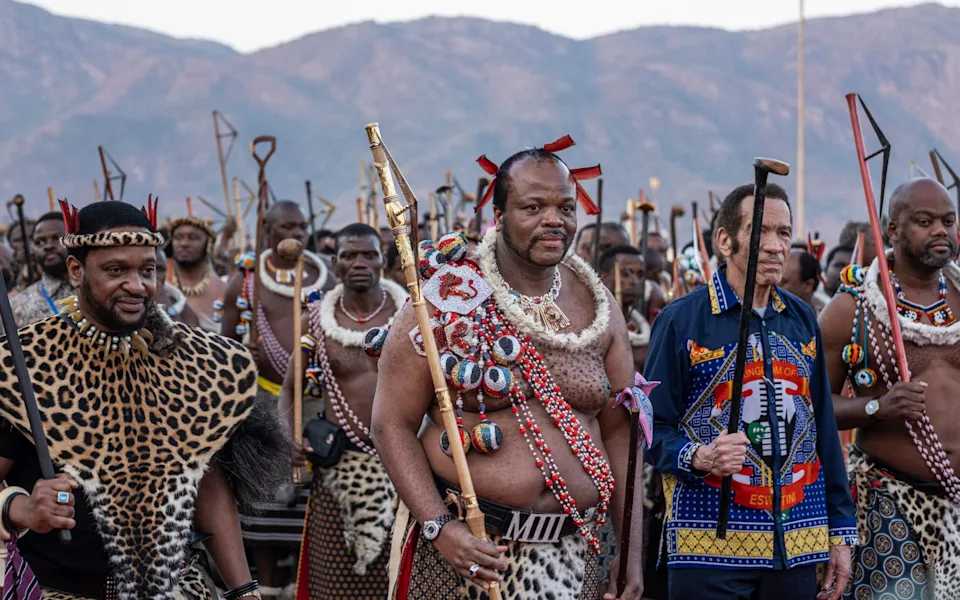
Eswatini, previously called Swaziland, is a country of about 1.2 million people between South Africa and Mozambique. It is one of the world’s last remaining absolute monarchies and the last in Africa. King Mswati III has ruled by decree since 1986. Political parties are effectively banned and pro-democracy groups have said for years that Mswati III has crushed political dissent, sometimes violently.
Pro-democracy protests erupted in Eswatini in 2021, when dozens were killed, allegedly by security forces. Eswatini authorities have been accused of conducting political assassinations of pro-democracy activists and imprisoning others.
As with South Sudan, rights groups criticized the Trump administration’s choice to send the deportees to Eswatini, given its record.
Amy Fischer, Amnesty International USA’s director of refugee and migrant rights, said the U.S. State Department’s own 2023 human rights report found credible accounts of unlawful or arbitrary killings by security forces in Eswatini, impunity for abuses, and harsh prison conditions.
“As a result, anyone returned to this country is at risk of serious human rights violations,” she said. “The cruelty is the point.”
US is seeking more deals
The Trump administration has said it is seeking more deals with African nations to take deportees from the United States. Leaders from some of the five West African nations who met last week with President Donald Trump at the White House said the issue of migration and their countries possibly taking deportees from the U.S. was discussed.
Some nations have pushed back. Nigeria, which wasn’t part of that White House summit, said it has rejected pressure from the U.S. to take deportees who are citizens of other countries.
Rwanda’s foreign minister told The Associated Press last month that talks were underway with the U.S.about a potential agreement to host deported migrants. A British government plan announced in 2022 to deport rejected asylum-seekers to Rwanda was ruled illegal by the U.K. Supreme Court last year.
The U.S. also has sent hundreds of Venezuelans and others to Costa Rica, El Salvador and Panama.
‘Not a dumping ground’
The eight men deported by the U.S. to war-torn South Sudan, where they arrived early this month, previously spent weeks at a U.S. military base in nearby Djibouti, located on the northeast border of Ethiopia, as the case over the legality of sending them there played out.
The South Sudanese government has not released details of its agreement with the U.S. to take deportees, nor has it said what will happen to the men. A prominent civil society leader there said South Sudan was “not a dumping ground for criminals.”
Analysts say some African nations might be willing to take third-country deportees in return for more favorable terms from the U.S. in negotiations over tariffs, foreign aid and investment, and restrictions on travel visas.
The Eswatini government said its arrangement with the U.S. posed no security threat to the people of Eswatini. “This exercise is the result of months of robust high-level engagements between the U.S. government and Eswatini,” it said.