



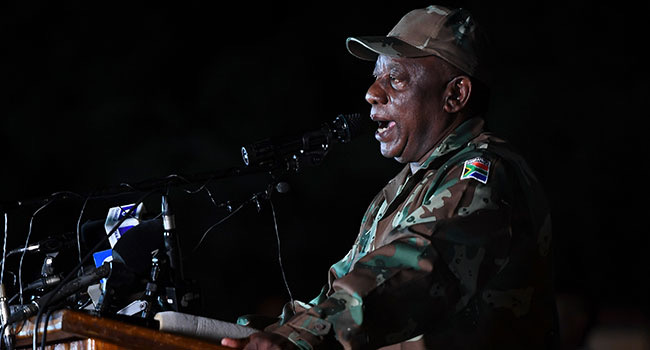
South African President Cyril Ramaphosa on Sunday delivered a nationally televised address from the Union Buildings in Pretoria, pledging decisive government action on illegal immigration while ordering citizens to stand down from vigilante enforcement as anti-foreigner protests continued to spread across Gauteng, KwaZulu-Natal and the Western Cape.
Ramaphosa convened the address, billed by the Presidency as a “family meeting,” under mounting pressure from anti-immigration movements including March and March, which has set 30 June 2026 as a deadline for undocumented foreign nationals to leave the country. The movement has warned of a national march if the government fails to respond to its demands before that date.
The address came days after Ramaphosa tabled the Presidency Budget Vote in Parliament, where he outlined a package of enforcement measures including increased workplace inspections, prosecution of employers who hire undocumented workers, stronger border security and action against corruption within immigration structures.
On Sunday evening, the president drew a firm constitutional line on the question of citizen enforcement. He stated that only authorised government officials are permitted to act against violations of immigration law, and that no private individual has the right to stop someone in the street to demand proof of identity.
“Only the authorised government officials may act against violations of the law, including violations of our immigration laws. No other person is allowed to confront someone in the street to demand proof of identity.”
Is the South African government doing enough to protect foreign nationals while addressing illegal immigration?
This poll has closed. Subscribe to view the results.
Ramaphosa acknowledged public frustration, conceding that the state had been slow to act and that gaps in enforcement had fuelled community anger. He insisted, however, that the rule of law could not be circumvented, and that recent violent incidents involving foreign nationals did not reflect government policy or the values of South Africans.
The president repeated his warning against xenophobia and vigilantism, framing illegal immigration as a challenge that required an African-led continental response rather than street-level enforcement. Speaking earlier in the week during a state visit by Kenyan President William Ruto, Ramaphosa argued that migration pressures were rooted in uneven economic development across the continent and called for deeper regional integration as a long-term solution.
Cabinet has approved a revised White Paper on Citizenship, Immigration and Refugee Protection, described by government as the most significant reform of the country’s immigration framework in a generation. The Department of Employment and Labour has also finalised a National Labour Migration Policy introducing maximum quotas for documented foreign workers, alongside an Employment Services Amendment Bill that would empower the Minister of Labour to set sector-specific employment caps for foreign nationals.
Several countries with significant national communities in South Africa, including Lesotho, Zimbabwe, Kenya and Malawi, have advised their citizens in the country to exercise caution amid the protests. Nigeria announced the repatriation of 130 nationals in response to earlier incidents, and both Nigeria and Ghana formally raised concerns with Pretoria.
The address is closely watched in Maseru. Tens of thousands of Basotho nationals live and work in South Africa, and the escalating protest environment has raised alarm among Lesotho’s diaspora community and the government alike.