

Mohahlaula Airlines
Wednesday, July 22, 2026
Home Blog Page 64

Focus turned to harnessing the demographic dividend for development in Lesotho 

0

Maseru

Under the theme “Harnessing the demographic dividend in Lesotho – youth inclusion factor” the Youth Dialogue Initiative (YDI) and UNESCO commemorated the International Youth Day with some of the youth representation and members of parliament in Maseru this Tuesday.

Mope Khati, a young member of parliament, shared the difficulties of being a young parliamentarian and the obstacles they face to bring about change. 

He expressed that Lesotho is currently in an era where it cannot afford to see the youth effecting change to change the scope of its development in all aspects, especially economically. 

“Many countries have turned around their economic statuses during the period when they had a demographic dividend, like we do in the country. This is a period where our population has a lot of young and energetic people. We therefore have to harness this and take advantage,” said Khati. 

As part of the organising committee, Tumelo Moteuli of the YDI expressed his disappointment to some of the expected guests, who he said had hoped that their presence would benefit the youth in different ways. 

He said one of the objectives of the summit was to enlighten the youth on the basic issues that affect them, which are discussed to effect change in their lives, including the breakdown of the lingo used in the parliament. 

He indicated that his belief is that Basotho youth will show more interest in issues that affect them once they are enlightened and understand clearly what is discussed.

“We hope to be part of the enforcers of seeing that the SDGs are met. We are the source of change; the better the production and development of the youth in the country, the better the development of the country. I had hoped to have some of the representations from some organisations and more members of the parliament in these deliberations,” Moteuli uttered.

“Due to unemployment, which is reigning in the country, a lot of young people tend to seek answers from the use of drugs or even resort to crime to make ends meet. However, this can be solved by clarifying to the youth that there are open platforms for them, which could help them be independent without waiting to be employed by the government, which a lot of young people have pinned their hopes on,” he added.

In the deliberations, Molefi Ntšonyane hammered and emphasised ways that the youth can tackle unemployment, which is at an alarming rate in Lesotho.

“We tend to complain about not seeing results from the government and those in leadership whereas there is such a low number of us that even vote to help effect who gets to sit in those seats of leadership,” Ntšonyane said, adding that these are the very people that hate politics, stripping themselves off their right to vote and be part of the change makers. 

A member of parliament, the Chair of Chairs and leader of the Education, Youth and Health Cluster Committee, Mokhothu Makhalanyane, quoted that studies reveal that 65 per cent of the African continent’s population is the youth. 

He said in Lesotho, the current studies found that 48.9 percent of the population of Basotho is the youth. 

“In this youth, 38 percent form the working class while 24 percent is unemployed. The youth need a mind-shift influence to make them aware that the change relies on them. The spirit of patriotism will help them be effective in making changes. We need more representation of the youth in parliament, if they appear in numbers, probably they will help pass bills that really speak for their interests rather than having them discussed and passed by those that are not of their class,” Makhalanyane said.

He expressed how impressed he was by the ideas he heard from young people in the country and their zeal to add value and help in the development of the country. 

“Some of the young people have shared their perspectives that they are hoping to see a Lesotho where the minister of youth is someone young, befitting by merit of age and leadership attributes. They said in the same ministry they hope to see the Principal Secretary as a young person who will have to leave office as soon as they exit the young class age,” he remarked.  
100 Basotho to be trained for airport jobs

0

Maseru

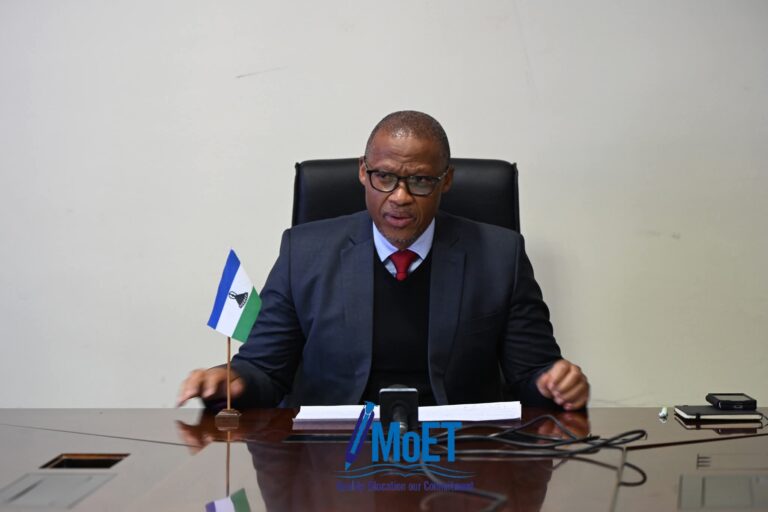
The Ministry of Education and Training (MOET) launched an online course for 100 Basotho men that will run for a month starting18 August. 

The training will be conducted by the ministry in partnership with Digital School and the Skilled Academics and Mohammed Bin Rashid Al Maktoum Global initiatives from the United Arab Emirates (UAE) and monitored by the Technical Vocational Education (TVD) department. 

“The training will offer four courses: Reception and Access Control Management, CCTV monitoring and Patrol duties, Incident reporting, crowd control, emergency response and fire safety,” Ntoi Rapapa, the Minister of MoET, announced.

He said they had prepared to undergo these courses with LOIKI, Thaba-Tseka Technical Institute, CCCC Leribe, and Ntlafatso located in Mohale’s Hoek. 

“After discussions and considerations, the first training phase will intake 100 trainees. The selected beneficiaries should have at least a COSC or LGCSE certificate and should be between the ages of 21 and 40. The purpose of the certificate stands as proof that there won’t be any language barrier as the courses will be delivered in English,” the minister said. 

He, however, noted that candidates don’t need to have passed this level of education, but the certificate will offer evidence that the candidate has sat for their examinations.

“Post negotiations, the first training cohort has been designated to be undergone by only males. Candidates should be no less than 173cm tall as per the requests by Mohammed Bin Rashid Al Maktoum Global Initiatives. The reason behind this, in their experience, is that places that offer jobs related to these courses like airports, tend to be highly strict with meeting height requirements,” Rapapa said, adding that the ministry will monitor performance and search for opportunities in and outside the country but within the SADC region. 

In the next cohort, the ministry is optimistic to include the lecturers of the four selected institutes to pass the skills to the learners.

To further improve the course, talks between the Ministry and the UAE to introduce 5 extra courses as time progresses are still ongoing, and the extension promises to include females as beneficiaries too.

These courses will also be availed for countries including Malawi, Zambia and Zimbabwe.  

High Court Delivers Stern Blow to GBV with Life Sentence for Triple Murderer

In a landmark judgment underscoring the judiciary’s firm stance against Gender-Based Violence (GBV), the High Court has sentenced Lehlohonolo Masoleng of Braamfontein, Mohale’s Hoek, to a lifetime in prison for the brutal murder of three women he lured through social media.

Masoleng, convicted on Monday, was found guilty of killing ‘Matšepo Likotsi, ‘Maletsema Foka and Kefuoe Moretlo (also known as ‘Matokelo Mahlo). The court heard how the victims, believing Masoleng to be a romantic partner, agreed to meet him in person after online interactions. 

In each case, he allegedly had sexual relations with the women before taking their lives in what the presiding judge described as “senseless and merciless killings.”

Delivering the sentence, Justice Tšeliso Mokoko did not mince words in expressing the judiciary’s resolve to protect women from violent partners and predatory men who exploit their vulnerability.

“The judiciary must safeguard the rights of women, particularly in situations involving intimate partners, whether they are husbands or lovers,” Justice Mokoko said. 

“To fulfil this protective role, the courts must impose stringent penalties on perpetrators.”

He stressed that such decisive action serves a dual purpose, punishing offenders while sending a resounding message to society that GBV will not be tolerated. The judge noted that public outrage over the rising tide of femicide and domestic violence has reached critical levels, making it imperative for the justice system to respond firmly.

According to Justice Mokoko, public places immense trust in the courts to address “reckless” acts of violence that rob families of mothers, daughters and sisters. He called these murders “a stain on our society” and emphasised the constitutional duty of the judiciary to shield women from harm.

Beyond punishment, the judge issued a sobering warning to women, particularly those active on social media platforms. He urged extreme caution when communicating with strangers online, noting that such spaces are increasingly being used by predators to identify and trap their victims.

“This case should be an eye-opener to women,” he said.

“Do not visit strangers who claim to love you on social media. By doing so, you may be putting your life in danger.”

The conviction and sentencing mark a significant moment in Lesotho’s fight against GBV which continues to claim the lives of women across the nation. Advocacy groups have long called for stronger legal consequences for offenders, arguing that only robust sentencing can deter would-be perpetrators.

As Masoleng begins his life term behind bars, the High Court’s judgment stands as both a punishment for his crimes and a stark warning to those who might contemplate similar acts. It is also a call for vigilance among women and a reminder that the battle against GBV is as much about societal awareness and prevention as it is about judicial action. 

In the words of Justice Mokoko, “The safety and dignity of women must never be negotiable. The courts will continue to stand firm in defence of that principle.”

NUL AND THE UNIVERSITY OF LIVERPOOL LAUNCH HISTORIC DEAL

0

Roma

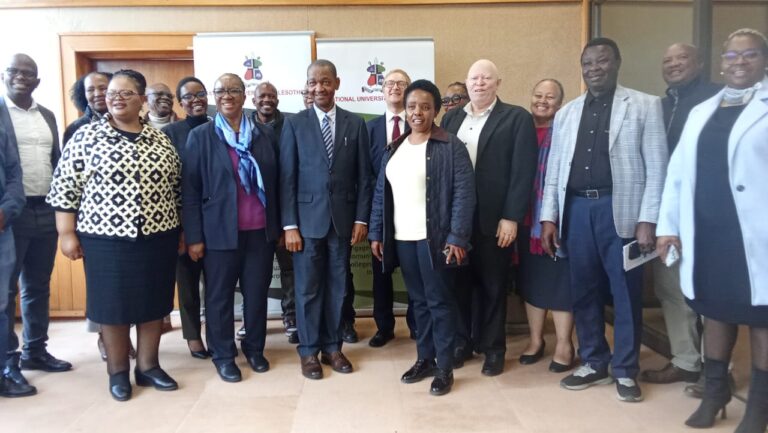
In a significant milestone for academic collaboration, the National University of Lesotho (NUL) and the University of Liverpool (UL) signed a memorandum of understanding to foster mutual academic and research cooperation between the two institutions this week.

This partnership is expected to open new avenues for joint research projects, academic exchanges and capacity building initiatives. Merging their resources and expertise, NUL and UL seek to enhance the quality of education and research in different industries. 

It also marks the start of a fruitful alliance that will interest students, university faculty members and researchers from both universities.

“Today we are here witnessing the signing of the MoU between the two institutions seperated by geography but combined by ambition, purpose and shared belief in transformative power in education,” the NUL Vice Chancellor, Professor Isaac Fajana, said in his remarks, adding that the agreement is far more than ink on paper but a bridge linking academic partnerships built on mutual respect.

“Through this collaboration, we envision joint research projects, faculty and students exchange, as well as shared curriculum”, VC Fajana continued.

He further acknowledged all the parties involved in the alliance, highlighting that their efforts are recognised. 

Deputy Vice Chancellor from the University of Liverpool, Professor Richard Black, expressed gratitude to the NUL team for the beautiful collaboration, saying they work with many universities globally and have several existing activities happening currently because they believe collaboration can help shape the world.

Mr Harry McDonald, the High Commissioner of the United Kingdom to Lesotho, added on to the conversation, saying the ceremony was an exciting experience for him, celebrating the alliance between the NUL and the UK, emphasising that it’s a championship alliance. 

“This partnership will be fruitful because of the people working on it,” he said with confidence, highlighting that this is the 4th agreement the NUL has signed with UK-based institutions in the past 3 years. 

He said they in the UK keep coming to forge partnerships with Lesotho because they believe in its future and it is a capable nation. 

“This partnership would not have been possible without the work and the drive of the team. And I wish the alliance of these two nations grow for the better,” McDonald exclaimed.

The NUL Librarian, Dr Buhle Mbambo-Thata also weighed in by thanking the NUL management team for allowing this collaboration. 

“We thank the vice chancellor and the marketing team for supporting this collaboration. This is going to help build good relations between the two institutions.” 

Professor Kananelo Mosito, the Pro Vice Chancellor of the NUL closed the ceremony by expressing gratitude to all and the attention granted. 

His words echoed pride and joy as he said, “This MoU is far more than a ceremonial act, it is a solemn affirmation of our shared vision, a vision that binds our two institutions in the noble pursuit of scholarships.”

 He said that while the day marked the official and formal signing of the partnership, the journey towards it began months ago when they had the honour of hosting guests from the University of Liverpool at the Roma campus. 

“Dialogues have just matured in partnerships. I’d also like to acknowledge the vital role played by the British High Commissioner; his commitments to fostering academic and cultural linkages between our two nations have been a fruitful element,” he said. 

The NUL was established in 1945 as Pius XII University College and was later renamed the National University of Lesotho in 1975. The University currently has 7 faculties and among its notable alumni is the university’s Chancellor, His Majesty King Letsie III.

LEC Board Makes U-Turn on Acting Allowances, Reverts to 10% Ahead of Fresh Bailout Request

0

MASERU – The Lesotho Electricity Company (LEC) board has reversed its stance on executive acting allowances, cutting them back to 10 percent just months after defending payouts totalling M2.1 million per month.

Acting CEO Ntsie Maphathe informed staff members of the decision earlier today, according to company insiders. The reversal comes as LEC prepares to approach Minister of Finance and Development Planning Dr Retselisitsoe Matlanyane for a fresh bailout estimated at over M200 million.

This will be the second state rescue for the financially crippled utility in under a year. In March 2025, LEC received approximately M300 million to import electricity and meet operating expenses after liabilities outstripped assets by nearly M100 million. In October 2024, Cabinet had been sharply divided over an earlier M700 million bailout proposal to settle debts with Eskom, Electricidade de Moçambique, LEGCO, and the Muela hydropower plant.

Contradicting Its Own Policy

The decision to previously ignore the 10 percent acting allowance cap has now drawn fresh attention to LEC’s own documented rules. A memorandum dated 29 October 2021, signed by then Managing Director Mohato Seleke, confirmed that the revised acting appointments policy approved by the board, was designed to limit acting positions to short-term measures and set compensation guidelines. That policy, effective from 1 November 2021, was meant to prevent long-standing acting appointments and control related costs.

Despite this, in May 2025 the board justified multimillion-maloti monthly payouts to acting and suspended executives by claiming the policy had not been formally adopted and that no minutes existed to validate it.

Salary Hike Amid Crisis

Adding fuel to public anger, less than two months before the latest bailout request, Maphathe issued a 23 June 2025 memorandum announcing a 3 percent salary increase for all staff. The increment, approved by the board, was staggered across pay grades to address salary disparities. While management thanked staff for their patience during negotiations, critics see the move as tone-deaf given the utility’s financial distress.

Mounting Pressure

LEC is still under a forensic investigation launched in March 2025, with several executives suspended as the Auditor-General and Public Accounts Committee probe procurement irregularities, unaccounted funds, and governance failures.

Independent business & current affairs journalism · Lesotho Subscribe — M85/month
| Independent business & current affairs journalism · Lesotho