

Mohahlaula Airlines
Wednesday, July 22, 2026
Home Blog Page 78

AG uncovers major financial discrepancies in Government accounts 

0

Maseru- In what has now become a norm with public finances, Mathabiso Makenete, the Auditor General (AG) of Lesotho, has issued an adverse opinion on the Consolidated Financial Statements of the Government for the fiscal year ending March 31, 2022. 

This audit, has highlighted significant discrepancies and mismanagement in public funds, raising serious concerns about the financial integrity and transparency of the government.

The adverse opinion is based on several critical findings. One of the most glaring issues is an unexplained difference of M5.3 billion between the cash balances in the bank accounts and the Consolidated Statement of Receipts and Payments. This discrepancy, although reduced from M6.2 billion in 2021, indicates persistent inconsistencies in financial reporting.

The AG’s report points out seven key areas contributing to the adverse opinion. Among these is a significant difference in reported cash receipts, where only 8 out of 27 revenue-collecting units had matching figures across the Consolidated Financial Statements (CFS), ministries’ financial statements, and the Integrated Financial Management Information System (IFMIS) ledger. 

The CFS showed a total of M17.326 billion, whereas ministries’ statements totalled M16.007 billion, and the IFMIS ledger reported M17.297 billion.

Non-cash assets also revealed substantial issues. The report noted that M415 million from previous years had not been cleared or disclosed in the current year’s accounts. Additionally, a misclassification of a M26 million advance for COVID-19 vaccines by the Ministry of Health further complicated financial transparency.

Pending litigation claims also presented inconsistencies. The CFS for 2021/22 listed claims totalling M492 million across seven ministries, a sharp increase from the M71 million reported in the previous year. This discrepancy raises questions about the accuracy and completeness of financial disclosures.

Accountability for expenditure remains a critical issue. The audit revealed that two ministries, Communications, Science, and Technology, and Home Affairs, exceeded their budgeted expenditures by M21.9 million and M2.9 million respectively, contravening legal requirements. Additionally, a capital expenditure bill amounting to M1.6 billion had not been enacted at the time of the audit.

Persistent issues from prior years continue to plague the financial statements. Notably, balances of below-the-line accounts since April 2009 have not been carried forward, resulting in misstated financial statements for thirteen years. Furthermore, a transfer of M450 million from the Trust Monies Account into the Consolidated Fund in 2017 remains regularized.

The management of public assets also came under scrutiny. The report highlights inadequate security in passport distribution, leading to losses amounting to M3.6 million due to mutilated passports. Additionally, many government ministries fail to maintain asset registers, leading to insufficient disclosures of government-owned assets.

Delays in public infrastructure projects due to institutional and regulatory issues have resulted in underutilization of funds and unmet project objectives. This inefficiency underscores the need for better project management and regulatory compliance.

The Auditor General commended her team and the Accounting Directorate for their efforts to improve the government’s accounting standards.
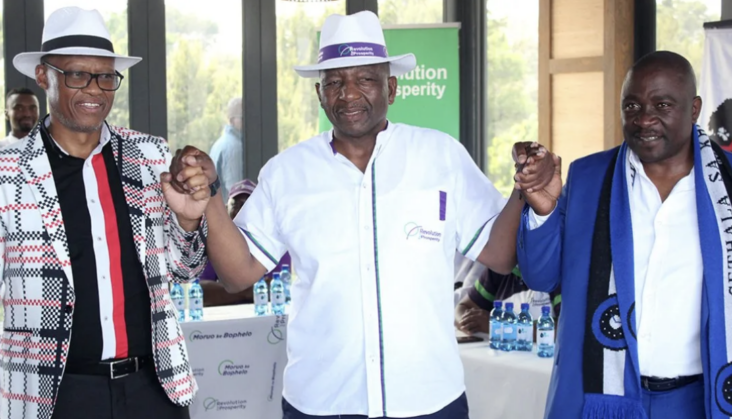
Minet Launches Annual Independence Marathon 

Maseru

Minet Lesotho has officially launched the annual Minet Independence Marathon, set to take place on October 5 this year in Thaba-Bosiu, Maseru. The event will occur a day after Lesotho celebrates its 58th independence anniversary, marking its liberation from Britain in 1966.

The marathon will feature race categories of 42km, 21km, 10km, and 5km, with the start and finish lines located at ‘Melesi Lodge in Thaba-Bosiu. While the prizes for each category will be disclosed on June 30, the event promises to cater to both elite and social runners, embracing participants of all races, ages, and genders.

Minet Lesotho’s Chief Financial and Operating Officer, Lehlomela Mokhati, highlighted the significance of the marathon during the launch. “We are thrilled to launch the Minet Independence Marathon, which is set to be an annual event,” Mokhati said. “This year’s event is unique, especially as we celebrate 200 years since the formation of the Basotho nation by King Moshoeshoe I in 1824.”

Mokhati encouraged both local and international participants to join this historic event, emphasizing Minet’s dedication to its corporate social responsibility pillars: education, health, and building sustainable communities. He explained that choosing Thaba-Bosiu for the marathon not only honors its iconic status but also aims to stimulate economic activity in the area, with local residents being hired for various roles such as car marshals.

The marathon, Mokhati added, will also aid local athletes in preparing for international competitions. “With a route meticulously crafted to showcase our country’s scenic beauty and cultural landmarks, participants can expect an unforgettable journey filled with exhilarating moments and cherished memories,” he said. “Join us as we embark on this epic journey of sweat, tears, and triumph at the Minet Independence Marathon. Together, let’s make history one step at a time.”

In addition to promoting physical activity, the event will offer health services such as TB and HIV testing, as well as blood donation opportunities.

Minet’s Executive Business Development Manager, ‘Mantai Moteka, expressed the company’s ambition to elevate the marathon to an international level, attracting athletes from around the world to experience Lesotho’s stunning landscapes and contribute to the country’s economy. “Under the theme ‘Selling Healthy Lifestyles,’ the Minet Independence Marathon intends to deliver an exhilarating blend of athleticism, camaraderie, and celebration,” Moteka said. “Whether you are a seasoned runner aiming for a personal best or a first-time participant embarking on a transformative journey, there is something for everyone at our marathon.”

The Minet Independence Marathon stands as a testament to Minet Lesotho’s commitment to promoting sports, health, and community development, creating a lasting legacy for future generations.

What a bad government we have!

0

The government of Prime Minister Sam Matekane is grappling with escalating famo gang violence that has left the nation reeling. 

The recent brutal murders in Fobane, where innocent lives, including that of a pregnant women and children, were tragically cut short, have ignited national outrage. Yet, the government’s response has been less about innovative solutions and more about invoking archaic, dictatorial laws which have no place in a democratic country like Lesotho.

Police minister Hon. Lebona Lephema’s decision to declare famo gangs as subversive and unlawful organizations marks a lazy turn in the government’s approach, perhaps summarising the current administration’s performance… The issuance of a gazette to outlaw these groups and the punitive measures against individuals associated with them has sparked significant backlash from society and opposition political parties.

Dr. Mahlape Morai, former acting Lesotho Mounted Police Services Commissioner, further inflamed the situation by threatening to arrest anyone playing famo music associated with banned gangs, including radio and TV presenters. Her assertion that listening to or promoting such music equates to supporting criminal organizations is a chilling echo of oppressive regimes where basic freedoms are curtailed under the guise of national security, a reason in the main why this administration shouldn’t be allowed to impose state of emergency.

“If you are promoting their music or encouraging it, know that it is a crime,” Dr. Morai declared. “Listening to a song purely translates into supporting it. By listening to that song I am supporting [it], and that is a crime.”

This heavy-handed approach is not just limited to music. Journalists, tasked with informing the public, now face the threat of arrest for sourcing news from banned gang members. “When they come back and tell the public about it, they are committing a crime,” Dr. Morai warned, implying that any dissemination of such information could be deemed criminal.

The Matekane administration’s contemplation of declaring a state of emergency further exacerbates fears of authoritarian rule. 

Opposition parties vehemently opposed this move, arguing that it would lead to a significant erosion of civil liberties. The prospect of security agencies, already accused of harassment, gaining broader powers under a state of emergency is a terrifying thought for many.

The invocation of Section 10 of the Internal Security Act, No. 24 of 1984, to ban famo gangs reflects a reliance on outdated and repressive laws. While the Act allows the Minister to declare any organization unlawful if deemed subversive, it also opens the door to broad and unchecked governmental powers. The declaration makes it a criminal offense to support, promote, or associate with these organizations in any capacity.

Thomas Hobbes’ social contract theory, where people surrendered some freedoms for state protection, is being twisted to justify these draconian measures. The Constitution of Lesotho, which guarantees freedoms of expression, peaceful assembly, and association, is under siege. Matekane’s government undermines Lesotho’s constitution, it appears that it is more intent on exerting control than addressing the root causes of gang violence.

The real issue lies in the deep-seated socio-economic factors fueling the rise of these gangs. Poverty, unemployment, and lack of opportunities drive individuals towards gang affiliation. Banning famo music or threatening journalists does nothing to address these underlying issues. Leader of Basotho National Party, Hon. Machesetsa Mofomobe rightly argue for a broader approach that tackles poverty and provides viable alternatives.

The recent parliamentary debate over the proposed state of emergency revealed stark divisions. While the government insists on its necessity to curb violence, the opposition fears the encroachment on fundamental freedoms. The skepticism is not unfounded; stories of security forces overstepping their bounds, such as the army raiding a funeral on reports of illegal firearms, paint a grim picture of what might come under a state of emergency.

Prime Minister Matekane’s government must find a balance between enforcing security and respecting civil liberties. His campaign promise to crack down on gang violence now rings hollow as his administration resorts to oppressive tactics. The villagers, who have long suffered from gang violence, deserve a government that addresses their plight without resorting to dictatorial measures.

In seeking to enforce security, Matekane risks alienating the very people he seeks to protect. Giving the army and other security agencies unlimited powers is not the answer. Instead, the government must engage with dissenting voices, explore comprehensive solutions, and uphold the constitutional rights of its citizens. Only then can Lesotho hope to overcome the scourge of gang violence without sacrificing its democratic principles.

Gem Diamonds To Be De-Registered For Breaching Lesotho Mining & Minerals Act?

Maseru – Yearn for Economic Sustainability (YES) expressed its grievances after they engaged the committee of natural resources as well as the Ministry of Natural Resources to intervene in a matter they believed had to be dealt with promptly. 

They have since resorted to writing to the Right Honorable Kime Badenoch who is the Secretary of State for Business and Trade (UK) to intercede because neither the committee assigned, nor the Ministry is acting accordingly.

Background history states that, “in 2005 the government of the Kingdom of Lesotho and Gem Diamond Limited established a joint venture called Letšeng Diamond (Pty) Ltd, where Gem Diamonds Limited has 70% shares and The Government of the Kingdom of Lesotho on behalf of Basotho has 30%…” This mining agreement was reached in terms of Section 44 of the Mines and Minerals Act, 2005. 

Lioli FC Clinches 2023/24 Vodacom Premier League Title in A Thrilling League Finale

Berea – In a showdown at Lioli Football Grounds (TY), Lioli FC emerged victorious, clinching the 2023/24 Vodacom Premier League title in a nail-biting match against rivals Matlama FC. The highly anticipated league title decider saw Lioli FC, leading the standings with 67 points, fend off a fierce challenge from Matlama FC, who were just two points behind at 65.

The match began with both teams displaying defensive prowess, leading to a goalless first half. Tensions were high as fans eagerly awaited a breakthrough. The turning point came in the second half when Sehlo Maso, wearing the number 6 jersey for Lioli, scored a crucial goal that sent the home crowd into a frenzy as they could sense victory within reach.

The atmosphere was electric as Lioli fans celebrated what they hoped would be the decisive moment.

However, the drama was far from over. As the clock ticked towards the end of the game, Matlama’s Jane managed to equalize, reigniting hopes for the trailing team. Despite this late comeback, Matlama’s efforts fell short of securing the points needed to overtake Lioli FC in the standings.

As the final whistle blew, Lioli FC held their own, finishing the season with 68 points, while Matlama FC ended with 66 points. The victory marked a triumphant end to the season for Lioli FC, while Matlama FC, despite being favorites to win, left the grounds with heavy hearts.

The celebration was capped off by a generous gesture from the Minister of Local Government, Home Affairs, and Police, Honourable Lebona Lephema, who awarded M150,000 to the Lioli players. As TY’s political candidate, Lephema’s support added an extra layer of joy to the team’s triumph.

Lioli FC’s victory in the 2023/24 Vodacom Premier League will be remembered as a testament to their resilience and determination, last season’s end, Lioli was 8th on the table, and this year they are champions, bringing immense pride to their supporters and securing their place as one of Lesotho’s greatest teams.

Correctional Service Commissioner admits warders brutally torture inmates

0

MASERU

The Commission of Inquiry began hearing testimonies at Maseru Central Prison on Monday morning. The Commission whose mandate is to investigate the conditions that led to the escape and ill treatment of inmates during the search operation at Central Prison in December last year is chaired by Justice Realeboha Mathaba.

Minister of Justice, Richard Ramoeletsi who testified told the commission that the video footage displaying the incidents of December 21 and 22 indicate that inmates were tortured motiveless. He further said the conditions in most of Lesotho’s prisons are merciless and inhabitable.

He mentioned that most prisons are congested due to the slow pace of justice. An example is the Maseru prison that has 679 inmates, of which 21% are imprisoned and 7% are awaiting trial. Ramoeletsi told the commission that 114 LCS recruits were unleashed on the inmates “with an instruction to probably inflict pain on inmates.”

Correctional Services Commissioner, Mating Nkakala, in his testimony, shocked everyone admitting that warders sometimes brutally torture inmates for breaking rules. Nkakala said torture is a custom in prison regardless of the fact that he had issued a circular in November 2023 banning it. He admitted that women prisoners are not exceptional.

He stated, that lately he has received worrying reports from Mokhotlong and Maseru Correctional facilities of inmates who are usually abused by the warders who are supposed to take care of them. He said 15 warders were disciplined and seven laid off for beat up inmates in 2023. Nkakala said inmates are brutally assaulted for crimes such as smuggling dagga and cigarettes they get from visitors or illegal imports from warders they receive as gifts.

Nkakala said some inmates staying at the LCS’ farm in Lepereng were brutality battered on 18th December 2023. He said he only learnt about the beating two weeks later, as officers hid it from him. He said his Deputy Matingoe Phamotse told him that there was a raid conducted by recruits at Lepereng who found a lot of smuggled goods. He said prisoners had political party t-shirts. Nkakala said anything bearing emblems of a political party is not allowed.

He said his officers never told him the truth about the beating of the inmates. In regard to prisoners that absconded last year, Nkakala said Deputy Commissioner Mosheoane Tšolo told him that six inmates had run-away. He said he instantly reported the matter to the Minister of Justice Richard Ramoeletsi.

Nkakala said Tšolo told him that two inmates, Makhikila Tlali  and Aumane Nkoale were found next to the Police Training College and he was shown the two back in custody. He said Seboka Motumi and Bokang Tsoako were later arrested and Tsoako was killed later. Nkakala said, “I was told that Tsoako was assaulted.” He said he instantly ordered the station commander to take Tsoako to a health facility.

Nkakala said Tsoako had numerous wounds all over his body and his feet were bleeding feet. He said an explanation he received was that Tsoako was hiding in a ceiling which collapsed due to his weight and he sustained those injuries when he fell.

Nkakala said a day after the escape he received a report that inmates were brutally assaulted and upon his arrival he found 47 inmates critically injured. Justice Mathaba questioned Nkakala over lack of strategic plan for the LCS.  He said Lesotho Correctional Services Act dictates the commissioner to draft policies for the organisation. Nkakala defended himself by saying they were at the verge of engaging a consultant to help draw up strategies for the LCS.

Justice Mathaba said, “Normally consultants do not do everything, they just facilitate, meaning you have to have a vision as a leader.” When asked about the period in which the facility has been operating without strategic plan, Nkakala said the last time it was done was in 2010.

Justice Mathaba asked Nkakala if he had received any training  before getting into high office but Nkakala said in as much as it is their desire for every officer to get training and attend workshops on their elevation to the next rank, due to budget restrictions they are not able to get such training.

Justice Mathaba said most of problems Nkakala had mentioned show that there is no co-operation and there is lack of leadership. Nkakala admitted that there are separations among the staff and some support him while some do not.

Technical Assistance Program Launched

MASERU

Friday 17 May 2024 marked a noteworthy day where the Central Bank of Lesotho (CBL) and its Strategic Partners officially launched a Technical Assistance Program. The event took place at the Lehakoe Recreation and Cultural Centre. The strategic partners that funded and supported the project were the World Bank and European Union respectively. This development’s main objective is to improve the country’s financial sector.

The Governor of the Central Bank of Lesotho, Dr Emmanuel M Letete expressed that this partnership comes at a time when the country is in a crisis for jobs and a better quality of life in general. The financial sector is put in place to benefit the Basotho. The World Bank and European Union came together to bring to fruition a vision of a more resilient and stable financial sector. The outcomes of this vision include inclusive growth and financial sector inclusion. He said that the products of the financial sector should be utilized for the betterment of the country’s state. He also added that it is highly imperative to develop a strategy and ensure that it works. Inclusion is chief and strides have been made however, it seems that they are not enough because not everyone is included especially women.

The collaboration will also assist in improving the payment system and provide meaningful and visual progress. Dr. Letete challenged everyone to reverse the adverse situation and motivated the serving of people. He said he believes that the partnership will go a long way and that 3 or 4 years down the line much difference will be noticeable, and all these can be achieved if we work together. Be that as it may, he did note that some of the challenges that have been met are cyber incidences, but he said that it is these challenges that strengthen and create a very resilient society.

Her Excellency Mrs Paola Amadei who is the Ambassador of the European Union in Lesotho said that in Lesotho, as in many counties, reliable and effective financial systems are a basic prerequisite of having a dynamic private sector that can thrive and create decent jobs. Coming together not only mitigates risks but can also unlock potential for innovation, resilience, and sustainable development. The European Union injected M6,000,000 which is expected to assist in enhancing key areas such as Financial Sector Development Strategy (FSDS), Policy and regulatory reforms, increasing Electronic Payment Acceptance (EPA) and strengthening Credit Reporting System (CRS). Currently, there is a technical assistant embedded in the Ministry and supporting it with public finance management reforms. The technical assistance that the Central Bank of Lesotho will benefit from this collaboration is the Rapid Response Window for Investments and Business Environment facility.

To the persisting challenges faced by the financial sector in the country, they will be alleviated in the following ways:

– Advancing and finalizing the development of Lesotho’s Financial Sector Development Strategy (FSDS) and setting high level outcome targets in key financial sector domains

– Identifying and prioritizing set of legal, policy and regulatory reforms to be implemented during the strategy’s implementation period.

– Increasing Electronic Payment Acceptance (EPA) both from the demand-side (consumers and merchants) and the supply side (payment of service providers).

– Strengthening Credit Reporting System (CRS) to also complement the activities financed by the CAFI project and engaging in a policy dialogue with the authorities on the validity and feasibility of the policy, institutional and infrastructure reforms recommended by the initial assessments.

Remarks made by a representative from the World Bank cited that the partnership allows the World Bank to aid the Central Bank of Lesotho and the Ministry. He said that as much as the strategy is a good one, but it will, just like any other have its own distinct challenges along the way. Data from 1995-2015 indicates that financial sector strategies help improve financial sector inclusion and stability. He advised that Lesotho’s financial sector should integrate multiple sub-sector strategies that are under development such as the financial inclusion strategy, financial education strategy and payment system strategy. With this program, the World Bank will also be permitted to undertake an electronic payment assessment.

The keynote address was delivered by Hon. Rets’elisitsoe Matlanyane who is the Minister of Finance and Development Planning who thanked the pioneers of this grand initiative. She commented that there is a need to consolidate so that efforts that are supported are not duplicated so that costs and time spent doing similar things is saved because not doing so hinders development. She said the government of Lesotho is committed to the development of this country. Furthermore, she said that the partnerships such as these should be done in an effective manner because not much is achieved when operation is done in silos. The financial sector is key and strategic as well as a basic requirement to a country’s development.

Hon. Matlanyane further stated that we live in a challenging landscape with a series of unprecedented shocks which have caused a bit of a drag when it comes to recovery. She said that she will always advocate for financial intermediation, and she strongly believes that Electronic Payment Infrastructure is essential as it will assist in the delivery of services more efficiently. She says that the ‘manual’ means of collecting money which ultimately puts people at the risk of handling cash must be done away with because most times that money does not end up where it is supposed to. Much more revenue can be collected if digital platforms are used. Finally, transactions should be done through systems where they are traceable and auditable.

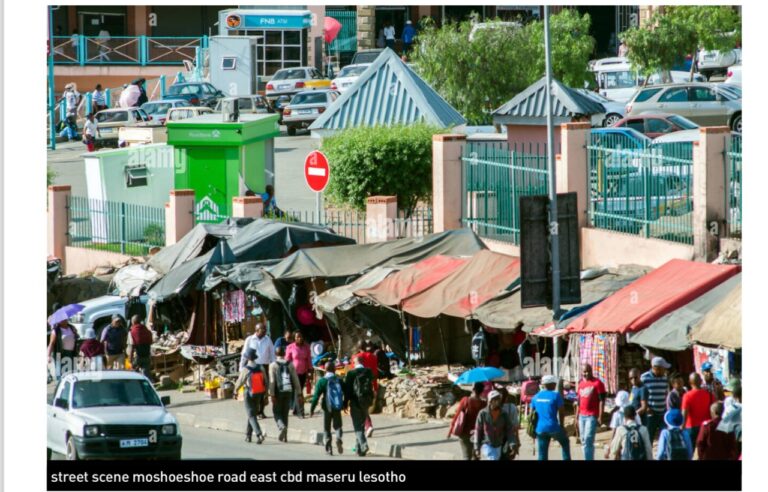
Street Vendors Evicted as Road Directorate Clears Moshoeshoe Road for Development

Maseru- Street vendors working along Moshoeshoe road, found their shacks removed and some stock taken away by Maseru city council (MCC) authorities and Roads Directorate on Wednesday15th of May,on the same day MCC released a press release, affirming that they have between 6000 and 7000 street vendors who are legalized to work inside different spaces in Maseru town.

Vendors have temporary permits; this means MCC can remove them anytime when there are infrastructure developments. Developments can affect vendors in different ways; they might find themselves permanently moved from their working spaces.

Road Directorate had negotiations with MCC and different street vendor’s organizations, and they came to agreement that vendors should evict Moshoeshoe Road by 5th May 2024. According to MCC 180 street vendors will be affected by the development, however only 122 vendors have permits.

MCC has given vendors without permits a chance to follow right procedures to apply for permits until 15 June 2024.

“Street vendors who are affected should be aware that after the development this places Local Market, litopong tsa Metro, Thibella and Lepoqong will be open for the public.” MCC said.

Olympic zone Committee spokesperson Marets’epile Letsie noted that they were given a notice on Monday 13thMay to evict Moshoeshoe Road and vendors will be given transport to take their shacks to their respective homes, despite that they are not happy with their eviction because they do not want to go home but they need to work for their families.

“We were given a notice on Monday, but we feel betrayed by MCC because we have a case against them at court, MCC was supposed to wait for court to make judgment. They cannot evict us here without placing us somewhere where we can make money. It is tough for us out here. Yes they have given us transport to take our shacks home, but it does not make sense, since most of us are from rural areas.  We tried making strike but police threatened us. We have written countless letters to Prime Minister asking for help, however none of those letters have been answered, all we want is employment.” Letsie noted.

Almost every corner of Maseru has street vendors, this has made Maseru look like the most undeveloped town.

ReNOKA-LEGCO partnership to boost green growth

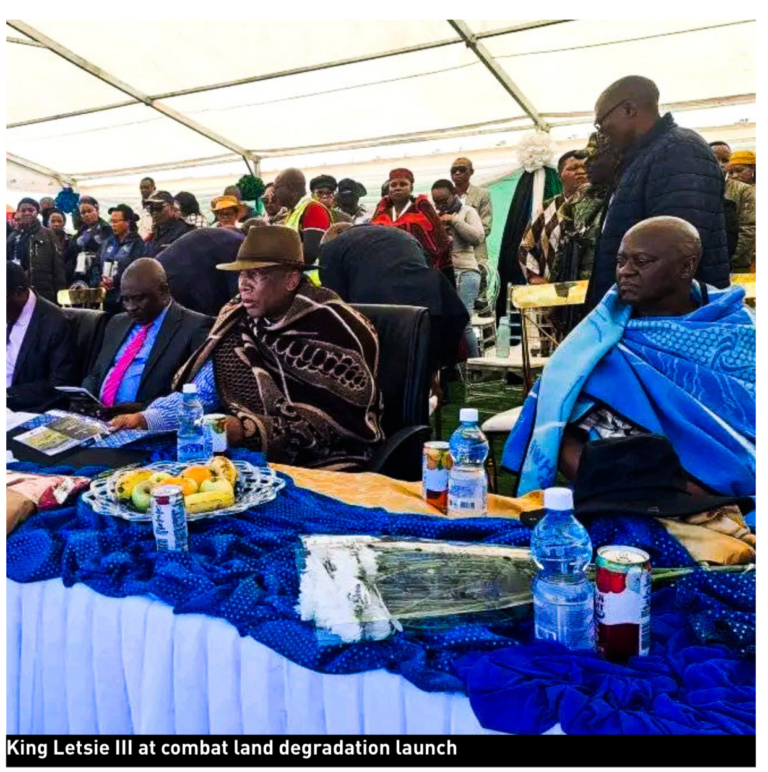
Ha – Ramathole – In a move to combat severe land degradation and safeguard vital infrastructure, the Kingdom of Lesotho has inaugurated a landmark partnership aimed at enhancing the resilience of the Ha Ramarothole Solar Power Plant through integrated catchment management (ICM). The partnership, forged between ReNOKA, the Lesotho Electricity Generation Company (LEGCO), and international partners, underscores a robust strategy to secure the nation’s land and water resources while bolstering renewable energy output, at Mafeteng on Thursday morning.

His Majesty King Letsie III officially launched the partnership today, highlighting the urgent need to address environmental degradation threatening the country’s ecological balance and economic stability.

“We live in times where weather patterns as we have known them have been affected by climate change. It is often that developing countries are more heavily impacted by the changing climate than developed countries. Therefore, it gives me great pleasure to witness partnerships such as the one we are launching today which strive towards increasing climate resilience of our land, people, and public infrastructure while at the same time produce clean energy,” remarked the His Majesty King III.

Lesotho, often referred to as the water tower of Southern Africa due to its abundant water resources, is facing severe land degradation. This degradation not only threatens the ecosystem but also the livelihoods of communities reliant on these environmental resources. To address this, ReNOKA, supported by the European Union and the German Government through the Deutsche Gesellschaft für Internationale Zusammenarbeit (GIZ) GmbH, has embarked on a phased approach to rehabilitate Lesotho’s catchments.

The partnership with LEGCO is a crucial step in this endeavour. The Ha Ramarothole Solar Power Plant, an 80MW solar photovoltaic project, plays a key role in Lesotho’s renewable energy strategy, feeding into the national grid to increase energy security and reduce dependency on imports. However, the plant is threatened by significant erosion, characterized by gullies that compromise its infrastructure. The erosion has damaged the boundary fence and the foundations of several solar panels, prompting LEGCO to seek ReNOKA’s expertise in watershed rehabilitation.

Fabian Kyrieis, Germany’s head of cooperation, highlighted the broader implications of the project, saying, “Regionally, ReNOKA is a flagship initiative for a comprehensive Integrated Catchment Management approach that combines the restoration of land and water resources, the protection of the most vital ecosystems, and the empowerment of local communities and national institutions. It aims for a coherent ICM Governance approach that overcomes silos and embraces multi-stakeholder partnerships like the one we are launching today.”

The implementation of ICM measures at the solar plant began in December 2023, funded by the Government of Lesotho and supported technically by the Ministry of Environment and Forestry. These measures aim to mitigate erosion by reducing the quantity and velocity of water flowing from the mountains, a significant contributor to gully formation around the plant. ReNOKA plans to establish new ICM institutions within the sub-catchment to involve local communities in planning and implementing sustainable land management practices.

EU Ambassador H.E. Paola Amadei emphasized the significance of data-driven insights in these efforts.

“The Atlas is the result of a collaborative effort between ReNOKA and the Food and Agriculture Organisation (FAO). The Atlas will provide extensive data for policy-makers, as well as for researchers and academic institutions,” she said. “As we embark on this journey, fueled by data-driven insights and collective determination, let us reaffirm our commitment to safeguarding Lesotho’s natural resources for future generations,” said Amadei.

This partnership not only protects the solar power plant but also enhances Lesotho’s ability to become an exporter of renewable energy, promoting green and resilient growth. The initiative aligns with the Government of Lesotho’s National Strategic Development Plan II (NSDP II) and demonstrates the tangible connections between the EU’s ‘Renewable Lesotho’ and ‘Metsi a Lesotho’  programs, which aim to harness the country’s renewable energy potential and improve water security for rural communities, respectively.

Over the past three years, ReNOKA has made significant strides, rehabilitating more than 565 hectares of watersheds, establishing over 300 ICM community structures, and mobilizing over 3,800 community members.

“For infrastructure projects to last – especially in the view of climate change – it is important to take environmental factors in their planning, construction, and management into account and to increase their resilience against climate and environmental risks through preventative and adaptive measures,” stated Kyrieis.

The Ha Ramarothole initiative marks a critical step towards ensuring that Lesotho’s natural resources are managed sustainably, fostering a resilient and prosperous future for the Basotho people.

Independent business & current affairs journalism · Lesotho Subscribe — M85/month
| Independent business & current affairs journalism · Lesotho