


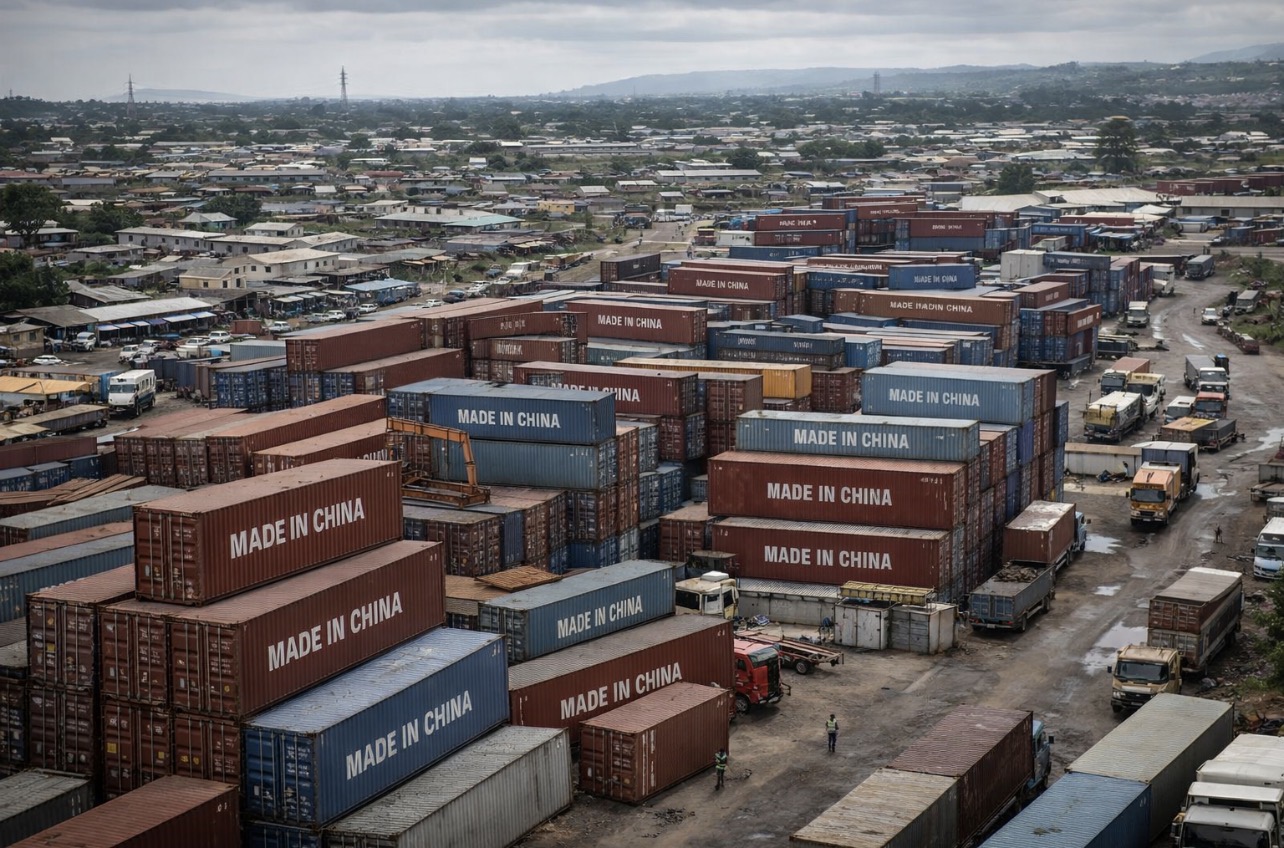
For years, African policymakers have been told that China represents opportunity. Infrastructure, trade, South South cooperation, an alternative to Western conditionality. That narrative is now collapsing under the weight of hard numbers. For countries like Lesotho, China is not merely an imperfect partner. It is a structural problem.
The problem is not ideology. It is economics.
China’s global trade strategy is built around export dominance, domestic market protection, and selective import dependence limited largely to raw materials. That model is devastating for small developing economies that lack scale, bargaining power, or diversified export baskets. Lesotho fits that description almost perfectly.
China Buys Almost Nothing from Lesotho
Start with a simple but uncomfortable fact. China does not buy meaningful value added goods from Lesotho. It never has.
Lesotho’s exports to China are narrow and shallow. Wool, a small volume of diamonds, and a handful of low value electrical components dominate the trade data. In total value terms, Lesotho exports tens of millions of dollars to China annually. In contrast, imports from China into Lesotho span machinery, electronics, vehicles, textiles, household goods, and industrial inputs.
This is not trade partnership. It is asymmetry.
China’s import appetite is structurally constrained. Beijing has spent the past decade pursuing self sufficiency in high value manufacturing while aggressively expanding export capacity. The result is a record global trade surplus exceeding one trillion dollars. That surplus exists because China produces far more than it consumes and because it has little incentive to open its domestic market to foreign manufactured goods, especially from small economies.
Except for raw materials, China buys almost nothing from Africa. Lesotho is no exception.
Market Access Is a Myth
Defenders of China often argue that African producers simply lack competitiveness. That explanation ignores China’s deliberate market architecture.
China protects its domestic market through regulatory barriers, standards regimes, state subsidies, and industrial policy that favors national champions. These are not accidental outcomes. They are policy choices.
For a country like Lesotho, which struggles to access even regional markets, penetrating the Chinese consumer or industrial supply chain is effectively impossible. This is why Lesotho’s export relationship with China has not evolved beyond commodities despite years of diplomatic engagement.
Trade without access is not trade. It is dependency.
Dumping and the Destruction of Local Industry
China’s export model relies on scale, cost suppression, and state backed manufacturing ecosystems. When surplus goods flood developing markets, local producers cannot compete.
South Africa is already responding by considering antidumping duties on Chinese and Indian vehicles after imports surged by hundreds of percent while local production stagnated. If South Africa, with its industrial depth, is under threat, smaller economies like Lesotho do not stand a chance.
Cheap imports may benefit consumers in the short term, but they hollow out domestic industry. Once local manufacturing collapses, jobs disappear, skills erode, and economies become permanently import dependent.
This phenomenon has a name in economics. Premature deindustrialisation.
Africa has experienced it before. China is accelerating it.
Botswana, Diamonds, and the Synthetic Shock
The damage is not limited to manufacturing. Botswana’s diamond industry is under severe pressure, not only from cyclical downturns but from structural shifts in global demand.
China is one of the world’s largest producers and consumers of synthetic diamonds. These lab grown stones are cheaper, scalable, and increasingly accepted by consumers. As synthetic supply expands, natural diamond prices weaken.
Botswana’s fiscal stability is tied to diamonds. Lesotho’s diamond sector, smaller but still significant, faces the same threat. This is not a coincidence. It is the downstream effect of China’s industrial strategy.
China manufactures the substitute. China consumes it. African producers absorb the loss.
The Illusion of Infrastructure for Trade
Supporters of China often point to roads, buildings, and projects. Infrastructure matters, but infrastructure without industrial development is a dead end.
What is the point of better roads if they only carry imported goods inland? What is the value of industrial parks if local firms cannot compete against subsidised imports?
Trade policy cannot be separated from production. China understands this. Africa has been slower to learn.
Why the West Now Makes Economic Sense Again
This is not a call for nostalgia or blind alignment. It is a strategic reassessment.
Western markets, for all their flaws, remain more open to value added imports from developing economies. They offer clearer rules, deeper consumer markets, and greater scope for integration into global value chains.
Lesotho’s textile exports to the United States under AGOA demonstrate this reality. When access exists, production follows.
China offers scale without access. The West offers access with conditions. From an economic development perspective, access matters more.
A Strategic Imperative for Lesotho
Lesotho cannot afford sentimental geopolitics. It must pursue hard headed economic realism.
Diversify trade partners. Reduce exposure to dumping. Protect fragile domestic sectors. Push value addition relentlessly. Prioritise markets that buy more than raw materials.
China is not an enemy. But it is not a development partner either.
It is a competitor with overwhelming scale, a closed domestic market, and a trade model that structurally disadvantages small economies.
Pretending otherwise is no longer intellectually honest. Or economically sustainable.