



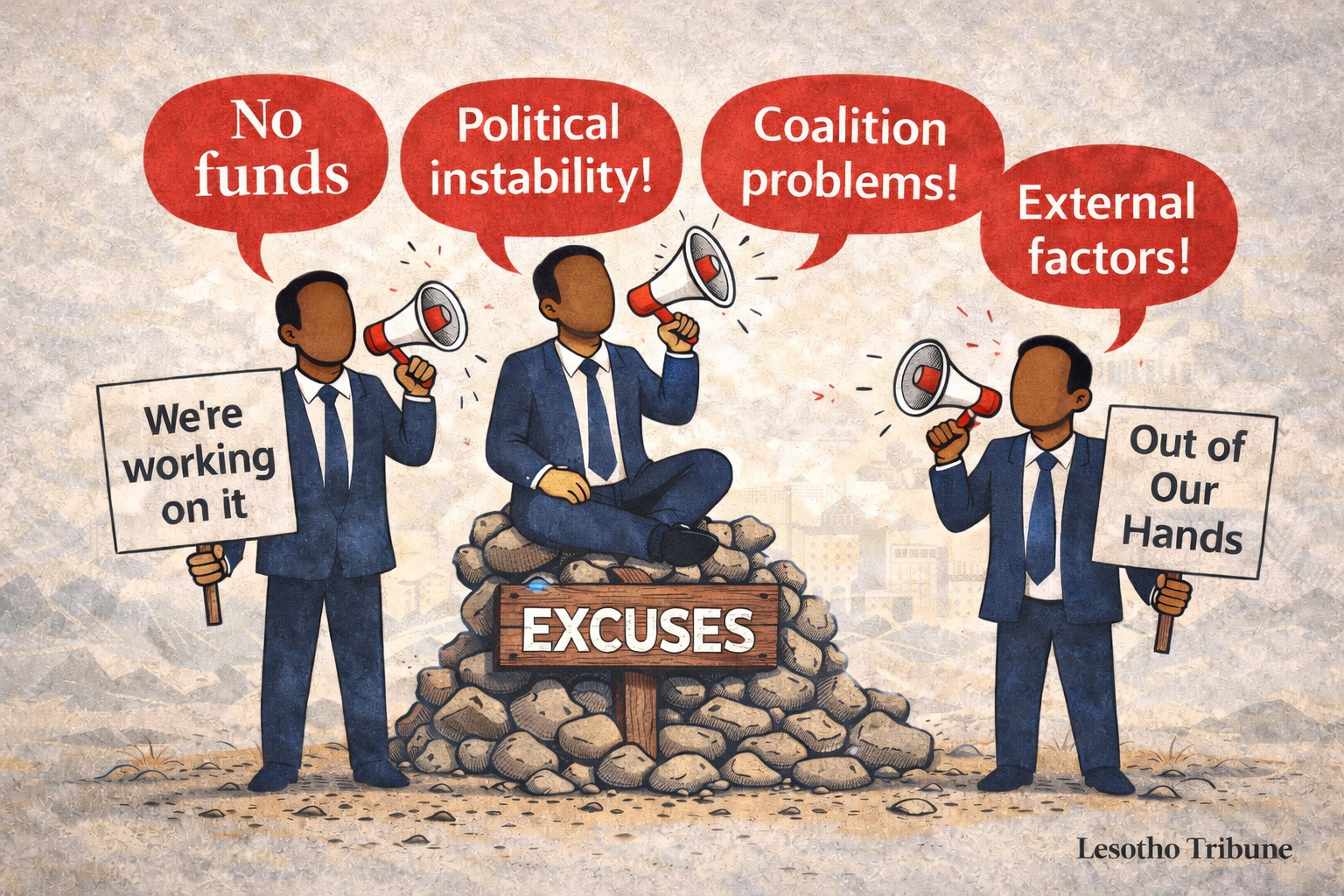
There is a quiet envy creeping into conversations across Lesotho. Not the loud, resentful kind, but the uncomfortable kind that comes from watching peers move on while you remain stuck explaining why tomorrow never quite arrives.
Across Africa in 2025, several countries have begun telling stories that sound suspiciously like progress. Not perfection. Not miracles. Just movement.
Zimbabwe, of all places, posted a 9.64 percent economic growth rate in the third quarter of 2025, according to figures reported by Lesotho Tribune.
That number alone should make us pause. Zimbabwe has spent years as a regional warning sign, invoked whenever African economies were discussed in the past tense. Yet here it is, growing faster than many of its neighbours, including Lesotho.
The reasons are not mysterious. Even the World Bank attributes Zimbabwe’s rebound to targeted regulatory reforms, recovery in agriculture and mining, and deliberate efforts to make the business environment workable, not perfect, just workable.
Elsewhere, Rwanda continues to post strong growth, anchored in an approach that emphasises measurement and implementation. The National Institute of Statistics of Rwanda’s GDP publications reflect an economy that is still expanding at a pace many countries would envy.
Kenya, for all its political noise, continues to signal intent through growth expectations and financing. Reuters reported that Kenya expects faster growth in 2025 and signed a yen-denominated loan with Japan, a reminder that some governments keep pushing the machinery of development even while arguing loudly on the surface.
This is not to romanticise these countries. Each has deep problems. But they share something Lesotho increasingly lacks. Momentum.
Back home, the numbers tell a far less flattering story. Growth projections hover around one percent, sometimes dipping below. That is not a temporary slowdown. It is stagnation with a calendar.
Lesotho is not short of plans. It is not short of strategies, policy documents, or vision statements. What it is short of is leadership capacity that can convert intent into execution. The ability to decide, implement, and stay the course even when it is politically inconvenient.
Here, development conversations tend to stall at blame. Coalition politics. External shocks. South Africa. Global uncertainty. All valid factors. But none sufficient to explain why year after year, nothing really moves.
Countries that are now growing did not escape constraints. They worked around them. They simplified rules. They picked sectors. They sent signals to investors that the state might be imperfect, but it was at least predictable.
In Lesotho, predictability has become a luxury. Policy reversals are common. Appointments raise more questions than confidence. Institutions limp instead of lead. And corruption, as recent public polling suggests, is increasingly seen not as a side problem, but as the root of everything else.
This is where the envy becomes sharper.
Young Basotho watch peers in Kigali, Nairobi, even Harare, finding work, starting firms, exporting services. Meanwhile, here, the most reliable growth sector seems to be excuses.
It would be unfair to say Lesotho has no capable people. It has many. What it lacks is leadership that treats development as an urgent, measurable task rather than a slogan recycled every election cycle.
Development is not mystical. It is boring, repetitive, and unforgiving. It rewards consistency. It punishes drift.
Other African countries, even those with heavier baggage than ours, have accepted this reality. Lesotho, for now, seems content to debate it.
And that may be the most worrying signal of all.