

An editorial inspired by reflections shared by Joang Molapo
In moments of global crisis, the temptation is always to reduce complex history into simple loyalties. Countries are sorted into sides. Narratives become slogans. Those who disagree are dismissed as sympathisers of one camp or another.
Yet sometimes a quiet reflection from an experienced observer forces us to pause and think a little deeper.
Former minister Joang Molapo recently shared a personal story recalling how his father, Lesotho’s first ambassador to the Middle East, was posted to Tehran in 1974. At the time, the decision might have puzzled some. Why would a small African kingdom establish an embassy in Iran rather than in Saudi Arabia, the largest oil producer in the world?
The answer, as Molapo recounts, lay in something that has become rare in modern politics: strategic thinking.
His father and an Iranian deputy foreign minister explained to a curious young boy that Iran was not simply another oil state. It was something far older and far deeper. Iran was Persia.
The civilisation we now call Iran predates Christianity by centuries. Long before the rise of Europe’s modern states, the Persian empires had already built complex systems of governance, law and trade. Under dynasties such as the Achaemenids, Persia governed a vast multicultural empire stretching from the Mediterranean to the Indus Valley. It pioneered administrative systems, road networks and diplomatic practices that historians still study today.
Even the idea of respecting local cultures within a wider empire was practiced by the Persians thousands of years ago. When Cyrus the Great conquered Babylon in 539 BC, he famously allowed displaced peoples to return to their homelands and practice their religions freely. Some historians even refer to the Cyrus Cylinder as one of the earliest expressions of human rights.
This long civilisational memory matters. Nations that carry thousands of years of history do not easily disappear from the geopolitical stage.
Geography reinforces this reality. Iran sits at one of the most strategically significant crossroads in the world. It links the energy-rich Persian Gulf with Central Asia, the Caucasus and Russia. It borders multiple regions that have shaped global trade routes and political rivalries for centuries. Add to that a population far larger than most of its neighbours, and the result is a country that inevitably commands regional influence.
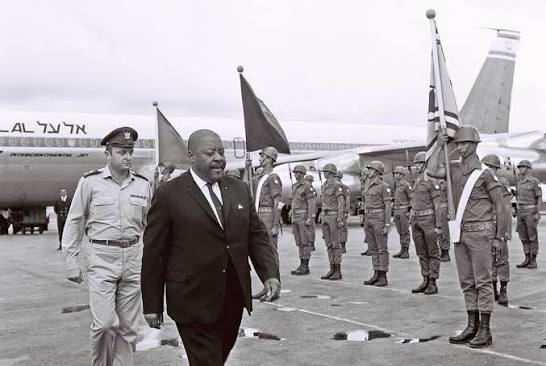
These were the realities that leaders such as Leabua Jonathan appear to have understood decades ago. Posting an embassy in Tehran was not simply a diplomatic choice. It reflected a recognition that Iran was, and would remain, a central actor in global geopolitics.
History proved that judgement correct.
The Iranian Revolution dramatically altered Iran’s political orientation. The fall of the Shah and the rise of a new Islamic republic reshaped alliances across the Middle East. But the revolution did not erase Iran’s geography, its population, or its long civilisational continuity.
For the United States, the revolution meant the sudden loss of a key regional ally. Since then, Washington has spent more than four decades attempting to contain Iranian influence through sanctions and diplomatic isolation. The assumption was that economic pressure might eventually force political change.
Yet Iran endured. Sanctions strained its economy, but they did not eliminate its regional relevance.
During the administration of Barack Obama, the world briefly witnessed a different approach. The Joint Comprehensive Plan of Action sought to bring Iran back into structured engagement with the global economy in exchange for restrictions on its nuclear programme. It was an attempt to influence behaviour through integration rather than confrontation.
When the agreement was later abandoned under Donald Trump, the strategy shifted back toward pressure and coercion.
Whether that shift will ultimately produce stability remains uncertain. What history consistently teaches, however, is that great civilisations do not simply vanish because they are sanctioned or isolated.
Iran is not merely a government or a regime. It is the modern expression of Persia, a civilisation that has existed for millennia. Culture, geography and history combine to ensure that it will continue to shape regional dynamics regardless of who governs in Tehran.
Perhaps the deeper lesson for Basotho lies closer to home.
Molapo’s reflection reminds us that our own leaders once engaged the world with a sense of strategic awareness. Decisions were sometimes made with an eye on long historical currents rather than immediate political convenience.
In today’s political environment, that kind of thinking often feels absent. Too frequently we reduce international affairs to partisan talking points or ideological loyalties.
But the world is more complicated than that.
Understanding history. Recognising geography. Appreciating civilisational depth. These are the tools of serious statecraft.
Lesotho may be small, but thoughtful diplomacy and strategic awareness once allowed its leaders to read the global chessboard with surprising clarity.
Molapo’s story is therefore not simply about Iran. It is a reminder that strategic thinking is possible, even from a small mountain kingdom, when leaders take the time to understand the deeper forces that shape the world.