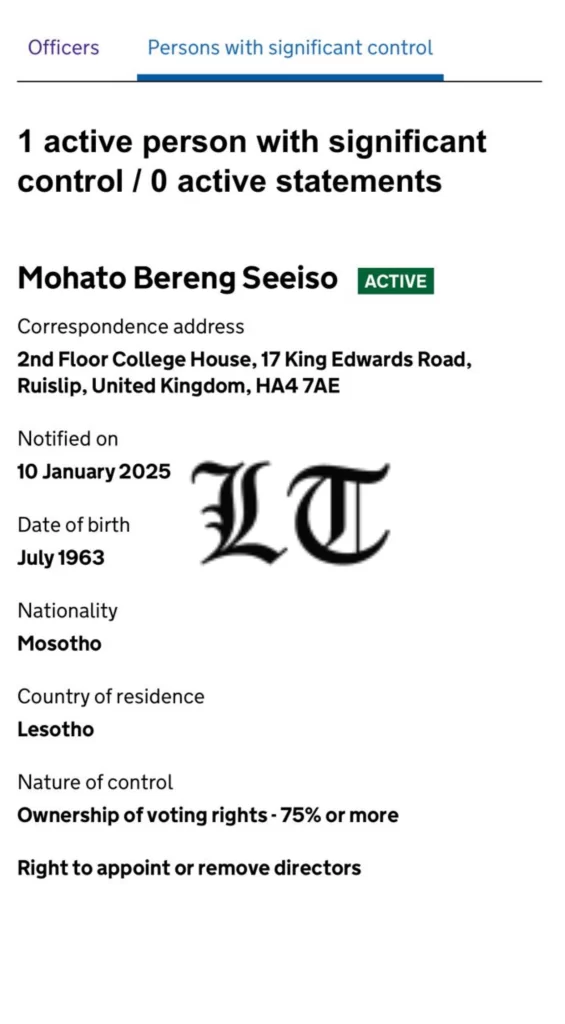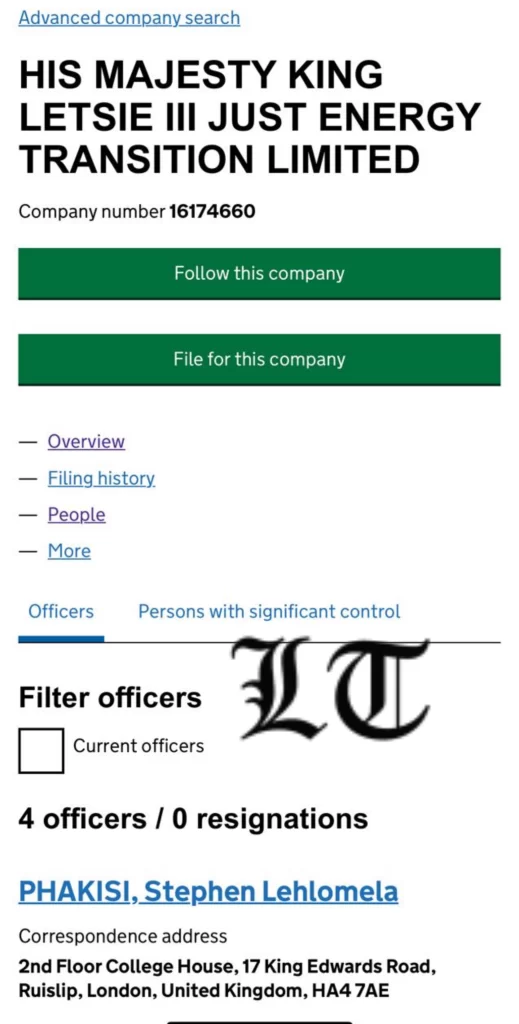



MASERU – His Majesty King Letsie III has registered a company to champion what could become Africa’s first national Just Energy Transition (JET) programme. The HMKLIII Just Energy Transition Fund—established with the King’s endorsement and direct involvement—seeks to transform Lesotho into the continent’s first carbon-neutral country while laying the foundation for a new, sustainable economic model.
The initiative, known as the HMKLIII JET Fund, is unlike any other in Lesotho’s history. Spearheaded by the monarchy and backed by the country’s highest political offices, the programme positions Lesotho at the forefront of renewable energy and climate-resilient development in Southern Africa.
“Opportunities to completely redirect a country’s economic trajectory with a single, cohesive programme are rare,” notes a project brief. “We have such an opportunity with Lesotho’s HMKLIII Renewable Energy Programme. There is a narrow window of opportunity created by the South African power crisis. If we miss this chance, it is unlikely we will get a second one.”
A New National Pathway
The HMKLIII Fund is more than a green energy venture—it is a comprehensive national strategy designed to wean Lesotho off declining remittances from migrant mineworkers and reduce reliance on imported electricity from South Africa.
Its objectives include:
• Transitioning Lesotho to a 100% renewable energy economy by 2050
• Exporting clean electricity to South African mines and the Southern African Power Pool
• Investing proceeds into social development and ecological rehabilitation, notably through the Renoka Programme
• Meeting and exceeding Lesotho’s Nationally Determined Contributions (NDCs)under the Paris Agreement
The Fund is currently seeking catalytic funding to kickstart its initial projects. Early supporters will be offered convertible notes with potential for strong equity returns. Developers are invited to form equity-sharing partnerships, ensuring inclusive benefit from Lesotho’s clean energy transition.
Governance at the Highest Level
The HMKLIII initiative is governed by a board of seasoned professionals and global advisors, under the royal stewardship of His Majesty King Letsie III and Kgosi Leruo Molotlegi of the Royal Bafokeng Nation. The leadership structure is designed to ensure integrity, transparency, and international credibility.
Board of Directors:
• Independent Non-Executive Directors: TP Nchocho, Raphael Vermeir CBE, Usha Rao-Monari
• Executive Directors: Prof Michael Solomon, Stephen Phakisi
• Senior Advisors to the Board: Mark Cutifani CBE, Michael Murphy
This governance framework reflects a deliberate effort to blend local “ownership” with global standards.
Political and Diplomatic Support
The initiative enjoys cross-ministerial support within Lesotho’s government, ensuring smooth integration across national development goals:
• The Hon. Samuel Ntsokoane Matekane, Prime Minister and Minister of Environment
• The Hon. Dr. Rets’elisitsoe Matlanyane, Minister of Finance
• The Hon. Lejone Mpotjoane, Minister of Foreign Affairs
• The Hon. Mohlomi Moleko, Minister of Natural Resources and Energy
International development partners are also backing the programme:
• EU Ambassador Paola Amadei
• UK High Commissioner Harry MacDonald
• UN Resident Coordinator Amanda Khozi Mukwashi
A Strategic Alliance with the LHDA
One of the Fund’s strongest assets is its partnership with the Lesotho Highlands Development Authority (LHDA), which oversees the Lesotho Highlands Water Project (LHWP). LHDA’s expertise in dams, tunnels, and hydroelectric infrastructure will be central to the JET programme’s successful rollout.
The LHDA, which operates the hydro plants at Katse and Muela, will be responsible for developing the power generation and transmission infrastructure under the HMKLIII mandate.
Flagship Energy and Infrastructure Projects
The HMKLIII Fund has laid out a comprehensive pipeline of renewable energy and infrastructure developments:
• Maputsoe Solar Farm (100 MW): A plug-and-play project leveraging Lesotho’s high solar irradiance, capable of feeding both domestic and future industrial energy needs.
• Floating Solar on Katse & Mohale Dams (650 MW): These installations will complement the proposed Kobong Pumped Storage Scheme, with interim use in the national grid or exports.
• Letseng-la-Terai Wind Farm (1,000 MW): A long-term wind project situated in the highlands, expected to involve 150 turbines in mountainous terrain.
• Kobong Pumped Storage Scheme: Reassessed for feasibility under the new energy mix, this project aims to use renewables to power hydro-lifts, avoiding previous cost barriers tied to Eskom’s pricing.
• Oxbow Hydropower Scheme (80 MW): Currently under study by Artelia, this gravity dam and headrace tunnel setup offers peak power capabilities and will integrate into Phase II of LHWP.
• Katse Dam Data Centre (100 MW): Tapping into Lesotho’s cool climate and abundant water, this high-capacity centre will link with South Africa’s thriving data infrastructure, serving cloud and AI sectors with low latency.
Digital Backbone for a Greener Economy
Lesotho’s ambitions include positioning itself as a regional digital hub, taking advantage of South Africa’s advanced telecom infrastructure. With copper networks being phased out and fibre expanding rapidly, the conditions are right for high-speed data-driven economic growth.
Government incentives aligned with the AfDB-funded e-Government strategy further support ICT expansion, while the proximity to Johannesburg’s digital markets makes Lesotho an ideal base for cross-border data services.
Why It Matters Now
The HMKLIII JET Fund represents a once-in-a-generation opportunity to transform Lesotho’s economy, environment, and global relevance. By integrating clean energy generation, regional exports, digital infrastructure, and social reinvestment, the initiative presents a model of sustainable development grounded in national ownership.
That His Majesty King Letsie III would lend his name—and formal registration—to the initiative underscores its significance.
Far from being merely symbolic, the King’s involvement signals that climate action and energy sovereignty are not abstract ideals, but national imperatives.
Should the HMKLIII vision succeed, Lesotho will not only become the first country in Africa with a fully renewable energy sector, it will demonstrate that even small nations, with the right leadership and strategy, can become global pioneers in the fight against climate change.