



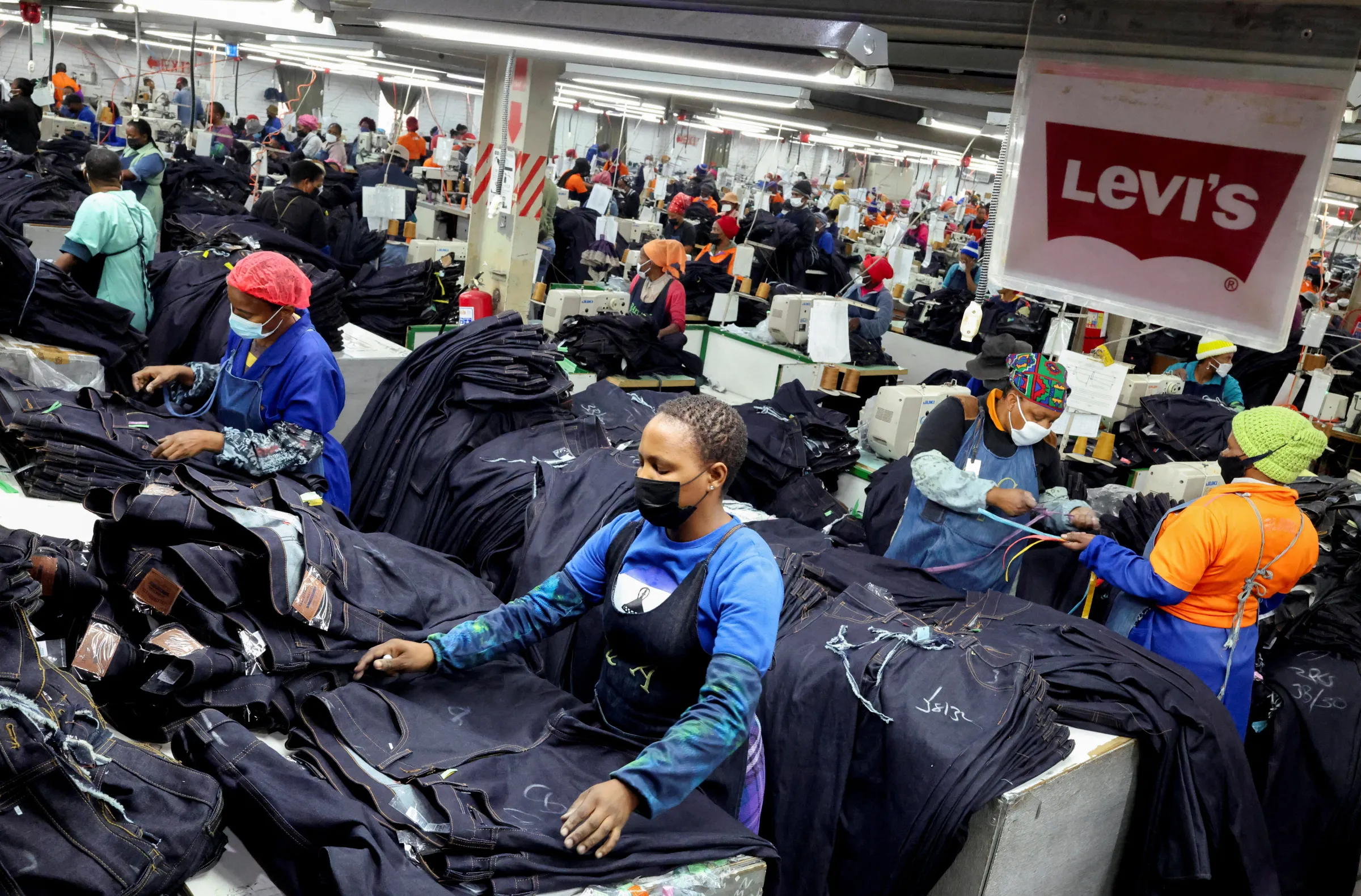
The World Bank’s latest economic projections for Lesotho paint a stark picture of an economy whose productive core is weakening rapidly. At the centre of this deterioration is the manufacturing sector, long regarded as Lesotho’s primary source of export earnings and formal employment. While fiscal balances remain strong on paper, the underlying data shows that manufacturing-led growth has collapsed, exports are contracting, employment is frozenand poverty remains entrenched.
The World Bank’s medium-term outlook shows that after a brief rebound in 2024, economic growth in Lesotho is projected to slow sharply, falling below levels required to sustain employment or reduce poverty. Real GDP growth, which reached 2.9 percent in 2024, is forecast to drop to 1.3 percent in 2025, decline further to 0.7 percent in 2026, and recover only marginally to 1.1 percent in 2027.
More troubling than the headline growth figures is the composition of that growth. Export performance, historically anchored by manufactured goods, particularly textiles and apparel, is projected to deteriorate steadily. After slowing sharply in recent years, exports of goods and services are expected to contract from 2025 onwards, marking a decisive break from the export-led model that once underpinned Lesotho’s industrial base.
By contrast, imports continue to grow at elevated rates, underscoring the economy’s increasing dependence on external production. This widening gap between imports and exports points to a loss of competitiveness in manufacturing and a shrinking role for domestic production in meeting both local and international demand.
Sectoral data reinforces this trend. Industrial output, which includes manufacturing, remains one of the stronger-performing sectors in the short term, but its momentum is fading rapidly. Growth in industry is projected to slow steadily over the forecast period, falling to near-stagnation levels by 2027. Services, which employ the majority of the workforce, show even weaker performance, with minimal growth and periods of contraction. Agriculture, meanwhile, settles into low, marginal growth, offering little offset to industrial decline.
The labour market tells a similarly bleak story. Despite years of investment-driven activity and periods of strong government spending, employment levels remain effectively unchanged. The World Bank projects that less than half of Lesotho’s working-age population will be employed throughout the entire forecast period. This stagnation suggests that recent growth has been capital-intensive and fiscally driven, rather than labour-absorbing.
Inflation is expected to moderate from the highs recorded in recent years, but this easing offers limited relief in the absence of income growth. With employment stagnant and real wages under pressure, lower inflation alone is unlikely to improve household welfare.
Paradoxically, this economic weakening is unfolding alongside one of the strongest fiscal positions Lesotho has recorded in decades. The World Bank projects sustained fiscal surpluses over the medium term, supported by high revenues and declining public debt. Government debt is expected to fall steadily, creating what appears, on paper, to be a picture of macroeconomic strength.
Yet the data suggests that fiscal stability has not translated into economic transformation. Investment remains concentrated in large capital projects, while manufacturing output, export competitiveness and job creation continue to deteriorate. The disconnect between fiscal performance and real economic outcomes raises questions about the effectiveness of public spending in supporting productive sectors.
The social consequences of this imbalance are evident in poverty indicators. World Bank projections show that poverty rates will remain largely unchanged through 2027, regardless of the threshold used. Nearly half of the population is expected to remain below the international extreme poverty line, while the overwhelming majority of Basotho continue to live below income levels associated with middle-income economies.
Taken together, the numbers point to an economy that is fiscally sound but structurally fragile. Manufacturing, once the engine of growth and employment, is no longer fulfilling that role. Export capacity is shrinking, jobs are not being created, and poverty remains entrenched despite macroeconomic stability.
Without a reversal in manufacturing performance and a shift toward productivity-driven growth, Lesotho risks entrenching a model in which the state’s balance sheet improves while the real economy continues to hollow out. The World Bank’s data suggests that this is no longer a looming risk, but an unfolding reality.
Table 1: Recent History and Projections – Growth and Demand (%)
| Indicator | 2022 | 2023 | 2024 | 2025e | 2026f | 2027f |
| Real GDP growth | 2.4 | 1.8 | 2.9 | 1.3 | 0.7 | 1.1 |
| Gross fixed capital investment | 18.9 | 49.4 | 20.4 | 27.9 | 23.7 | 21.6 |
| Exports (goods & services) | 36.7 | 2.2 | 2.1 | -0.3 | -0.6 | -1.0 |
| Imports (goods & services) | 22.5 | 10.3 | 10.9 | 11.2 | 9.8 | 9.3 |
Growth briefly rebounds in 2024 but collapses thereafter, with exports turning negative and investment failing to sustain productive activity.
Table 2: Sectoral Growth at Constant Factor Prices (%)
| Sector | 2022 | 2023 | 2024 | 2025e | 2026f | 2027f |
| Agriculture | 12.5 | 2.4 | 1.5 | 1.5 | 1.7 | 1.8 |
| Industry (incl. manufacturing) | 5.0 | 5.0 | 5.3 | 3.2 | 2.8 | 2.0 |
| Services | 0.9 | 0.8 | 2.1 | 0.6 | -0.1 | 0.7 |
Manufacturing-led growth peaks in 2024 before steadily weakening, while services stagnate and agriculture remains marginal.
Table 3: Employment, Inflation and External Position
| Indicator | 2022 | 2023 | 2024 | 2025e | 2026f | 2027f |
| Employment rate (% of 15+) | 48.5 | 48.5 | 48.4 | 48.4 | 48.4 | 48.4 |
| Inflation (CPI %) | 8.3 | 6.4 | 6.1 | 4.5 | 5.0 | 5.1 |
| Current account (% GDP) | -11.7 | -6.9 | 5.0 | -1.7 | -3.8 | -1.0 |
Employment remains frozen below half of the working-age population despite moderating inflation and episodic external relief.
Table 4: Fiscal Indicators (% of GDP)
| Indicator | 2022 | 2023 | 2024 | 2025e | 2026f | 2027f |
| Fiscal balance | -1.7 | 5.7 | 7.2 | 3.4 | 3.0 | 2.6 |
| Public debt | 66.5 | 60.7 | 53.0 | 50.5 | 50.1 | 47.5 |
Strong fiscal surpluses and falling debt mask deeper weaknesses in productive capacity and employment creation.
Table 5: Poverty Rates at International Thresholds (%)
| Poverty Line | 2024 | 2027f |
| $3.00/day (2021 PPP) | 45.7 | 45.8 |
| $4.20/day (2021 PPP) | 59.8 | 59.8 |
| $8.30/day (2021 PPP) | 86.8 | 86.9 |
Poverty levels remain effectively unchanged, confirming that fiscal stability and investment-led growth have not translated into welfare gains.