


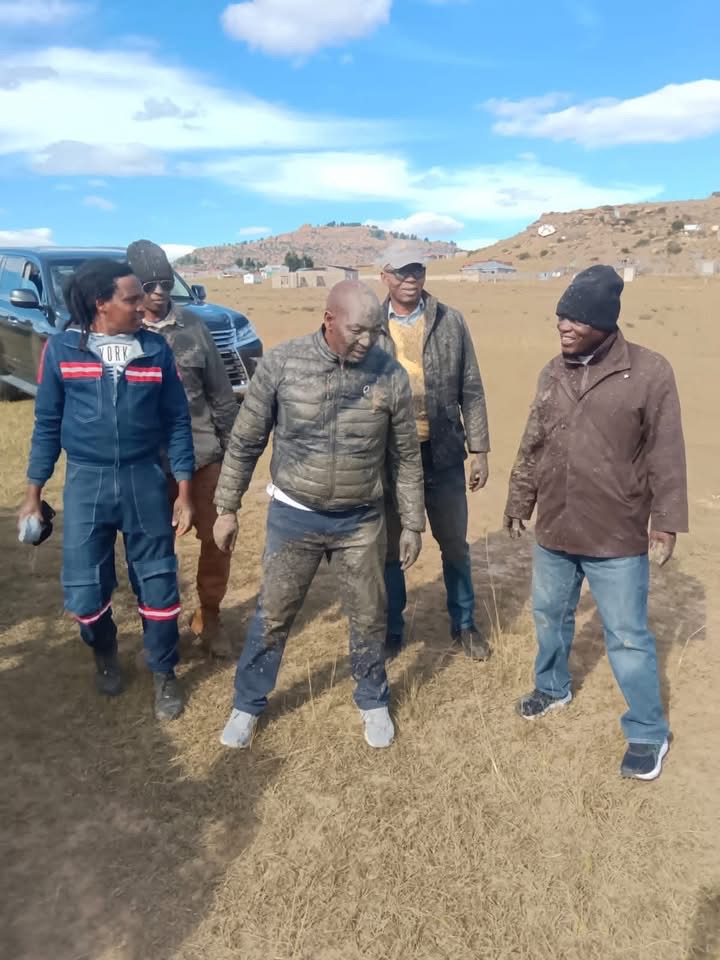
A series of images and videos showing Prime Minister Sam Matekane riding an off-road ATV yesterday (25 May 2026) ignited fierce debate across social media platforms, exposing once again the delicate and often unforgiving relationship between political leadership and public perception in difficult economic times.
What appeared to some as an ordinary recreational activity quickly evolved into a national conversation about leadership, empathy, privilege, and political timing.
By Monday evening, Basotho social media spaces had effectively turned into a digital courtroom. Citizens from across the political spectrum weighed in with sharp and often emotional reactions. Some defended the Prime Minister’s right to private leisure. Others saw the spectacle as profoundly disconnected from the lived realities of ordinary citizens grappling with unemployment, poverty, rising costs of living, and economic uncertainty.
Interestingly, some of the harshest criticism did not come from opposition supporters, but from sections of Matekane’s own political base. Several ruling party supporters publicly expressed frustration, arguing that the images projected the wrong message at the wrong time. To them, the issue was not necessarily that the Prime Minister was riding an ATV, but rather what the images symbolised in the broader national context.
In politics, symbolism matters. Often more than intention.
For a country where many young people remain unemployed and where households continue to struggle under economic pressure, visuals of a sitting Prime Minister engaging in what many perceive as luxury leisure were always likely to trigger strong reactions. Politics, after all, is rarely judged in isolation from social conditions.
The criticism reflected a growing sensitivity among citizens toward displays of comfort or extravagance by political leaders during periods of economic strain. Around the world, leaders are increasingly expected not only to govern effectively, but to constantly project awareness of public suffering. Whether fair or unfair, optics have become part of governance itself.
Yet defenders of the Prime Minister were equally vocal. Supporters argued that Matekane remains a human being entitled to rest and recreation like any other citizen. They accused critics of imposing unrealistic expectations on leaders, as though occupying public office strips one of the right to unwind.
Others pointed out that there was nothing illegal, unethical, or abusive about the activity itself. In their view, the outrage reflected a deeper culture of politicising every aspect of leaders’ personal lives, especially in the age of social media where moments are amplified instantly and interpreted emotionally.
Some supporters further argued that Basotho often demand relatable and approachable leaders, yet criticise them when they appear outside formal political settings. To them, the ATV videos humanised the Prime Minister rather than diminished him.
The incident nevertheless reveals something much larger than a weekend recreational outing. It speaks to the growing pressure on political leaders to constantly manage public sentiment in an era where perception travels faster than policy. Social media has fundamentally altered political communication. A single image can shape national discourse more powerfully than a parliamentary speech or a policy document.
In previous generations, leaders were largely judged by official actions and public addresses. Today, they are judged continuously. Their clothing, hobbies, private moments, body language, and leisure activities are all absorbed into the political narrative.
For Matekane, who rose to power partly on the promise of business-minded pragmatism and economic renewal, the public scrutiny may be particularly intense because expectations remain extraordinarily high. Many Basotho still associate his leadership with hopes for economic improvement and job creation. In such an environment, any perceived display of detachment can quickly become politically combustible.
At the same time, the controversy also exposes the emotional state of the nation itself. Public frustration over unemployment and economic hardship often seeks expression through symbolic moments. The ATV videos may simply have become a convenient outlet for broader anxieties that already existed beneath the surface. In that sense, the reaction was likely less about the machine itself and more about accumulated public frustrations.
What remains clear is that leadership in modern politics increasingly requires not only governing capacity, but emotional intelligence and sensitivity to public mood. Leaders today operate under a permanent public microscope where even recreational moments carry political consequences.
Whether the backlash fades quickly or evolves into a larger conversation about leadership style and public image remains to be seen. But for a brief moment this week, an ATV ride became far more than an ATV ride.
It became a mirror reflecting Lesotho’s economic anxieties, political polarisation, and the ever-complicated expectations citizens place upon those who govern them.
Did Prime Minister Matekane's ATV ride send the wrong message to struggling Basotho?
This poll has closed. Subscribe to view the results.