


South Africa committed R30-million for Lesotho’s HIV and tuberculosis response at the Senqu Bridge opening in Mokhotlong. The gesture arrives as Lesotho continues to reckon with the loss of at least 23 percent of its PEPFAR funding, 1,500 health counsellors, and a health system that health committee chair Mokhothu Makhalanyane says was set back at least 15 years in a single year.
MOKHOTLONG
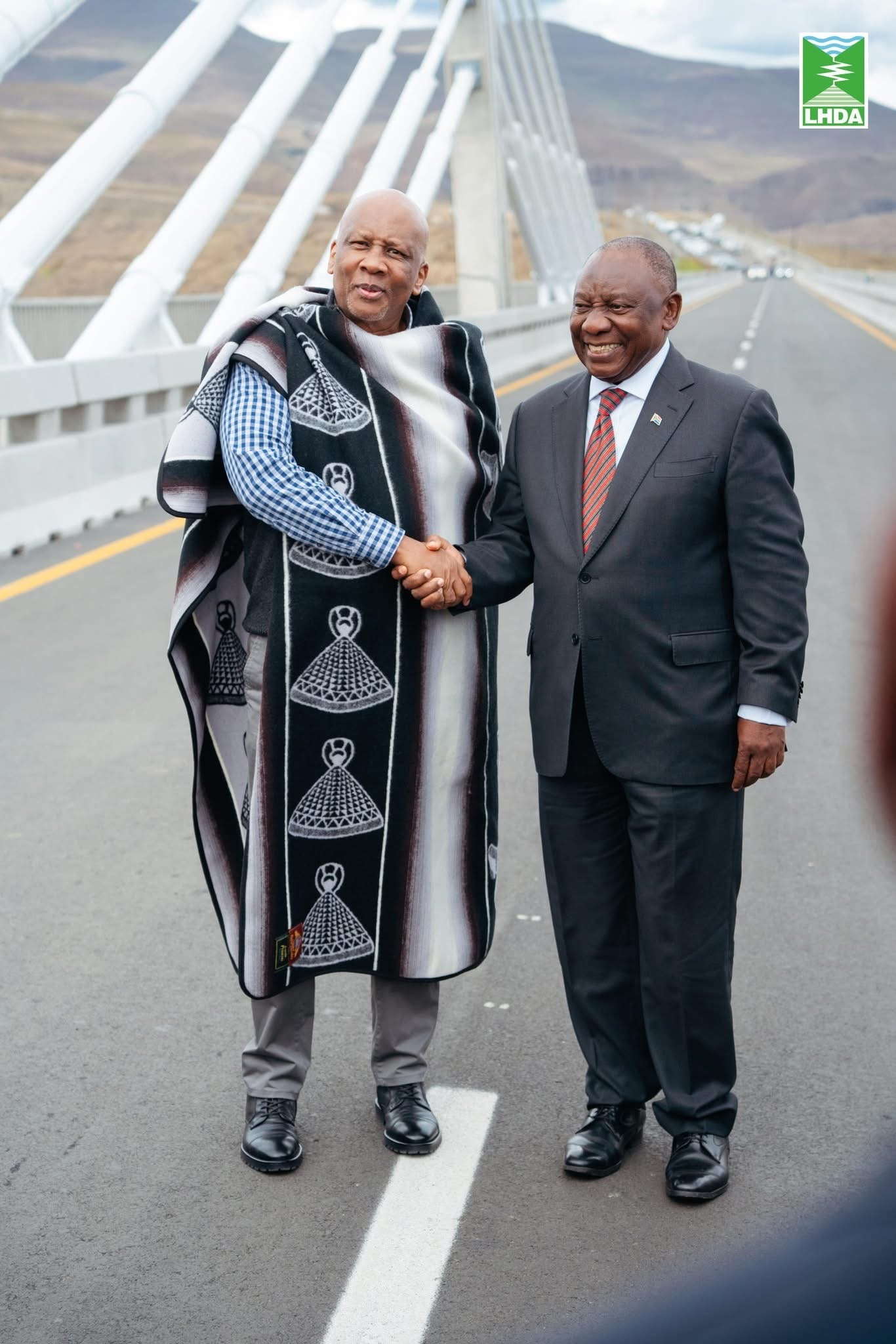
President Cyril Ramaphosa announced on Wednesday that South Africa will provide R30-million in humanitarian assistance to Lesotho, directed at the country’s response to HIV and tuberculosis. The announcement came at the official opening of the Senqu Bridge in Mokhotlong, where Ramaphosa stood alongside King Letsie III and Prime Minister Samuel Matekane to mark a milestone in the long-running Lesotho Highlands Water Project. The pledge was made through the African Renaissance Fund, South Africa’s vehicle for continental development assistance.
The timing of the commitment was pointed. Ramaphosa named the context plainly: declining levels of international assistance. What that phrase gestures toward is a rupture that has not been plainly named from the stage of any regional summit but that has quietly dismantled much of Lesotho’s public health architecture over the past fifteen months.
When President Trump signed an executive order freezing foreign assistance on his first day back in office in January 2025, the consequences in Lesotho were immediate. Within weeks, clinics shut. Workers were dismissed. Patients stopped treatment. The US Agency for International Development, which had been the primary implementing partner for the President’s Emergency Plan for AIDS Relief since 2003, was effectively dismantled. In Lesotho, PEPFAR had committed more than $630 million to the HIV response since 2006. Over nearly two decades, with close to $1 billion in cumulative US support, the country had assembled a health network capable enough to slow one of the world’s most severe HIV epidemics.
What the freeze exposed was how little of that system Lesotho could independently sustain. The government funded only M273.68 million of the country’s M2.2 billion health budget in the year prior to the cuts. Of that government contribution, M268 million went directly to purchasing antiretrovirals, leaving, as HIV and AIDS programme manager Dr Tapiwa Tarumbiswa told a parliamentary committee in June 2025, just three percent of the government’s health allocation for everything else, including salaries and office supplies.
“We’re going to lose a lot of lives because of this.”
Mokhothu Makhalanyane, Chairperson, Lesotho Legislative Health CommitteeThe scale of disruption was registered globally. The Center for Global Development, drawing on state department data obtained through a Freedom of Information suit, found that PEPFAR-supported coverage in Lesotho declined by more than 50 percent at the height of the crisis in 2025, one of the steepest drops recorded across the 53 PEPFAR-recipient countries. The Foundation for AIDS Research placed Lesotho in the top ten countries globally for the proportional share of PEPFAR funding cut when foreign assistance was frozen, with a minimum loss of 23 percent. Testing numbers fell sharply after Lesotho lost 1,500 HIV counsellors in February 2025 alone. The WHO warned in March that the country might run out of antiretroviral stocks altogether.
Progress that had taken a generation to achieve was halted abruptly. UNAIDS data had shown a 74 percent decline in new HIV infections in Lesotho since 2010, and a 47 percent decline in AIDS-related deaths. By late 2024, Lesotho had reached UNAIDS’s 95-95-95 milestone, meaning 95 percent of people living with HIV knew their status, 95 percent of those were in treatment, and 95 percent of those had a suppressed viral load. Achieving that milestone in a country where an estimated 260,000 of its 2.3 million residents are HIV-positive was a result of sustained, coordinated effort over two decades. Makhalanyane, chairperson of the country’s legislative health committee, said the cuts had set Lesotho back at least 15 years.
The Senqu Bridge, 825 metres long and 90 metres high, is the first extradosed bridge in Lesotho and the largest of three major crossings being built to span the Polihali Reservoir. It was constructed at an estimated cost of R2.4 billion, with 86 percent financed by South Africa, by an international joint venture led by the Webuild Group. The bridge was inaugurated jointly by King Letsie III and President Ramaphosa on 22 April 2026, in a ceremony marking 40 years of partnership under the Lesotho Highlands Water Project.
Phase II of the LHWP will increase water transfer volumes from 780 million to 1.27 billion cubic metres per annum, while boosting Lesotho’s hydropower capacity. The project is the largest single investment South Africa has made outside its borders. Gauteng, South Africa’s most populous and economically dominant province, sources approximately 60 percent of its water from Lesotho’s highlands. The bridge construction created more than 1,200 jobs, the majority for Basotho workers. A 38-kilometre tunnel connecting the Polihali and Katse reservoirs remains under construction.
Against that backdrop, South Africa’s R30-million pledge is a gesture of solidarity, but its scale requires honest framing. Lesotho’s total annual health budget, before US funding was withdrawn, ran to approximately M2.2 billion, of which the US contribution through PEPFAR and USAID programmes represented the dominant share. The R30-million announced by Ramaphosa, directed through the African Renaissance Fund, addresses a fraction of the gap that US disengagement created. It does not replace the testing infrastructure, the counselling workforce, or the supply chains that were disrupted. What it does is signal a shift in the architecture of health aid in the region: that South Africa is beginning to assume a role it has not previously been asked to play.
For Prime Minister Matekane, who told the gathering that “the royalties and infrastructure that flow from this project are not incidental benefits, they are central to our development finance strategy,” the Senqu Bridge ceremony offered a moment to reframe Lesotho’s position. The country is not only a recipient of aid. It is a sovereign supplier of the water resource that sustains the industrial heartland of the Southern African region. Lesotho’s per capita HIV burden, its poverty rate, and its dependence on external health financing are not separate from that relationship. They are part of the same account.
In May 2025, Congress voted to restore some PEPFAR funding, and by August only $2.9 billion of the $6 billion budgeted for the 2025 fiscal year had been made available. By the end of 2025, PEPFAR-supported coverage had partially rebounded globally. But health workers in Lesotho said the disruption had caused irreparable harm, with patients who missed months of treatment and supply chains that take far longer to restart than to break down.
The Senqu Bridge was built to endure. The plaque unveiled by King Letsie III and President Ramaphosa on Wednesday carries the inscription: “Officially opened on 22 April 2026 in celebration of 40 years of partnership and regional development.” What the partnership has not yet fully reckoned with is that Lesotho’s ability to remain a stable, functioning state capable of honouring long-term infrastructure commitments depends on a health system that is currently being rebuilt after a near-collapse it did not cause and could not prevent. The R30-million is a beginning. Whether the region treats the underlying structural dependence as a problem worth solving at scale is a different, larger question.