



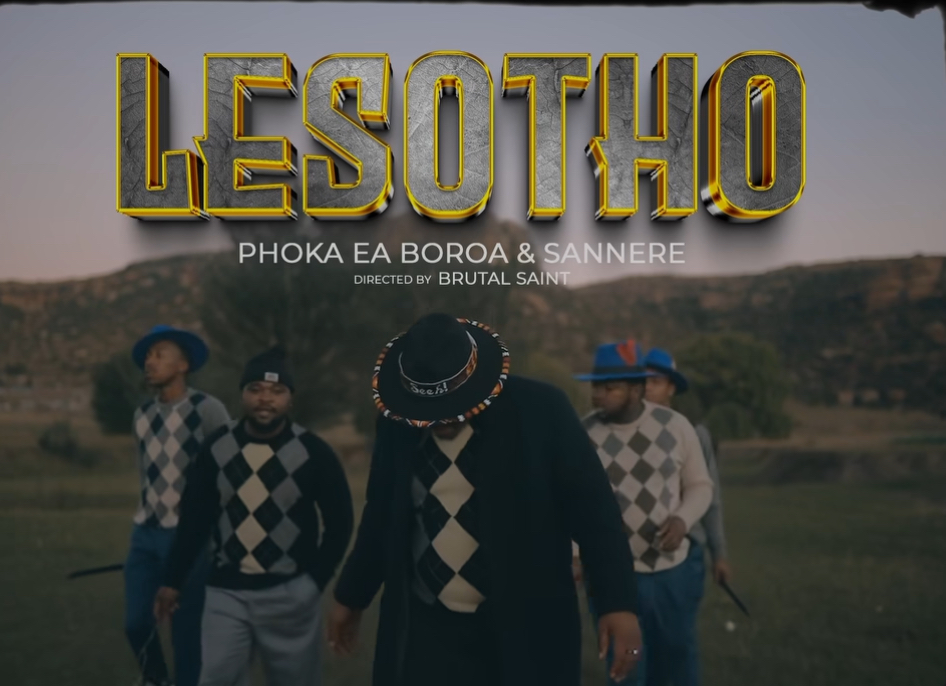
evolution of identity. Hip-hop gave Sannere lyrical structure and rebellion; famo gives him belonging and resonance.
When he first came up in music circles, he rapped like someone trying to outthink his own shadow. Every line was tight, deliberate, calculated. But with his new track Lesotho (with Phoka ea Boroa, extremely talented and highly underrated) he seems to have loosened the collar a bit. What we are hearing now is a man returning home without losing the city in his voice.
“Lesotho” is a conversation between two worlds that have always flirted with each other but rarely kissed in public. The drums and accordions are pure Basotho tavern. The rhythm has dust on its boots. Yet the delivery still carries the attitude of hip-hop: that unapologetic sense of ownership, the feeling that a mic is both a weapon and a mirror.
Sannere manages to blend both without sounding forced.
There is something brave about what he is doing. Hip-hop in Lesotho has long been about mimicry, about trying to sound like someone from somewhere else. Famo, on the other hand, is often treated as the music of the past: something to be appreciated but not lived. Sannere ignores that divide. “Lesotho” takes the lyrical discipline of hip-hop and lays it over a famo heartbeat. The result is raw, imperfect, and beautiful in its honesty. It feels like what Basotho youth sound like when they stop pretending to be visitors in their own culture.
His flow still carries the swagger of a rapper. But the language has shifted somewhat. He raps in idioms your grandmother would nod to. He borrows metaphors of the fields and the mountains, yet his tone remains streetwise. That combination gives the track an unusual depth. It sounds both familiar and new, as if two generations of Basotho musicians were finally shaking hands.
The production is also worth noting. The beat is gritty, but not in a way that drowns the story. There are moments where you can almost see the crowd dancing before the verse ends. “Lesotho” feels alive in that sense.
It is too early to say if “Lesotho” marks a full shift in his direction, but it already feels like an artist declaring creative independence. There is a maturity in how he lets the Sesotho flow breathe. You can tell he is not performing for applause. He is experimenting. And that kind of curiosity is what keeps music relevant long after the trends fade.
For years, Lesotho’s urban music scene has suffered from an identity crisis, caught between imitation and nostalgia. Sannere may have just offered a way out. “Lesotho” shows that authenticity does not require abandoning ambition. You can speak to the world without muting your accent. You can be both rapper and famo storyteller, modern yet rooted, global yet unmistakably Basotho.
If this is where Sannere is headed, we might just be witnessing the “birth” of a sound that belongs to no one but us.