


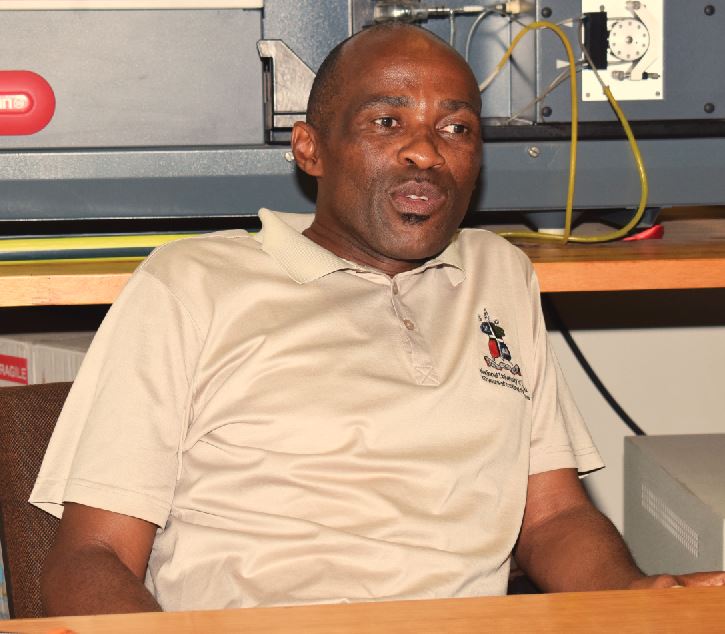
Professor Mosotho George has been elected to the Executive Board of Commonwealth Chemistry, placing a Mosotho scientist at the centre of global scientific governance. He is also facing a DCEO prosecution. The Tribune examines what both facts tell us about this country.
Lesotho has always had a complicated relationship with excellence. We celebrate it loudly when it breaks through. We suffocate it quietly when it threatens to inconvenience us.
The election of Professor Mosotho George to the Executive Board of Commonwealth Chemistry is, on the face of it, a moment of genuine national pride. It places a Mosotho scientist at the centre of global scientific governance, a body that shapes research priorities, international collaboration, and scientific diplomacy across dozens of countries. This is not a ceremonial appointment. It is influence, earned and consequential.
And yet it lands in Lesotho trailing a prosecution.
Because this is the same professor currently facing corruption and fraud charges brought by the Directorate on Corruption and Economic Offences. The allegations are that he used his position within NUL’s innovation structures to secure funding for a company in which he allegedly held undisclosed interests, involving approximately M129,000 in public-backed resources.
We are required, at this point, to note that he remains innocent until proven otherwise. We are also required, by the same commitment to honesty, to note who is doing the charging.
The DCEO is not a neutral instrument of justice. It has not been for some time.
This is an institution whose record on selective prosecution is, at this point, extensively documented. It has a pattern of targeting individuals whose prominence makes the charge sheet newsworthy, while demonstrating conspicuous restraint when the accused are politically protected. It operates in an environment where the line between law enforcement and political utility has been, on too many occasions, difficult to locate.
We are not saying Professor George is innocent. That is for the courts to determine. We are saying that a charge sheet originating from the DCEO does not carry the evidentiary weight that a charge sheet ought to carry. It carries, instead, a question: who benefits from this prosecution, and why now?
When an institution with a credibility deficit charges a man at the precise moment of his most significant professional elevation, the timing is not automatically suspicious. But it is not automatically innocent either. Editorial
That is not a question this editorial can answer definitively. It is, however, a question that responsible journalism requires us to ask.
Set the prosecution aside for a moment, or rather, hold it at arm’s length, which is where it belongs until the courts do their work.
Professor George’s election to the Commonwealth Chemistry Executive Board matters in concrete terms for this country. It generates scientific visibility in spaces where Lesotho is largely absent. It opens access to funding networks, research partnerships, and international policy conversations that a country of this size and resource base rarely enters. For a nation still too dependent on remittances and textile exports, scientific leadership is not an indulgence. It is strategy, and it is rare.
NUL, in particular, should be paying close attention. This appointment validates the calibre of talent the university can produce and creates potential pipelines for student exposure and institutional partnership. In a functioning system, this would be an unambiguous cause for institutional pride.
The tragedy is that Lesotho’s reflexive response to any public figure under prosecution is not nuance. It is either defensive celebration or wholesale condemnation, and neither serves the country.
The deeper problem this moment exposes is not Professor George’s alleged conduct. It is the institutional ecosystem in which both the appointment and the prosecution are simultaneously possible, and where neither outcome, acquittal or conviction, will produce meaningful institutional reform on its own.
Lesotho needs a DCEO that can be trusted, not because it charges prominent people, but because it charges the right people for the right reasons with the right evidence. It needs universities that can celebrate international recognition without anxiously scanning the footnotes for caveats. It needs a public culture that can hold two thoughts at once: this person may have done something wrong, and this person has also done something exceptional.
That is not a contradiction. That is called a human being operating in a broken system. And the broken system is the story, not the man caught inside it.