



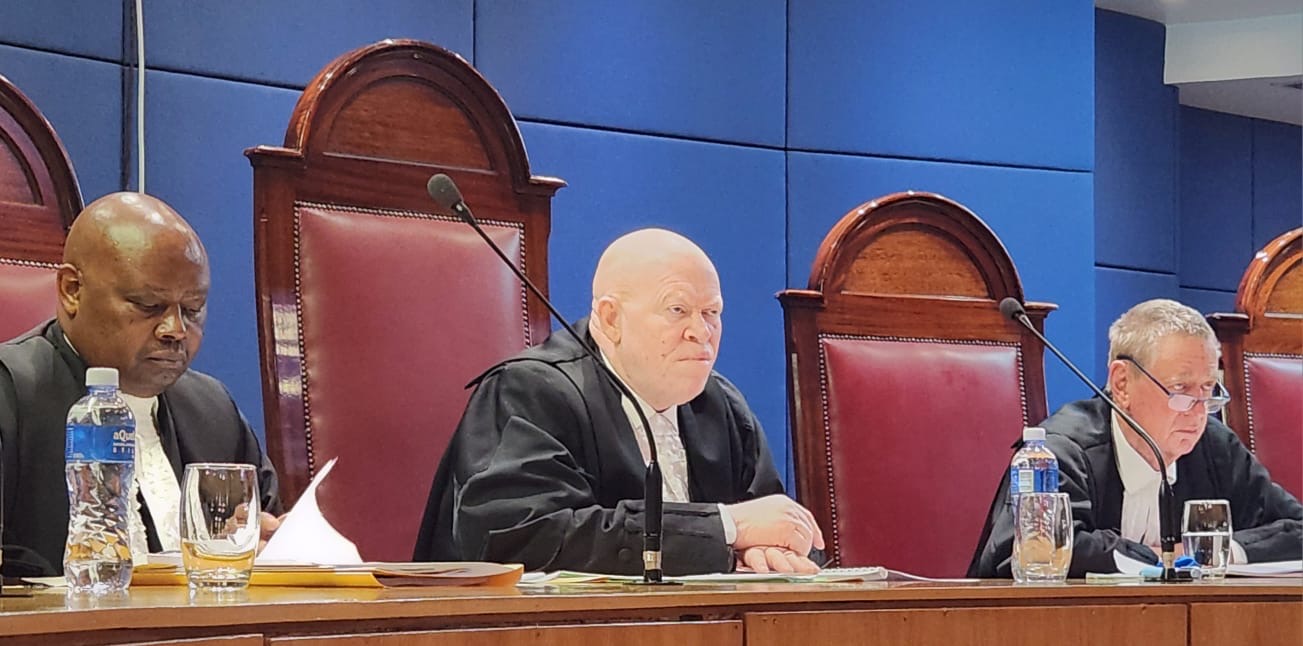
Judges sharply questioned the High Court’s decision to halt corruption charges against former minister Temeki Tsolo, as the state pushes to revive a controversial Frazer Solar deal prosecution.
A tense and closely watched hearing unfolded in the Lesotho Court of Appeal this week, as judges sharply questioned the High Court’s decision to permanently stay corruption charges against former government minister Temeki Tsolo.
At the centre of the matter is a controversial solar energy deal allegedly signed between the Government of Lesotho and Frazer Solar during Tsolo’s tenure in the Prime Minister’s Office. The state is now seeking to overturn the High Court’s ruling, arguing that the decision to halt the prosecution entirely was both irregular and unjustified.
From the outset, the panel of judges made clear that they were deeply concerned about the legal and procedural basis of the High Court’s decision. One of the key questions put to counsel was whether it was even competent for a court to grant a permanent stay of proceedings in the absence of a formal application requesting such relief.
The bench pressed further, probing whether a judge’s reluctance to continue with a part-heard case could ever justify such a drastic measure. The judges openly questioned whether the High Court may have overreached.
A permanent stay is not a light matter. It carries far-reaching implications for the administration of justice.
The judges emphasised that decisions of this magnitude do not only affect the accused person, but also the broader public. In cases involving allegations of corruption, particularly those tied to public office in Lesotho, the stakes are considerably higher. The court noted that the community at large has a vested interest in seeing such matters fully ventilated before a court of law.
The High Court’s ruling, which effectively brought the prosecution to an end, has therefore come under intense scrutiny. The Court of Appeal appeared particularly concerned that such a decision might undermine public confidence in Lesotho’s justice system, especially if it is perceived as prematurely closing the door on serious allegations of graft.
At the same time, the court did not spare the prosecution from criticism. Judges questioned the conduct of the state, particularly its repeated failure to appear in court on several occasions during the earlier proceedings.
There must be accountability on all sides.
The bench highlighted the delicate balance between protecting the rights of the accused and ensuring that justice is served in the public interest, a tension familiar to courts across the Southern African region.
Representing the appellants, Advocate Jay Naidoo sought to reassure the court that the Directorate on Corruption and Economic Offences (DCEO), which is handling the prosecution, had not been negligent. He argued that the High Court judge failed to properly consider explanations for the delays and absences, effectively shutting down the case without fully engaging with the facts.
According to Naidoo, the decision to impose a permanent stay was not only premature but also disproportionate to the circumstances. He maintained that the case deserved to be heard on its merits, rather than being dismissed on procedural grounds.
The judge did not entertain any explanations.
On the other side, Advocate Molefi Masoabi, representing Tsolo, painted a picture of a client facing personal and logistical challenges. He informed the court that Tsolo had not yet completed necessary processes with Legal Aid, which had affected his ability to adequately prepare for the appeal.
Masoabi further revealed that Tsolo had been unwell. In a dramatic turn, he told the court that Tsolo had collapsed on the morning of the hearing and had been rushed to hospital, adding another layer of complexity to the proceedings.
Despite these developments, the appeal moved forward, with the court focusing primarily on the legal principles at stake. Among the possible outcomes discussed was an order to uphold the appeal, set aside the High Court’s decision, and remit the matter back to the High Court for continuation before a different judge.
The panel hearing the appeal comprises some of the country’s most senior judicial figures, including Court of Appeal President Kananelo Mosito, Chief Justice Sakoane Sakoane, and Acting Justice Johann van der Westhuizen.
As proceedings concluded, the court reserved judgment. A decision is expected on 15 May 2026. Whether the High Court’s decision will stand or be overturned remains to be seen.
What is clear is that the Court of Appeal has signalled its willingness to scrutinise not only the outcome of the case, but also the processes that led to it. In doing so, it has underscored a principle fundamental to justice systems across Lesotho and South Africa alike: that justice must not only be done, but must also be seen to be done, especially in matters that carry significant public interest.