



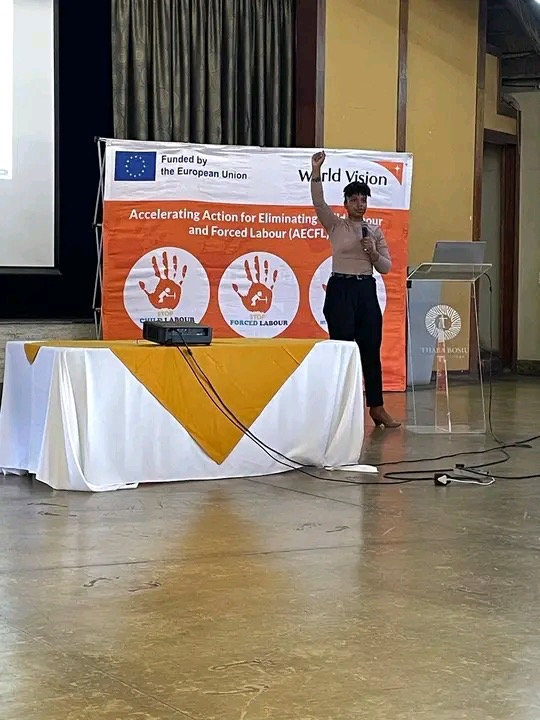
More than 9,000 children in Lesotho are in child labour instead of school, as journalists attending a World Vision and MISA Lesotho training workshop are urged to treat child labour and human trafficking with the same investigative urgency as any other crime.
BY LEMOHANG BOTSANE
Journalists in Lesotho have been called on to do more to expose child labour, forced labour, and human trafficking through careful and responsible reporting, as new figures reveal that 9,259 children in the country are currently engaged in child labour, representing a child labour rate of 31.9 percent.
The call was made during a two-day media training workshop held in Maseru this week, organised by World Vision International Lesotho together with the Media Institute of Southern Africa (MISA) Lesotho. The training formed part of the Accelerating Action for the Elimination of Child Labour and Forced Labour (AECFL) Project, funded by the European Union.
The workshop aimed to equip journalists with skills and knowledge to investigate and report on cases of trafficking, child labour and forced labour, while protecting the dignity and safety of children and other victims in the course of their reporting.
| Category | Number | Rate |
|---|---|---|
| Children in child labour (girls) | 4,685 | |
| Children in child labour (boys) | 4,574 | |
| Total children in child labour | 9,259 | 31.9% |
| Children in economic activity | 21.1% | |
| Source: Ministry of Labour and Employment, presented at World Vision / MISA Lesotho workshop, Maseru | ||
Speaking at the training, MISA Lesotho Acting National Director and investigative journalist Nicole Tau said ethical journalism was critical when reporting on vulnerable people such as children.
“Journalists must always follow ethical rules,” Tau said. “If we do not, we can lose the trust of the public. Victims may be afraid to speak, and people with information may refuse to help. Our job is to be accurate, fair, and sensitive at all times.”
“Child labour is a crime. It deserves the same serious attention and justice as any other crime. Many of these cases happen every day, but people do not know about them.”
Mathabang Kose, coordinator of World Vision’s AECFL Project, told journalists that the media had a significant role to play in ending child labour. “Child labour is a crime,” she said. “It deserves the same serious attention and justice as any other crime. Many of these cases happen every day, but people do not know about them. We are asking journalists to help expose what is happening so we can bring change.”
Inspector Nthabiseng Letsie of the Ministry of Labour and Employment presented the figures to the workshop, noting that the 31.9 percent child labour rate meant that almost one in every three children in Lesotho was working instead of focusing on school. A further 21.1 percent of children were involved in some form of economic activity to assist their families.
For workshop participant Lerato Lebakae, the training reshaped her understanding of how to approach these stories. “I now know how to report on these issues in a responsible way,” she said. “I can also help raise awareness about what vulnerable children are going through. This will help the public understand the problem better.”
Stakeholders at the workshop agreed that protecting children was a shared responsibility and urged the public, government, schools and communities to work alongside the media to ensure that every child in Lesotho has the opportunity to attend school, remain safe and build a better future.