


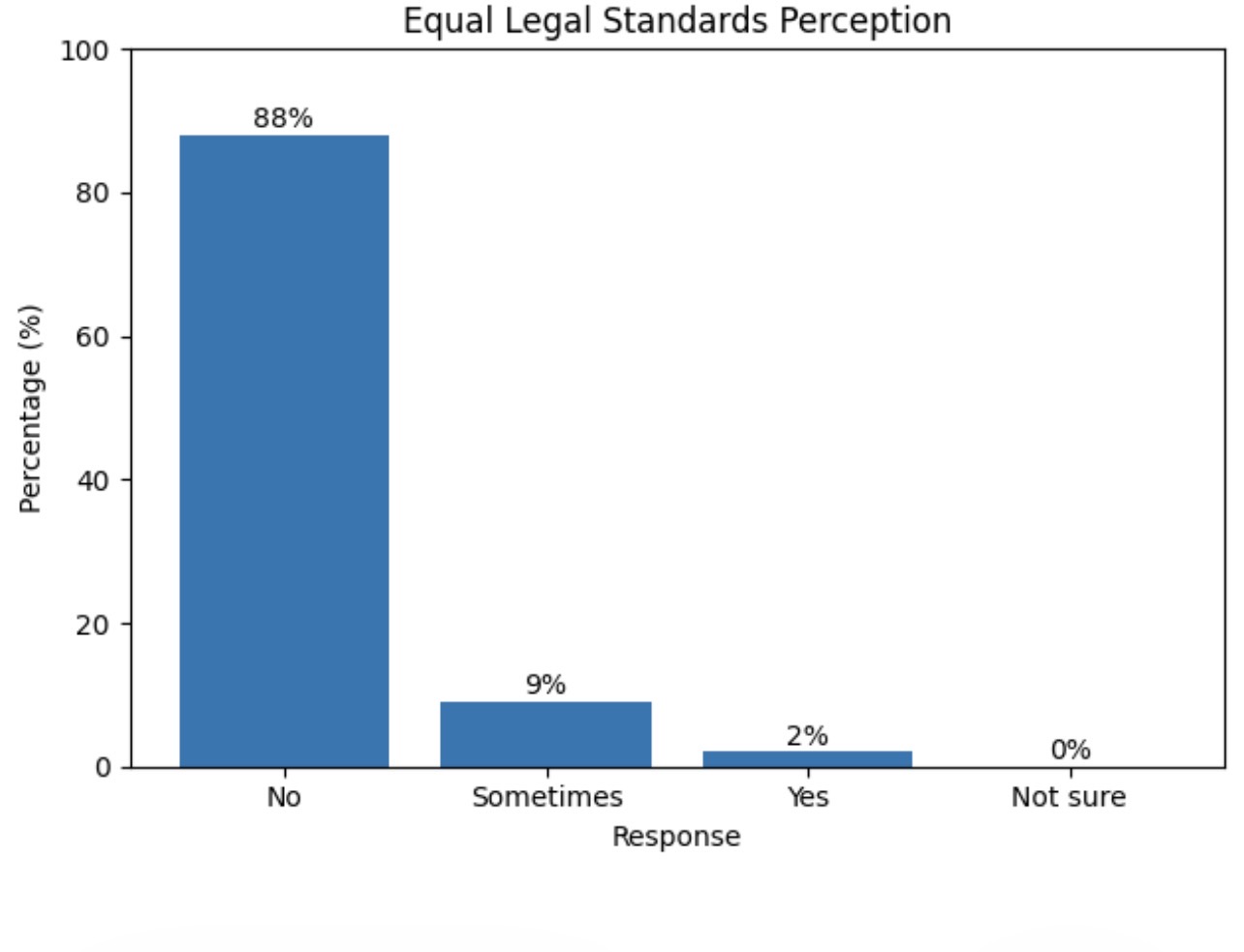
A recent Lesotho Tribune Sentiment Tracker poll has revealed a stark public perception: a large majority of respondents do not believe powerful individuals in Lesotho are held to the same legal standards as ordinary citizens.
The question posed was direct:
“Do you believe powerful individuals in Lesotho are held to the same legal standards as ordinary citizens?”
The response was equally direct.
Out of 43 votes recorded on X, 88 percent answered No. Only 2 percent said Yes, while 9 percent chose Sometimes. None selected Not sure.
Even allowing for the limited sample size, the imbalance is striking.
⸻
A Perception Gap
Public confidence in equal treatment before the law is foundational to constitutional democracy. When nearly nine out of ten respondents say they believe the law does not apply equally, it signals more than dissatisfaction. It signals distrust.
In a small jurisdiction such as Lesotho, where political leadership, business elites and public institutions often operate within overlapping social and professional circles, perception matters deeply. Citizens watch how investigations unfold. They observe who is charged swiftly and who is not. They notice which cases stall and which move quickly through the courts.
Whether that perception reflects legal reality is a matter for institutional data and case analysis. But perception alone carries weight. Trust in institutions does not collapse overnight. It erodes gradually, through accumulated impressions.
The Context Behind the Sentiment
The poll result does not exist in isolation. Over the past year, Lesotho has seen a series of high-profile investigations, corruption allegations, governance disputes and court challenges involving senior officials, politically connected individuals and institutional heads.
Some cases have resulted in arrests. Others have been delayed. A few have been publicly debated before reaching courtrooms. Each episode feeds into a broader narrative about consistency in enforcement.
For many citizens, the question is not simply whether prosecutions occur. It is whether they occur evenly, transparently and without fear or favour.
The 88 percent “No” response suggests that, among this group of engaged respondents, confidence in that evenness is low.
Rule of Law and Economic Implications
This is not merely a legal issue. It is an economic one.
Investor confidence is closely tied to predictability and equal enforcement. If markets perceive selective application of the law, capital becomes cautious. Contracts become uncertain. Risk premiums rise.
The rule of law is not abstract. It underpins credit systems, procurement integrity, public finance discipline and anti-corruption frameworks.
A country’s governance credibility is one of its most valuable intangible assets.
—————————————————————————
Important Note on Methodology
The Sentiment Tracker poll was conducted on X and gathered 43 votes with 203 views. It is not a scientific national survey and does not claim statistical representativeness.
It does, however, provide a snapshot of engaged public opinion within Lesotho Tribune’s audience base.
Sentiment is data. It may not be definitive, but it is directional.