



MASERU — A shadow of doubt is falling over Lesotho’s upcoming National Census. A sentiment poll conducted by the Lesotho Tribune has found that a clear majority of respondents do not trust the process enough to take part — a finding that, if it reflects broader public sentiment, could undermine one of the country’s most consequential statistical exercises in years.
The poll, run across the Tribune’s social media platforms, follows allegations that census enumerator recruitment may have been shaped by preferential selection before the official application window had even closed.
At its core, the controversy reduces to one question: Can Basotho trust a process designed to count them?
What the Numbers Show
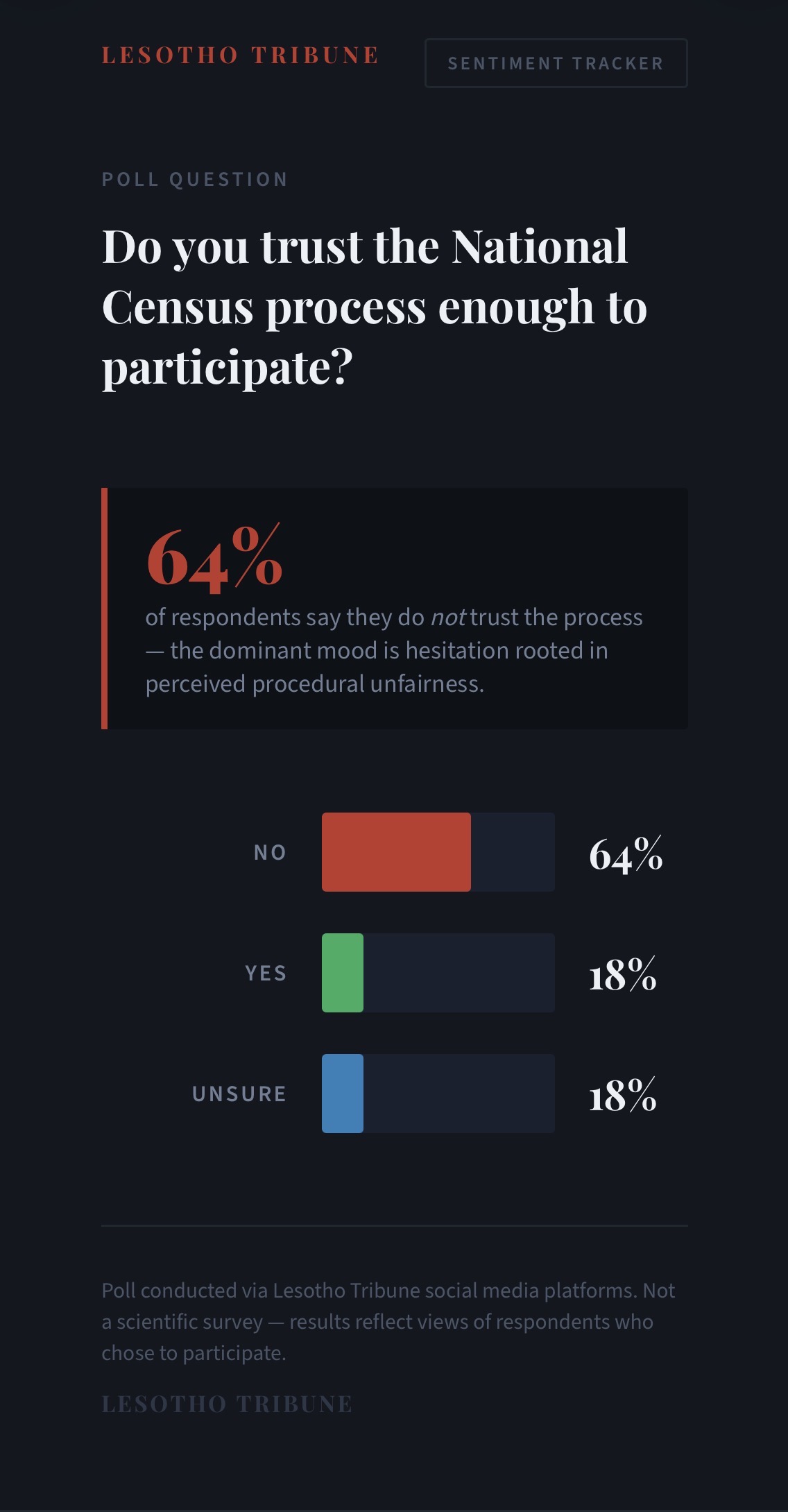
The results offer a striking portrait of public disillusionment:
∙ 64% of respondents said they do not trust the census process
∙ 18% said they would participate regardless of their concerns
∙ 18% remain undecided, watching for a government response before making up their minds
The sample size is modest, but the pattern is hard to dismiss. The dominant mood is not merely skepticism — it is hesitation grounded in a sense that the process was compromised before it began.
Why a Census Matters More Than Most Realise
A national census is not a routine administrative exercise. Its results shape the country for the decade that follows. They determine:
∙ How public resources are distributed across districts
∙ Where constituency boundaries are drawn
∙ How social and economic policy is designed
∙ How Lesotho presents itself to international partners and development institutions
When trust erodes this early in the process — at the recruitment stage, before a single household has been visited — the integrity of everything downstream is called into question.
The Perception Problem
Whether the allegations of pre-selection are ever formally substantiated may, in practice, matter less than the fact that many Basotho already believe them.
In governance, perception has real consequences. The claim that enumerators may have been chosen through back channels rather than merit does not sit in isolation. It lands in a landscape already shaped by years of concerns about:
∙ Preferential treatment in public appointments
∙ The politicisation of institutions meant to serve all citizens
∙ The absence of credible, independent oversight mechanisms
Each new allegation reinforces the last. And with each reinforcement, the burden of proof on government grows heavier.
The Quiet Danger: Apathy Over Anger
The most alarming outcome of a trust deficit is not public outrage. Outrage, at least, is visible and can prompt a response.
The real risk is silence.
A census does not collapse dramatically. It degrades quietly — through households that give incomplete answers, communities that turn enumerators away, and citizens who simply are not home. A low-trust census produces low-quality data. And low-quality data produces flawed decisions that governments, communities, and development planners are then forced to live with for ten years.
That is the true cost of perception mismanaged.
What Authorities Must Do Now
Restoring confidence at this stage is possible, but it requires deliberate, visible action — not reassurances alone. Authorities should consider:
1. Publicly clarifying the enumerator recruitment process, with full timelines
2. Publishing selection criteria and, where possible, the names of those selected and how they qualified
Silence or defensive denial at this point will only harden the doubts already forming.
The Stakes Beyond the Count
This moment is about more than census data.
It is a test of whether Basotho believe that national processes are conducted fairly — and whether they still see value in participating in them. When citizens begin to treat participation as optional, the effects ripple outward. Governance weakens. Institutions lose legitimacy. The distance between the state and the people it is meant to serve grows wider.
A credible census will not fix all of that. But a discredited one will make it considerably worse.
Disclaimer:
The Lesotho Tribune sentiment poll was conducted via social media and is not a scientific survey. Results reflect the views of online respondents who chose to participate.