


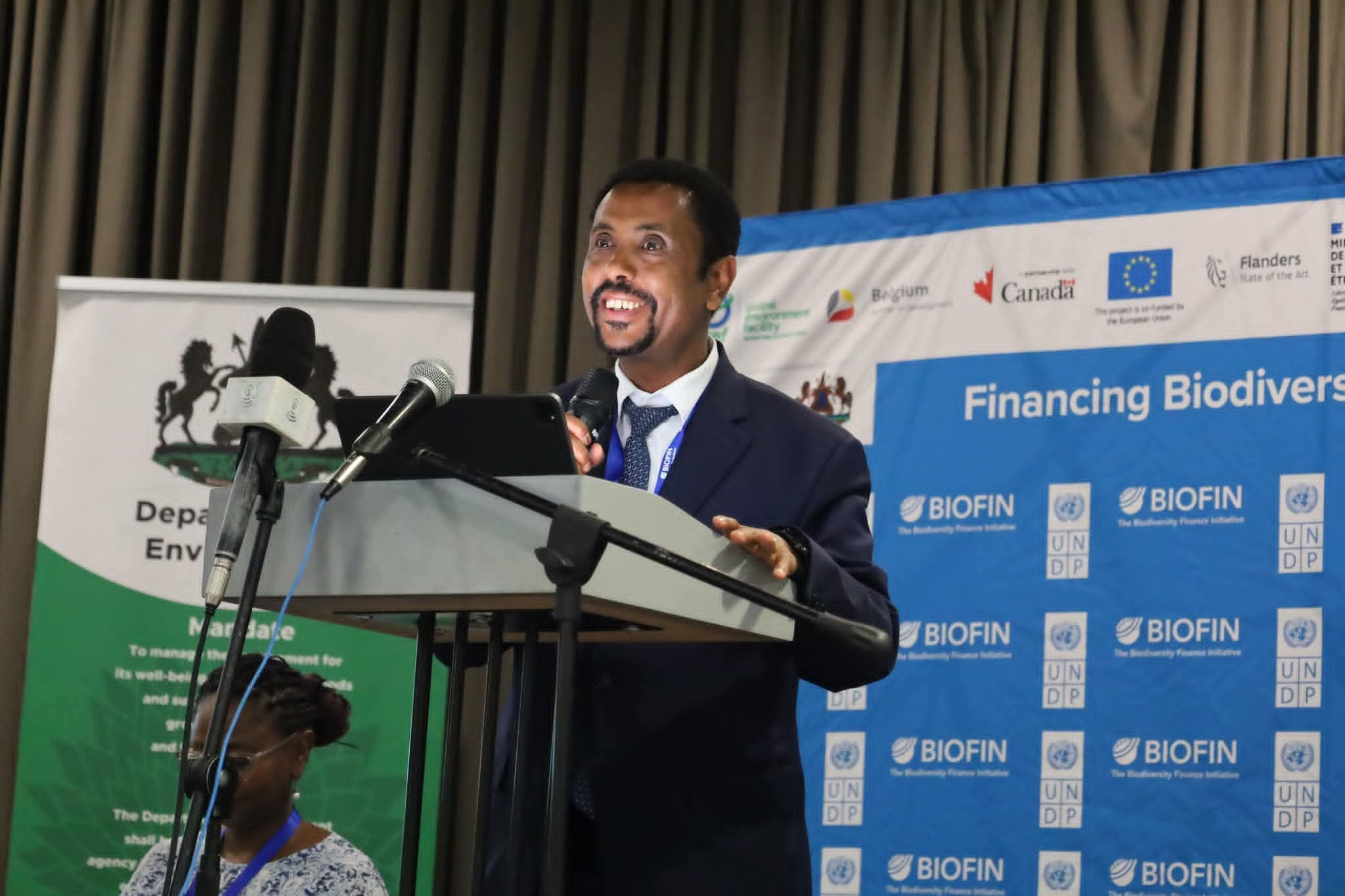
The Ministry of Environment and Forestry, in partnership with the Ministry of Finance and Development Planning and the United Nations Development Programme (UNDP) has launched the Biodiversity Finance Initiative (BIOFIN) project- a global programme that supports countries to identify, mobilise and sustainably manage financial resources required to protect biodiversity and strengthen ecosystem resilience.
This initiative is expected to support the implementation of the National Biodiversity Strategy and Action Plan III (NBSAP III) by bridging the biodiversity finance gap in Lesotho.
Taye Amsalu, the UNDP Deputy Resident Representative to Lesotho, said biodiversity is a very important part of nature worthy of being protected so that it can take care of people in return, encouraging participants of the launch to take care of their ecosystem and territories as the makers and breakers of sustainable development.
He said Lesotho was one of the few countries that is good at ratifying international treaties and international frameworks, commending its government for approving environmental-related treaties, conventions and frameworks.
However, he said these conventions need to be localised so that their trickle-down effect can be visible on the ground.
“What we are doing here is to domesticate some of those frameworks and make it work in our context. We have our own national sector development plan where environment is mainstream. We have our biodiversity strategic and action plan. And today we are going to see how do we really finance the plans we have,” Amsalu said.
He warned of the shortage in funding, saying the financial gap is one of the issues threatening Lesotho’s development impact.
“In terms of development trajectory, we are lqgging behind in a lot of development dimensions. And one of the problems is financing,” he said.
Amsalu said this issue was becoming very hard, especially given the current financial cuts across the globe, however reassuring that the launch was meant to reflect what Lesotho’s biodiversity’s financial architecture looks like.
The Ministry of Environment has been undertaking a lot of initiatives and activities to protect the environment, introducing alternative plans like the plastic levee, protected area use, tourism levees and others.
The Minister responsible for Environment and Forestry, Letsema Adontṣ̌i, said the project launch marked an important milestone in a collective journey to secure sustainable financing for biodiversity conservation and to position biodiversity as a core pillar of national development.
He warned of the source of biodiversity which he said was under increasing pressure, adding that the decline in climate, water, the system’s strong erosion and growing threat to water resources were suspected contributing factors.
Adontṣ̌i said these challenges were continuously intensifying the situation, putting an additional strain on the ecology systems and communities that depend on weather.
“Communities are suffering larger disturbances and harvesting smaller quantities. This clearly indicates that natural regeneration can no longer keep peace with humanity,” he continued, adding that the government was however finalising the recognition of national biodiversity strategies and active action plans aligned with other global biodiversity frameworks.
Through experience, the ministry has learned that strategies alone are not as sufficient. Without sustainable and predictable financing, “even the best plans remain aspirations rather than actions.”
As part of the Convention on Biological Diversity, Lesotho like many other parties is required to prepare, update and implement its National Biodiversity Strategy and Action Plans (NBSAPs) which provides the global direction for biodiversity action through to 2050; a vision to live in harmony with nature.
This vision, Rorisang Thamae, the UNPD Technical Leader, said can only be achieved if people were to take action to halt and reverse biodiversity loss for the benefit of people and the planet through conservation, sustainable use and fair and equitable sharing of benefits.
The Ministry of Forestry had engaged the UNDP in this initiative to look at some sustainable financing solutions that would be recommended for the implementation of biofin, bringing together economists and environmental partners to find financing solutions for biodiversity conservation in Lesotho.