



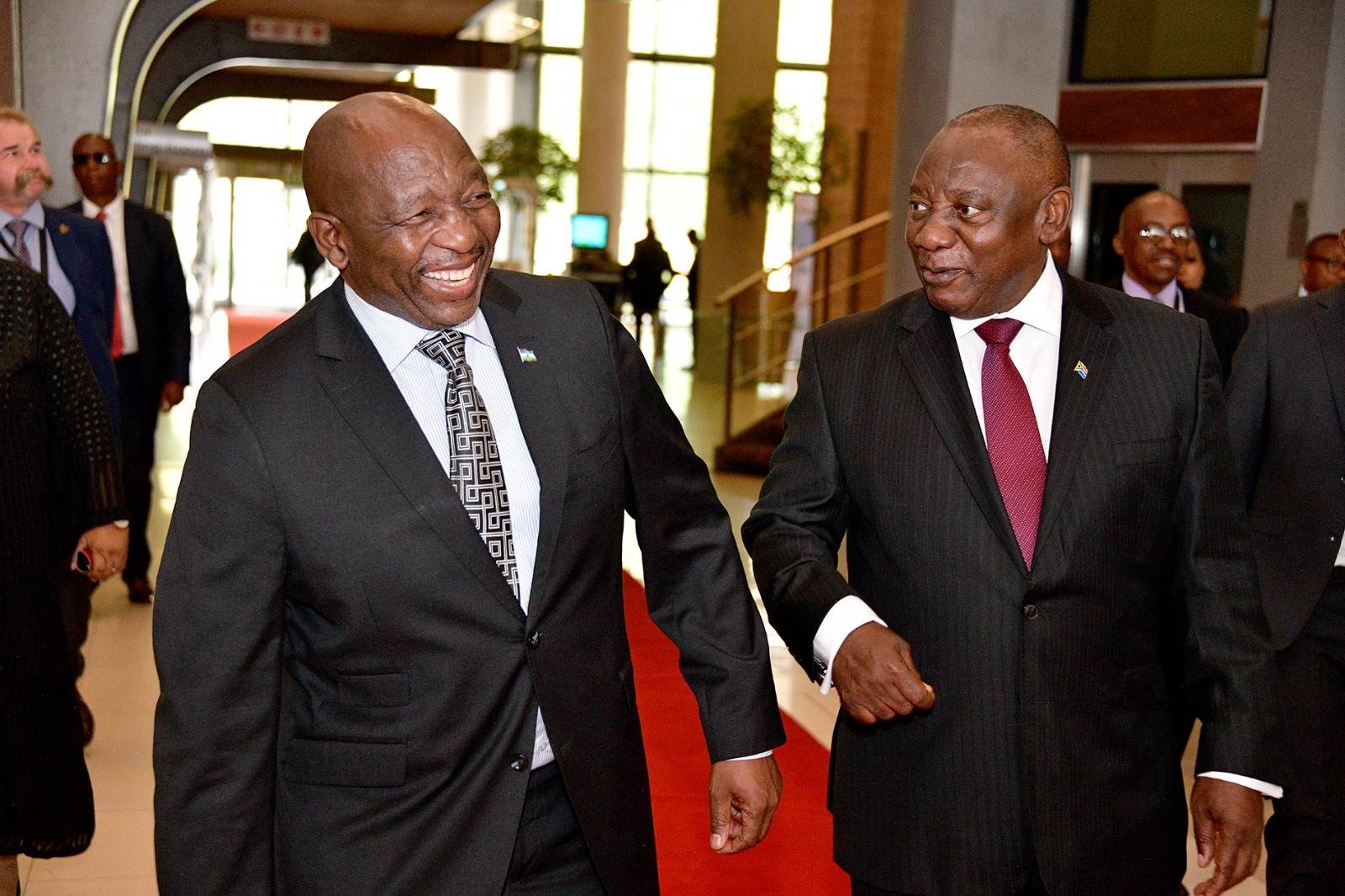
When governing parties command large parliamentary majorities, a dangerous comfort takes hold — the belief that numbers confer not merely the power to legislate, but the right to legislate anything. Recent events in Lesotho and South Africa have exposed that comfort for what it is: a constitutional fraud dressed in democratic clothing.
There is a dangerous comfort that settles over political parties when they command large parliamentary majorities. It is the comfort of believing that numbers confer not merely the power to legislate, but the right to legislate anything. That the ballot box, having spoken, silences all other voices, including the constitution itself. Recent events in both Lesotho and South Africa have exposed this comfort for what it is: a constitutional fraud dressed in democratic clothing.
The framers of modern constitutions understood, with hard-won clarity, that majorities could be just as tyrannical as kings. James Madison warned in the Federalist Papers that the greatest danger to republican government was not the despot in a palace but the faction with a majority, unchecked and unbridled. It was this understanding that gave birth to constitutional supremacy: the principle that what a parliament may do is bounded not by how many members voted for it, but by what the foundational law permits.
Two governments, separated by a border and a decade, have recently tested that principle and been found wanting.
“The greatest danger to republican government was not the despot in a palace but the faction with a majority, unchecked and unbridled.”
James Madison · Federalist PapersThe Constitutional Court of Lesotho has ruled that the National Assembly failed its constitutional duty by neglecting to pass legislation preventing conflicts of interest for members of parliament and senators in relation to government contracts. The court has ordered that the necessary legislation must now be drafted and passed, marking a significant judicial intervention against self-dealing by lawmakers. The legal action was brought by advocate and party leader Teboho Mojapelo, who argued that parliamentary inaction on the matter was unconstitutional.
Read clearly, this is a damning finding. A parliamentary majority — one dominated by the governing Revolution for Prosperity — sat in possession of a constitutional obligation and declined to honour it. The court did not need to strike down a bad law. There was no law to strike down. The delinquency here is not the abuse of legislative power but the deliberate abandonment of it: a majority choosing inaction because action would have constrained its own members’ ability to benefit from state contracts.
Former Chief Justice of the Constitutional Court of South Africa Albie Sachs wrote that constitutionalism requires power to be exercised not merely through lawful form but with lawful purpose. In Maseru, there was neither. The form of legislative duty was ignored. The purpose — the protection of public resources from those entrusted to govern them — was abandoned entirely. It took a private citizen and a court order to compel what a parliamentary majority owed the country as a matter of basic constitutional obligation.
South Africa’s Constitutional Court delivered a judgment in the Phala Phala matter that should have been a moment of reckoning for the African National Congress. The court’s findings confirmed what many constitutional scholars had long argued: that the executive is not above the document that created it.
The ANC’s response was to lean on its parliamentary majority. The party whipped its members to protect the President from parliamentary accountability proceedings, not because the law demanded it, but because the numbers permitted it. This is the precise abuse that legal theorist Ronald Dworkin identified when he distinguished between “policy” — advancing collective goals — and “principle” — upholding rights and legal integrity regardless of political cost. The ANC chose policy over principle. It chose the majority over the constitution.
The late Chief Justice Pius Langa wrote in Doctors for Life International v Speaker of the National Assembly that constitutional democracy demands not merely formal compliance with procedure but substantive respect for constitutional values. The ANC’s parliamentary manoeuvre in the Phala Phala matter satisfied the former and desecrated the latter.
“Parliamentary majorities are entitled to govern but not entitled to govern without constraint.”
Lord Johan SteynThe Constitutional Court of South Africa, in Economic Freedom Fighters v Speaker of the National Assembly, held through Chief Justice Mogoeng Mogoeng that no provision of the constitution may be used to undermine constitutional accountability. A parliamentary majority that uses procedure to frustrate rather than enable accountability is acting unconstitutionally regardless of the numbers behind it.
In Lesotho, the Court of Appeal has affirmed on multiple occasions that parliamentary sovereignty is subordinate to constitutional sovereignty. The legislature derives its authority from the constitution. It cannot, therefore, use that authority to hollow out the document from which the authority flows. This is not a radical legal position. It is the elementary grammar of constitutional government.
The RFP and the ANC occupy different political traditions and govern different countries. What they share is a willingness to use democratic process as a weapon against democratic accountability. Both have behaved, in the instances under examination, as constitutional delinquents. That is not a term applied lightly. It is the term the Constitutional Court itself applied to President Zuma in Democratic Alliance v President of the Republic of South Africa and Others, and it means precisely what it says: a failure to honour the obligations that constitutional office demands.
The RFP is a young party that entered government on a mandate for change. It has squandered that mandate with extraordinary speed by allowing a constitutional obligation to gather dust until a private citizen was forced to drag parliament to court to perform its basic duty. The ANC is an old party that defeated apartheid and wrote one of the world’s most admired constitutions. It has allowed that achievement to curdle into the instrument of its own protection.
Courts can correct specific constitutional violations. They cannot correct a political culture. That correction belongs to citizens.
The harshest sanction available in a constitutional democracy is not a court order. It is the withdrawal of democratic trust. Both the RFP and the ANC have earned that withdrawal. The electorate, which remains the ultimate constitutional authority, should administer it without hesitation.
Majority rule is the mechanism of democracy. It is not its purpose. The purpose is the protection of all citizens, including and especially those who did not vote for the majority. When a governing party forgets that distinction, it has not merely made a political error. It has committed a constitutional one.
The correction belongs to the people.
“`