



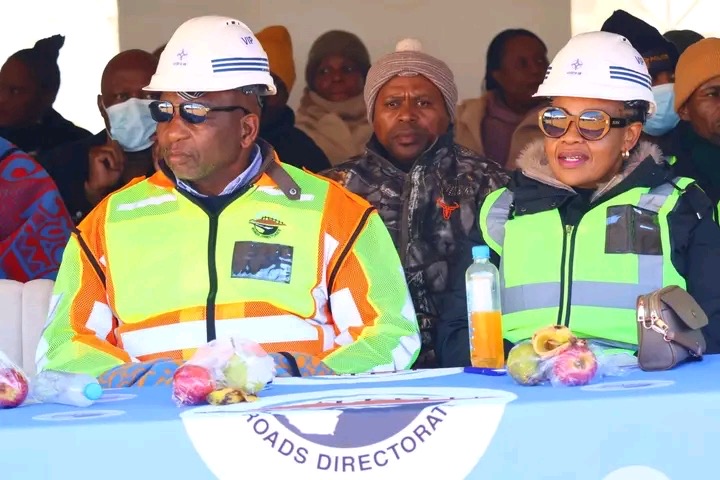
Prime Minister Matekane has broken ground on a M1.4 billion road and bridge project that will end decades of seasonal isolation for communities in Lebakeng, Qacha’s Nek, opening the district’s most remote villages to year-round access to schools, clinics and markets for the first time.
Prime Minister Ntsokoane Matekane officially launched the Mateleng-Lebakeng Road Upgrading Project at Melikane Combined School in Maheng on Thursday, turning the first sod on what the government has described as the largest project ever funded entirely from the national fiscus. The M1.4 billion contract has been awarded to China International Water and Electric Corporation, with construction scheduled for completion by February 2030.
The project entails the upgrading of 45 kilometres of road between Mateleng and Lebakeng to an all-weather tarred standard, the construction of 1.4 kilometres of gravel road to Melikane Combined School, and the construction of permanent bridges over four river crossings: the Tseleng, Lijabatho, Melikane and Senqu rivers. It is those crossings, washed out every rainy season, that have repeatedly severed communities from the outside world for days or weeks at a time.
“Today your government has heard your longest cry.”
Prime Minister Ntsokoane Matekane, Maheng, Qacha’s Nek
What the project will deliver
The Prime Minister told those gathered at Maheng that the consequences of the current road conditions are felt across every dimension of community life. Children miss school during the rainy season. Teachers decline postings in Lebakeng because the roads make the district effectively unreachable for extended periods. Patients fail to reach health centres. Addressing the crowd directly, Matekane framed the project in terms that went beyond infrastructure. “When this road and the bridges are done, many problems will be history,” he said. “No more children missing school for days. No more teachers refusing posts here because the roads are bad. No more patients failing to reach health centres.”
He instructed the Minister of Public Works to ensure the work meets the highest construction standards and directed that the bridges be built to withstand any weather event. The project is aligned with the National Strategic Development Plan II, which identifies road infrastructure as a prerequisite for trade, market access and service delivery in underserved districts.
| Project component | Detail |
|---|---|
| Total project value | M1.4 billion (~$85.5 million) |
| Funding source | Government of Lesotho (fully funded) |
| Main road upgrade | 45 km, Mateleng to Lebakeng (tarred, all-weather) |
| School access road | 1.4 km gravel to Melikane Combined School |
| Bridges | Tseleng, Lijabatho, Melikane, Senqu rivers |
| Contractor | China International Water and Electric Corporation |
| Unskilled jobs for local communities | ~450 |
| Target completion | February 2030 |
USD equivalent at approx. M16.38/$1 (June 2026). Source: Office of the Prime Minister / Ministry of Public Works and Transport.
Local jobs, procurement and compensation
The Prime Minister said approximately 450 unskilled positions will be created for residents of villages along the road corridor. He directed the contractor to source materials locally where available, instructing it to purchase sand, stone and other inputs from the surrounding communities before looking elsewhere. He further directed local leaders to ensure Basotho entrepreneurs are given preference in supplying project materials.
On the matter of compensation for affected landowners, Matekane was unambiguous. “Whoever is responsible must pay people whose fields are affected, and they must pay on time,” he said, cautioning that he did not want to return to the district to resolve compensation disputes that should be settled before they arise.
Tourism and connectivity
Matekane called on the Ministry of Tourism to develop and promote the area’s considerable natural and cultural assets once the road is complete. He specifically identified San and Khoi rock art caves located between Thabana-li-Mele and Ha-Khanya, as well as the historic Melikane site, as attractions capable of sustaining an ecotourism economy. The Ministry of Forestry and Environment was directed to ensure that development proceeds within a framework of environmental protection. On digital infrastructure, the Prime Minister said he had already engaged the Minister of Communications on extending internet connectivity to Melikane Combined School.
What those present said
Minister of Public Works and Transport Motee Motiane told the ceremony that Qacha’s Nek and Thaba-Tseka remain among the least accessible districts in Lesotho and that poor road infrastructure directly compounds poverty and limits access to basic services. Addressing the contractor directly, he said: “We have trusted you with Lesotho’s biggest government-funded project. Treat it well and make sure the nation benefits.”
China International Water and Electric Corporation’s Southern Africa manager, Zhao Xudong, cited the company’s 70 years of experience across more than 80 countries and pledged timely, high-quality delivery with full environmental protection. He invoked a Chinese proverb that has become something of a development axiom: “If you want to get rich, build a road first. Where there is a road, there is wealth.”
Lebakeng MP Letlatsa Mokati said the project fulfils a commitment residents extracted from him at the time of his election in 2022. He urged the contractor to avoid the delayed payments and safety failures that have marred other infrastructure projects in the region. Principal Chief Mokhesi Tseko Makoa welcomed the development, observing that progress in Lesotho, though sometimes slow, was accumulating. Ntsiwoeng Community Council chairperson Teboho Lehoko said the project would mean most if it translated into measurable reductions in local unemployment. Melikane chief Leetso Khanya, in remarks that captured the sentiment of the occasion, said the community had not expected the intervention. “This government keeps its promises instead of just talking,” she said.
By Lemohang Botsane | Lesotho Tribune · Qacha’s Nek