



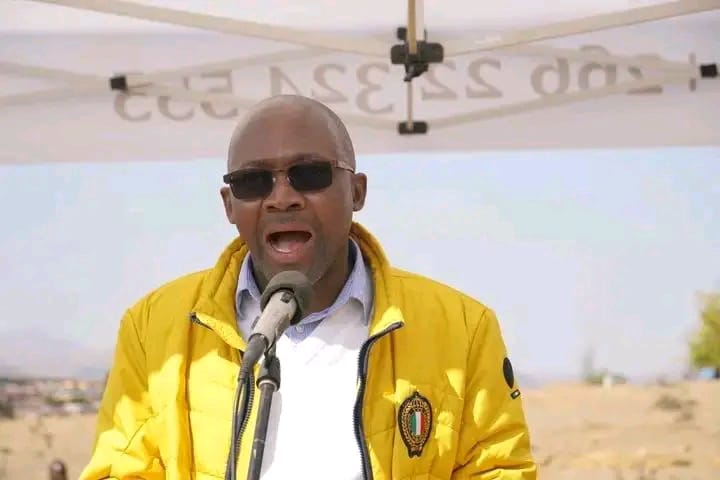
MASERU-Lesotho is in mourning following the passing of former Principal Secretary, community leader and senior opposition figure, Malefetsane Nchaka, whose death late Saturday night has closed a chapter on a life deeply entwined into the country’s public service and political history.
News of his death was confirmed on Sunday by All Basotho Convention (ABC) Secretary General, Thebe Mokoatle, who said Nchaka died at around 23:00 after a prolonged illness. He had been battling prostate cancer for some time.
Nchaka’s passing has sent ripples of sorrow through political circles, government institutions and communities where he was known not only as a senior official and politician, but also as a mentor, organiser and quiet mobiliser for development.
Those who worked closely with him describe a man whose life was shaped by an enduring belief in service, service to the state, to his party and to ordinary citizens.
Born and raised in Lesotho, Nchaka came of age in a period when the country’s public institutions were evolving and often under strain. It was within this environment that he built a career in public administration, steadily rising through the ranks to occupy some of the most demanding senior posts in government.
Among the positions he held, he is perhaps best remembered for his tenure as Principal Secretary in the Ministry of Agriculture and Food Security. It was a role that placed him at the centre of one of the most sensitive and strategic sectors of the national economy, food production, rural livelihoods and national resilience.
Colleagues from that period recall a disciplined administrator who paid close attention to systems, policy detail and institutional order. He was known to insist on punctuality, proper procedure and accountability, not out of rigidity, they say, but from a conviction that effective governance depended on strong, well-run institutions.
Under his watch, the ministry navigated complex challenges linked to food security, climate pressures and rural development. While public service rarely brings visible applause, those within the ministry credit Nchaka with strengthening internal coordination and pushing for policies aimed at improving support to farmers and rural communities.
Yet his life cannot be contained within job titles alone.
Beyond the corridors of government, Nchaka remained firmly rooted in community affairs. He was widely regarded as approachable, a senior figure who did not withdraw behind office doors, but who continued to attend local gatherings, party meetings and development discussions.
Mokoatle described him as “a committed public servant who dedicated much of his life to serving the nation through public administration and political engagement.” He said Nchaka believed deeply in democratic participation and in the responsibility of leaders to remain connected to the people they served.
That belief found renewed expression in the later chapter of his life, when he stepped more visibly into partisan politics.
As a senior member of the ABC, Nchaka was part of the generation that helped shape and sustain the party during critical moments of Lesotho’s multiparty era. Within party structures, he was known as a stabilising presence, someone who valued internal dialogue, organisational discipline and grassroots mobilisation.
His decision to contest the 2022 National Assembly elections as the ABC candidate for Thaba-Putsoa Constituency reflected not ambition, but continuity. To those close to him, it was proof that he had not retreated from public life after government service, but had instead chosen to re-engage directly with voters and community structures.
Although electoral contests are, by nature, uncertain and often unforgiving, Nchaka’s campaign was widely viewed as an extension of his lifelong commitment to participation and representation. He spoke frequently about development, youth involvement and the need for experienced leadership that could bridge the gap between state institutions and everyday realities.
In private life, friends and associates describe him as measured, thoughtful and respectful. He was not known for flamboyant speeches or dramatic gestures, but for careful listening and considered responses. In meetings, he preferred substance over spectacle, and he was often the one to remind colleagues of procedural detail or historical context.
His illness, though known to close associates, was largely borne with privacy and dignity. Even as his health declined, he remained in contact with party colleagues and friends, offering advice, encouragement and, at times, gentle humour.
The announcement of his death has prompted an outpouring of condolences from political figures, former colleagues and community members. Many speak of his consistency, a rare quality in public life, and of a man whose positions may have changed over time, but whose dedication to service did not.
As tributes continue to emerge, a portrait is forming of a leader who did not chase the spotlight, but who laboured within institutions, believing that progress is often built through patient administration, principled politics and sustained community engagement.
Funeral arrangements have not yet been announced, but the nation is already reflecting on a life marked by duty.
In Malefetsane Nchaka’s passing, Lesotho loses more than a former Principal Secretary or a senior party member. It loses a generation of leadership that understood public service not as a stage, but as a long, demanding journey, one that he walked with commitment until the very end.