



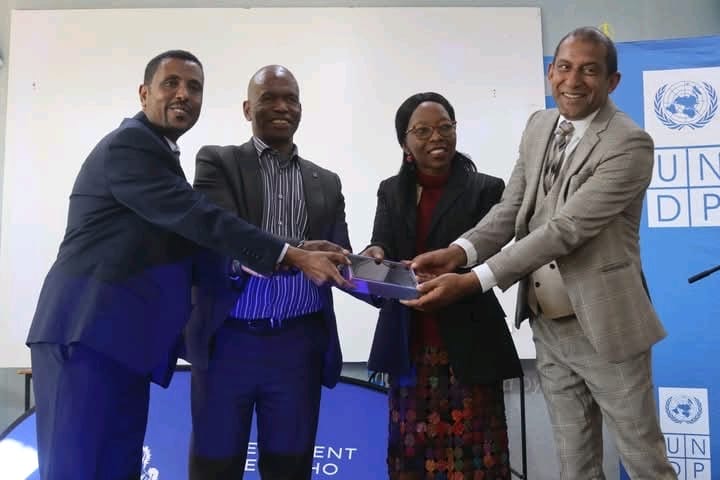
To bridge the digital divide in Lesotho, the United Nations Development Programme (UNDP) has launched a Community Digital Inclusion Model by transforming school computer labs into Community Digital Learning Centres. This initiative, launched in collaboration with the Ministry of Education and Training (MoET) and the Ministry of Information, Communication, Science, Technology and Innovation (MICSTI) in Maseru this week, aims to empower underserved communities with access to digital tools, skills training and e-government services.
Digital literacy is recognised as a cornerstone for building stronger economies and unified communities in today’s world. Supported by the UNDP, this project aspires to position Lesotho as one of the technologically advanced countries. With the help of 40 trained community members acting as digital ambassadors, the UNDP is committed to enhancing the understanding of technological devices among Basotho and demonstrating how these tools can be beneficial.
Lineo Ramabele, the Deputy Principal Secretary of MICSTI, emphasised that the primary goal of the initiative is to ensure that no Mosotho is left behind during this digital transformation era. The handover was not merely an act of charity; it symbolised the UNDP’s commitment to including all Basotho, regardless of gender orientation or economic class.
In his speech, UNDP Resident Representative Taye Amssalu described the event as more than just a formality; he viewed it as a promise of inclusion.
“We are handing over 55 computers and 100 tablets to enable this initiative,” he stated.
He highlighted the potential changes this initiative could bring to the services that Basotho require.
“Imagine a future where Basotho can apply for Identification Cards, Death Certificates, passports and police clearances online. Consider the convenience this would offer to those living in mountainous regions,” he exclaimed.
Nizam Goolam, Chief Executive Officer of the Lesotho Communications Authority (LCA), discussed the regulatory perspective on digital inclusion. He noted that key factors include ensuring universal access to ICT infrastructure for both urban and rural communities, as well as the affordability of services and devices. Goolam confirmed that these aspects have been carefully addressed in the new project.
“Expanding network coverage is vital for enhancing digital inclusion,” he asserted.
The LCA has established 124 base stations across the country as part of this effort. Goolam mentioned that millions of Maloti have been spent repairing infrastructure in remote areas vulnerable to vandalism. However, he pointed out that investing in infrastructure would have been a more beneficial use of that money.
“We are setting up computer labs in high schools and establishing Wi-Fi networks for tertiary campuses to meet the Ministry of Education halfway in fulfilling its requirements,” he explained, adding that this initiative aligns perfectly with the LCA’s mandate.
He also highlighted that efforts are being made to convert post offices into internet hubs for rural communities.
“There was a time when letters were an efficient mode of communication, but that is no longer the case. The infrastructure of post offices can now serve as internet hubs for those communities,” said Goolam.
As regulators in the communications sector, the LCA has not overlooked consumer protection issues. Goolam noted that the authority has conducted campaigns aimed at raising awareness about cybersecurity and the potential risks associated with being active online.