



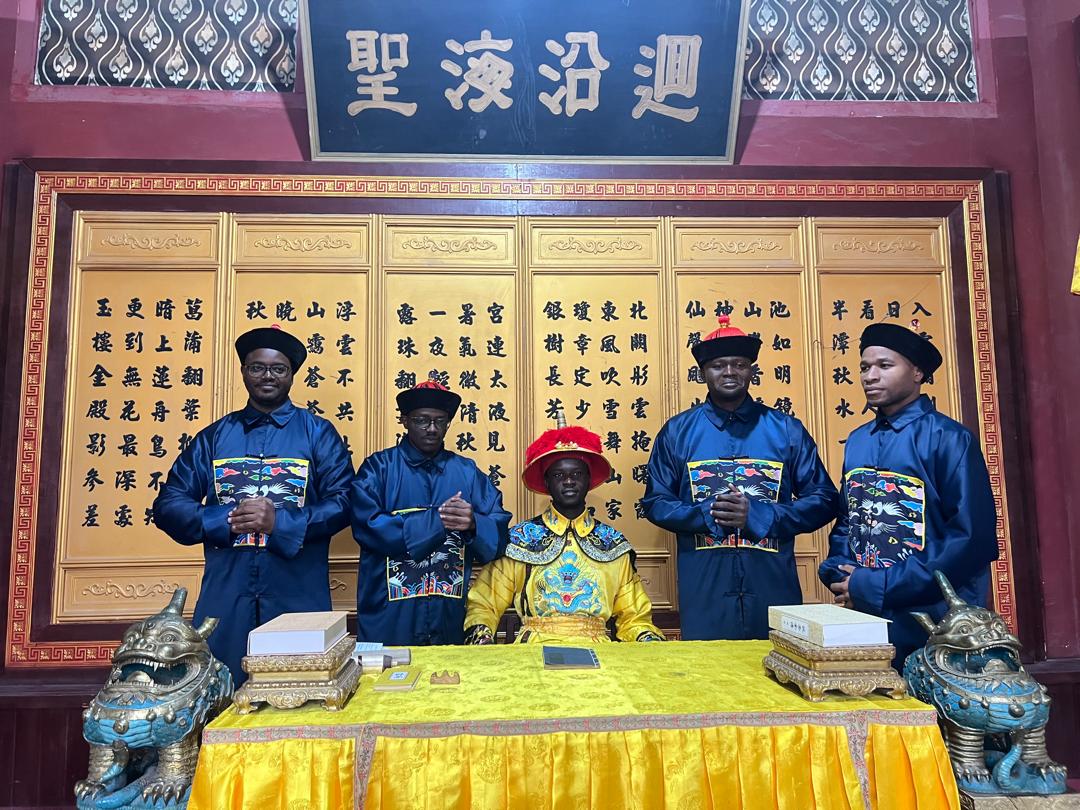
In Hengdian, China’s answer to Hollywood, the future of filmmaking is already here. Elsewhere in Zhejiang Province, productions that would traditionally require months of work, dozens of crew members and actors are now completed in a week. Where Western film industries nervously debate artificial intelligence’s role in creative work, China has decisively moved forward-not by replacing human creativity, but by retraining its workforce to harness AI as a tool for enhancement rather than replacement.
I witnessed this transformation first-hand during a CHINA-AID Educational Training Centre-sponsored month-long visit to Zhejiang province, and the implications for African storytellers are profound. The Training Program on Professional Skills for African Film and Audio-visualIndustry Practitioners was a robust initiative which proved that while we, in Africa, remain tethered to outdated paradigms – debating whether to embrace or resist technological change – China has leaped ahead by decades. The lectures received from Zhejiang Normal University’s film school proved that indeed AI is being embraced at every level and it is enhancing efficiency. The question facing African filmmakers isn’t whether to adopt these innovations, but how quickly we can do so while also learning from them.
The irony of my own education illustrates our predicament perfectly. When I graduated in 2007, I held a distinction in typewriting. Typewriters had already vanished from newsrooms. This disconnect between what we teach and what the world demands persists across much of Africa in 2025. We’re preparing students for industries that no longer exist while the tools reshaping global storytelling remain largely unexplored on our continent.
The Hengdian model
What China has built in Hengdian represents more than just infrastructure-it’s a complete reimagining of the production ecosystem. The scale is staggering, but what struck me most was the integration of AI and new technology at every level. AI doesn’t simply speed up post-production; it’s woven into all processes. The result isn’t soulless automation but rather the democratization of high-quality production capabilities. Companies like Versatile are achieving staggering results.
This matters for Africa because our stories have always struggled against resource constraints. Limited budgets mean limited ambition. But if AI can compress production timelines and reduce costs without sacrificing quality, suddenly the economics of African storytelling shift dramatically. A film that might have been impossible at $500,000 becomes viable at $50,000, a mere fraction. More stories can be told, more voices can be heard, and more perspectives can reach global audiences.
And unlike what Zimbabwe did decades ago by diminishing the role of the gatekeeper in the music sector opting for mere quantity and not quality, the quality that is being achieved is staggering. True, getting rid of gatekeepers does help one way, but without caution and care, societal and cultural values that distinguish any people may be eroded thereby doing more harm than good.
Learning from Lanxi and beyond
During my time in Zhejiang, I visited Lanxi, a city that exemplifies how China balances reverence for history and luminaries littered therein with aggressive modernization. Traditional architecture provides authentic backdrops for contemporary narratives. The past isn’t treated as a museum piece but as living inspiration for present creativity.
This approach offers a template for African storytelling. We too possess rich cultural traditions, complex histories, and diverse narratives that deserve global platforms. Yet we’ve often struggled to package these stories in ways that compete internationally-not because our stories lack merit, but because we lack the technical infrastructure and distribution networks to present them compellingly.
The vocational film school I visited in Zhejiang produces graduates who aren’t just theoretically trained but practically experienced. Their portfolios include work that has achieved national and international recognition while they’re still students. The curriculum not included boy adapts rapidly to industry changes but also drives it. When new platforms emerge or technologies evolve, the training evolves with them.

Compare this to many African film schools, where equipment is outdated, industry connections are limited, and graduates emerge with skills the market no longer values. The typewriting distinction I earned nearly two decades ago exemplifies this pattern repeated across disciplines. We cannot continue training for yesterday’s industries while tomorrow’s opportunities pass us by.
The China University of Zhejiang
At CUZ, I encountered an institution that treats filmmaking not as fine art alone but as an integrated discipline combining technology, business, and culture. Students learn traditional cinematography alongside AI-assisted production techniques. They study distribution strategies for emerging platforms that didn’t exist five years ago. They’re prepared not just to work in the industry as it exists but to shape the industry as it evolves.
This holistic approach is what African institutions must adopt. We need film programs that teach both craft and commerce, tradition and innovation, local storytelling and global distribution. Our graduates must be as comfortable navigating Chinese social media platforms as they are shooting on location in rural villages.
The collaboration imperative
The shortage of African stories in China represents both a challenge and an opportunity. The few African narratives that have reached Chinese audiences-whether through film, television, or digital platforms-have attracted strong viewership. The appetite exists; what’s missing is the pipeline.
This requires collaboration, not competition. We should invite Chinese filmmakers, technicians, and producers to Africa, immersing them in our contexts and stories. Simultaneously, we must send African storytellers to China-not as tourists but as serious students of their methods, technologies, and distribution strategies.
The goal isn’t to mimic Chinese content but to learn their processes. How do they integrate AI without losing human creativity? How do they develop new platforms rather than depending on Western gatekeepers like Netflix and YouTube? How do they monetize content across diverse distribution channels? These are technical and business questions, and China has developed compelling answers.
Beyond Western gatekeepers
Consider the mathematics of the current system. A Lesotho-produced film uploaded to YouTube might realistically achieve 100,000 views, primarily from neighbouring South Africa where local content naturally takes precedence. Netflix, meanwhile, imposes demands that effectively exclude most African productions from their platform. There is a new form they call micro-film that is garnering billions of views for a single film. On some platforms, a single stream is worth RMB2. If a Lesotho production gets 200 million views on such a platform, that amounts to RMB400 million. That is almost US$60 million or M1 billion.
One of the things that make such films attractive is their riveting storylines, high production value and short episodes. But wishing it does not make it happen. We must start working.
The revenue from such viewership transforms filmmaking from a financially precarious passion project into a sustainable industry. It revitalizes a whole economic ecosystem. It builds producer confidence. Success breeds investment, investment enables quality, and quality attracts larger audiences-creating a virtuous cycle that’s impossible within current Western-dominated distribution systems.
China has created dozens of platforms where content that might not suit traditional broadcasters generates millions in streaming revenue. These platforms reflect Chinese preferences and viewing habits, but their success demonstrates that alternatives to YouTube and Netflix are viable. Africa needs similar platforms tailored to our contexts, languages, and storytelling traditions.
Cultural resonance
One view I have always held is that any two peoples must always focus on their similarities instead of their differences. It was refreshing that Africans indeed share a lot of similarities with the Chinese. Our dishes differ, but we essentially eat the same things-grains, vegetables, meat prepared with care and shared communally. Our lives revolve around family, respect for elders, and collective rather than purely individual success.
These similarities suggest our stories might resonate with Chinese audiences more naturally than they do with Western ones. Where Hollywood has often reduced Africa to poverty, conflict, and exoticism, Chinese audiences might recognize the universal human experiences our stories contain-family obligations, generational tensions, economic aspirations, romantic complications, and the eternal dance between tradition and modernity.
The work must start now
We must start from where we are, pursuing excellence with available resources while building toward more ambitious goals. This means several concrete steps.
First, African governments and private investors must fund exchanges that send filmmakers, technicians, and students to Chinese institutions for extended training. Brief tourism-style visits accomplish little; we need immersive programs lasting months or years.
Second, we should invite Chinese production companies to establish African operations, not extracting our stories but collaborating on their telling. Joint ventures that combine Chinese technical expertise with African creative vision could produce work that succeeds in both markets.
Third, African entrepreneurs must develop continent-specific streaming platforms and social media networks. We cannot depend indefinitely on Western companies that don’t prioritize our content or Chinese platforms designed for Chinese users. We need infrastructure we control.
Finally, African film schools require comprehensive reform. Curriculums must evolve continuously, incorporating new technologies and platforms as they emerge. Partnerships with Chinese institutions could accelerate this process, bringing cutting-edge training to African students without requiring everyone to travel abroad.
The choice facing African storytellers isn’t whether to embrace AI and emerging technologies but whether we’ll do so proactively or find ourselves marginalized by another generation of innovations we failed to adopt. China’s example demonstrates that technological advancement need not obliterate tradition or eliminate jobs-it can enhance human creativity and multiply opportunities.
Our stories deserve global audiences. Our filmmakers deserve world-class training and tools. Our entrepreneurs deserve platforms that serve our interests. Looking east, we can find models that make all of this possible. The question is whether we’ll act while the opportunity remains, or whether we’ll still be debating the merits of change while the world moves forward without us.
Silence Charumbira is an international journalist based in Maseru, Lesotho. He is former Deputy Editor of the Lesotho Times and Sunday Express. He has also worked with multiple reputable organisations like China Daily, Guangming, Associated Press (AP) The Guardian and CNN, among others. He writes on diverse topics including China-Africa relations. Views expressed in this article are his own and do not necessarily represent those of the publication.