



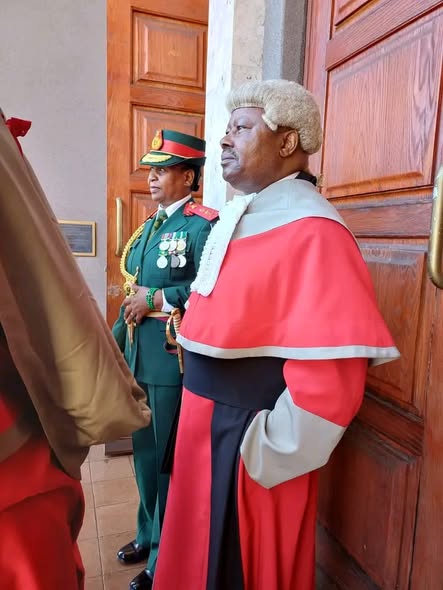
MASERU – Chief Justice Sakoane Sakoane has delivered a blunt assessment of Lesotho’s justice system: case backlogs are not disappearing any time soon.
Opening the 2026 judicial year, the Chief Justice warned that as long as courts remain the primary forum for resolving disputes, without effective alternative mechanisms, the pressure on the judiciary will continue to mount.
“The story of the backlog of cases does not end,” he said, arguing that expanding access to justice inevitably increases filings and deepens systemic strain.
Five Acting Judges Appointed
In response to the growing workload, the Judicial Service Commission, acting under section 120(5) of the Constitution, advised King Letsie III to appoint five acting judges. The appointments took effect on 1 September last year.
Those appointed are Advocate Sekake Malebanye KC, Advocate Tšebang Putsoane, Senior Resident Magistrate ’Manapo Motebele, Resident Magistrate Palesa Rantara and Advocate Tšoana Lesaoana.
Malebanye and Rantara have been deployed to the newly established Southern Division of the High Court, based in Mohale’s Hoek. The division officially opens for business today and is expected to begin hearing cases on 16 February. Its formal inauguration will be conducted by Prime Minister Sam Matekane on a date yet to be announced.
The Southern Division will serve Qacha’s Nek, Quthing and Mohale’s Hoek, as well as parts of Mafeteng including Matelile, Ha Ramabanta, Kubake and Ribaneng.
The Chief Justice described acting appointments as a practical recruitment pipeline, allowing candidates to gain judicial experience before committing permanently to the bench. However, he conceded that attracting senior practitioners from private practice and academia will remain difficult unless judges’ conditions of service improve.
“For the system to attract experienced and suitably qualified candidates, there has to be an improvement in the package for judges,” he said.
Independence and Accountability
Sakoane reaffirmed judicial independence as non-negotiable, stating that judges must be free to decide cases without interference from political actors, economic interests or public pressure.
At the same time, he insisted that independence must be matched with accountability, particularly in the timely delivery of judgments.
“Judges and magistrates account only through their judgments, judgments that are clear, reasoned, timely and anchored in law,” he said, cautioning that delayed rulings erode public confidence and bring the judiciary into disrepute.
He signalled that disciplinary measures would be used where necessary to enforce standards.
The Chief Justice also addressed corruption and unethical conduct within the courts, warning that even allegations, whether proven or not, weaken public trust.
“Corruption is not only a crime. It is a betrayal of the judicial oath and a subversion of justice,” he said, adding that wrongdoing would not be shielded.
He pledged that constitutional mechanisms and judicial codes of ethics would be enforced without fear or favour, stressing that integrity remains the cornerstone of a fair, clean and transparent judiciary. In a striking reference, he cited Deuteronomy 16:18–20, which calls for judges to administer justice with righteousness.
A “Hydra-Headed” Problem
Turning to systemic delays, Sakoane described them as a hydra-headed monster that multiplies when tackled in isolation.
He called for a whole-of-sector approach, examining all justice-sector institutions to identify root causes and craft targeted interventions.
He expressed disappointment with the performance of court-annexed mediation, saying it has failed to achieve its intended purpose because litigants often do not settle. He criticised lawyers, particularly those representing state institutions, for advising clients not to sign mediation agreements without further review, creating the perception that the Crown resists early settlement in cases brought by citizens against state agencies.
Performance Decline Raises Alarm
The Chief Justice revealed troubling performance statistics.
The Labour Court recorded a 22 percent decline in completed cases compared to the previous year, when 217 matters were finalised.
Even more concerning, performance in the Magistrates’ Courts declined by 51 percent compared to the 2024/25 judicial year.
Sakoane described the trend as disturbing, noting that most Basotho access justice through subordinate courts.
He said Chief Magistrates would be held accountable for the decline in performance.
To address the challenges, he announced that the bench-bar committee would conduct a study and submit a diagnostic report with recommendations to his office.
A System at a Crossroads
The message from the opening of the judicial year was clear: expanding access to justice without parallel reforms in capacity, compensation, ethics enforcement and dispute resolution will continue to strain the courts.
Backlogs may be here to stay for now. The question is whether institutional reform can move faster than the cases piling up.