Lesotho Tribune’s latest Sentiment Tracker reveals a nation divided, but not evenly.
In a cross-platform poll asking, “Should Lesotho be part of South Africa?” a plurality of respondents rejected the idea of incorporation, signalling that sovereignty remains a powerful emotional and political anchor.
Across 107 recorded votes on X, 45 percent selected “No, protect sovereignty.”
Meanwhile, 36 percent supported integration for economic reasons, 13 percent favoured regional integration only, and 6 percent remained undecided.
The margin is clear, but the underlying message is more complex.
Sovereignty Leads, But By No Landslide
At 45 percent, the pro-sovereignty camp leads. Yet it does not command an outright majority. Combined, 49 percent of respondents either favour full integration for economic reasons or prefer a deeper regional arrangement.
That near parity tells its own story. Attachment to independence remains strong. But economic pressure is clearly reshaping public thinking.
Economic Anxiety Is Driving the Debate
The 36 percent backing incorporation specifically for economic reasons suggests frustration rather than ideological realignment.
This bloc appears less concerned with national identity and more focused on jobs, income stability, market access, and currency alignment. It reflects a growing sentiment that economic performance, not symbolism, is what matters at household level.
If the question had been framed purely in economic terms, the numbers may have looked even tighter.
Regionalism as a Middle Ground
Thirteen percent opted for “Regional integration only.” This group represents a pragmatic middle path: deeper economic and administrative coordination without formal political absorption.
In many ways, this bloc may represent the strategic centre of the debate. It suggests that voters are exploring structural solutions beyond the binary of independence versus incorporation.
Online Reaction Reflects Emotional Undercurrents
Comments under the poll reveal that the debate is not merely technical.
Some users questioned the practical meaning of sovereignty in light of economic dependency. Others defended independence as non-negotiable regardless of economic hardship.
The tone underscores how closely sovereignty is tied to dignity and identity, even as economic realities challenge that attachment.
What This Means
Three key signals emerge:
1. Sovereignty remains the single strongest position.
2. Economic frustration is large enough to seriously challenge the status quo.
3. The debate is no longer fringe. It is mainstream.
While this poll reflects online participants rather than a scientific national sample, it offers a snapshot of an evolving conversation.
For policymakers, the message is clear. Citizens may not be ready to surrender sovereignty, but a significant portion are questioning whether current economic outcomes justify the existing model.
If economic performance improves meaningfully at household level, sovereignty sentiment will likely strengthen. If not, the 36 percent may grow.
⸻
Sentiment Tracker
Question: Should Lesotho be part of South Africa?
Platform: X
Total Votes: 107
Results:
No, protect sovereignty – 45%
Yes, for economic reasons – 36%
Regional integration only – 13%
Undecided – 6%
Lesotho Tribune will continue tracking shifts in public sentiment on key national questions.
A Lesotho-based human rights organisation has formally petitioned South Africa’s Parliament to scrap passport controls at the Lesotho–South Africa border, arguing that the current system is constitutionally outdated and socially harmful.
Advocates for the Supremacy of the Constitution, commonly known as Section Two, says the long-standing passport requirement no longer reflects the political and social realities of the two countries. In its submission, the group contends that the rule, introduced in 1963, originated in an era defined by apartheid-era security controls and racialised movement restrictions.
Although South Africa has since transitioned to democracy, Section Two argues that the legal architecture governing cross-border movement has not meaningfully evolved. The organisation maintains that mandatory passport controls undermine constitutional principles such as dignity, equality and freedom of movement.
A Border That Cuts Through Communities
Lesotho remains geographically encircled by South Africa. Families, language groups and economic networks span both sides of the border, often predating colonial demarcations.
According to the petition, the border regime disrupts social and economic life for thousands of people whose daily routines involve movement between the two countries. The group argues that what appears administratively routine in Pretoria or Maseru translates into significant hardship at community level.
Section Two also highlights operational failures within Lesotho’s passport system, citing prolonged backlogs that can leave applicants waiting months for travel documents. The delays, it argues, carry serious consequences.
Families reportedly miss funerals, births and urgent medical situations. Cross-border workers risk losing employment when documentation lapses. In more desperate circumstances, some individuals attempt to cross through informal routes along the Mohokare, also known as the Caledon River, exposing themselves to drowning, arrest, deportation and criminal charges.
The organisation contends that these realities illustrate a policy framework disconnected from lived experience along the border.
Proposed Alternative
Rather than abolishing border controls entirely, Section Two proposes a shift from passport-based entry to national identity document recognition between the two states.
The group argues that ID-based travel would preserve sovereign border management while acknowledging the deep socio-economic integration between Lesotho and South Africa.
South Africa’s Parliamentary Petitions Office has confirmed receipt of the submission. However, it noted that international agreements fall within the competence of the Executive branch rather than Parliament.
Section Two coordinator Kananelo Boloetse acknowledged the procedural response but said it sidestepped the substantive issue.
“The response was technically correct on treaty-making,” Boloetse said. “But it avoided the substance of what we were asking Parliament to do. We are not asking Parliament to negotiate directly with Lesotho, but to exert oversight and pressure on the Executive to act.”
A Debate Larger Than Documentation
The petition raises broader questions about regional integration, labour mobility and the unfinished business of post-apartheid reform. At its core lies a tension between sovereign border enforcement and the practical realities of communities whose social and economic ties ignore political boundaries.
Whether the proposal gains traction remains uncertain. What is clear is that the issue touches not only immigration policy, but constitutional values and the everyday lives of Basotho and South Africans who navigate one of the most unusual borders on the continent.
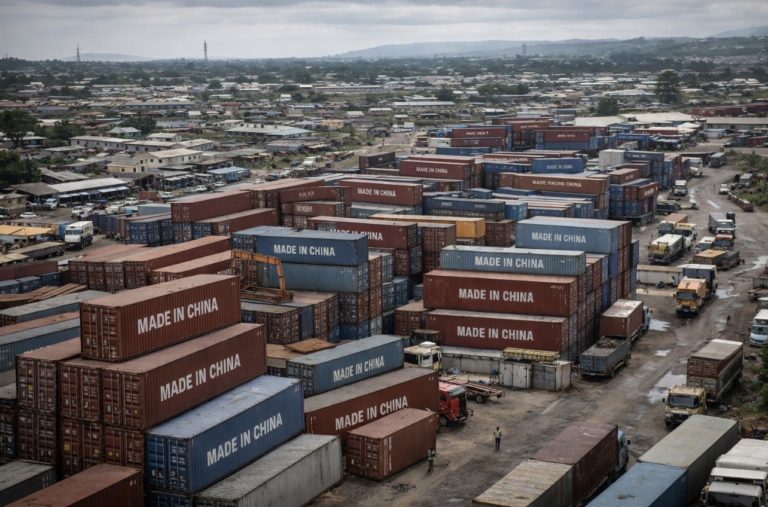
For years, African policymakers have been told that China represents opportunity. Infrastructure, trade, South South cooperation, an alternative to Western conditionality. That narrative is now collapsing under the weight of hard numbers. For countries like Lesotho, China is not merely an imperfect partner. It is a structural problem.
The problem is not ideology. It is economics.
China’s global trade strategy is built around export dominance, domestic market protection, and selective import dependence limited largely to raw materials. That model is devastating for small developing economies that lack scale, bargaining power, or diversified export baskets. Lesotho fits that description almost perfectly.
China Buys Almost Nothing from Lesotho
Start with a simple but uncomfortable fact. China does not buy meaningful value added goods from Lesotho. It never has.
Lesotho’s exports to China are narrow and shallow. Wool, a small volume of diamonds, and a handful of low value electrical components dominate the trade data. In total value terms, Lesotho exports tens of millions of dollars to China annually. In contrast, imports from China into Lesotho span machinery, electronics, vehicles, textiles, household goods, and industrial inputs.
This is not trade partnership. It is asymmetry.
China’s import appetite is structurally constrained. Beijing has spent the past decade pursuing self sufficiency in high value manufacturing while aggressively expanding export capacity. The result is a record global trade surplus exceeding one trillion dollars. That surplus exists because China produces far more than it consumes and because it has little incentive to open its domestic market to foreign manufactured goods, especially from small economies.
Except for raw materials, China buys almost nothing from Africa. Lesotho is no exception.
Market Access Is a Myth
Defenders of China often argue that African producers simply lack competitiveness. That explanation ignores China’s deliberate market architecture.
China protects its domestic market through regulatory barriers, standards regimes, state subsidies, and industrial policy that favors national champions. These are not accidental outcomes. They are policy choices.
For a country like Lesotho, which struggles to access even regional markets, penetrating the Chinese consumer or industrial supply chain is effectively impossible. This is why Lesotho’s export relationship with China has not evolved beyond commodities despite years of diplomatic engagement.
Trade without access is not trade. It is dependency.
Dumping and the Destruction of Local Industry
China’s export model relies on scale, cost suppression, and state backed manufacturing ecosystems. When surplus goods flood developing markets, local producers cannot compete.
South Africa is already responding by considering antidumping duties on Chinese and Indian vehicles after imports surged by hundreds of percent while local production stagnated. If South Africa, with its industrial depth, is under threat, smaller economies like Lesotho do not stand a chance.
Cheap imports may benefit consumers in the short term, but they hollow out domestic industry. Once local manufacturing collapses, jobs disappear, skills erode, and economies become permanently import dependent.
This phenomenon has a name in economics. Premature deindustrialisation.
Africa has experienced it before. China is accelerating it.
Botswana, Diamonds, and the Synthetic Shock
The damage is not limited to manufacturing. Botswana’s diamond industry is under severe pressure, not only from cyclical downturns but from structural shifts in global demand.
China is one of the world’s largest producers and consumers of synthetic diamonds. These lab grown stones are cheaper, scalable, and increasingly accepted by consumers. As synthetic supply expands, natural diamond prices weaken.
Botswana’s fiscal stability is tied to diamonds. Lesotho’s diamond sector, smaller but still significant, faces the same threat. This is not a coincidence. It is the downstream effect of China’s industrial strategy.
China manufactures the substitute. China consumes it. African producers absorb the loss.
The Illusion of Infrastructure for Trade
Supporters of China often point to roads, buildings, and projects. Infrastructure matters, but infrastructure without industrial development is a dead end.
What is the point of better roads if they only carry imported goods inland? What is the value of industrial parks if local firms cannot compete against subsidised imports?
Trade policy cannot be separated from production. China understands this. Africa has been slower to learn.
Why the West Now Makes Economic Sense Again
This is not a call for nostalgia or blind alignment. It is a strategic reassessment.
Western markets, for all their flaws, remain more open to value added imports from developing economies. They offer clearer rules, deeper consumer markets, and greater scope for integration into global value chains.
Lesotho’s textile exports to the United States under AGOA demonstrate this reality. When access exists, production follows.
China offers scale without access. The West offers access with conditions. From an economic development perspective, access matters more.
A Strategic Imperative for Lesotho
Lesotho cannot afford sentimental geopolitics. It must pursue hard headed economic realism.
Diversify trade partners. Reduce exposure to dumping. Protect fragile domestic sectors. Push value addition relentlessly. Prioritise markets that buy more than raw materials.
China is not an enemy. But it is not a development partner either.
It is a competitor with overwhelming scale, a closed domestic market, and a trade model that structurally disadvantages small economies.
Pretending otherwise is no longer intellectually honest. Or economically sustainable.
Before the courts decide guilt or innocence, a more basic failure demands attention. The Directorate on Corruption and Economic Offences appears not to understand what a university research and innovation hub is, how it functions, or why it exists. That ignorance matters. Because when an anti-corruption agency applies blunt instruments to institutions it does not comprehend, it does not merely risk miscarriages of justice. It risks sabotaging the country’s ability to produce knowledge, retain scarce expertise, and convert research into national development.
Research hubs, whether branded as innovation centres, technology transfer offices, or applied research units, are not peripheral add-ons to universities. They are the engine rooms of national knowledge production. They exist to translate academic expertise into practical solutions, commercial products, policy tools, and public value. In developing countries especially, they are one of the few mechanisms through which scarce intellectual capital is retained, funded, and directed toward national development priorities.
The National University of Lesotho’s Innovation Hub was conceived within this logic. It is meant to mobilise in-house expertise, attract external funding, incubate research-driven enterprises, and ensure that academic work does not remain trapped in journals that no policymaker reads or laboratory shelves that gather dust. This is not a novel idea. It is how universities across the world, including the Ivy League institutions so often cited as benchmarks, organise their research ecosystems.
At Harvard, Stanford, MIT, Yale, Princeton, and Columbia, the overwhelming majority of spin-offs, funded research projects, and innovation entities are led by professors who are full-time employees of the university. The same academic who lectures undergraduates is often the principal investigator on a grant, the scientific founder of a start-up, or the director of a research centre. This is not a loophole. It is the design.
Universities do not outsource their brains.
The idea that a professor’s dual role as an employee of the university and a researcher involved in externally funded projects is inherently suspicious betrays a fundamental misunderstanding of how research institutions function. Academic expertise is not an incidental input. It is the core asset. Strip universities of the ability to leverage their own staff for research and innovation, and you reduce them to teaching factories.
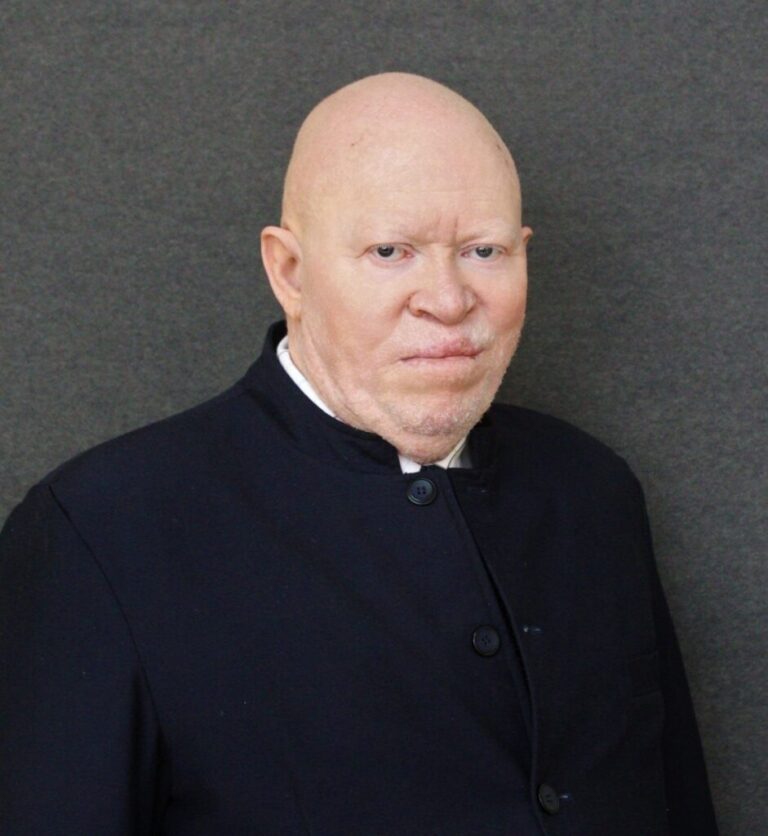
This is the context within which the Directorate on Corruption and Economic Offences has now arraigned Professor George Mosotho, an analytical chemist, on allegations of conflict of interest linked to research funding. The courts will, and must, determine the legal merits of the case. But outside the courtroom, a far broader and more troubling question arises. Does the DCEO understand the mandate, structure, and operational logic of university research hubs at all?
For a country like Lesotho, this is not an abstract concern. Analytical chemistry is not a surplus skill here. It is a rare, strategic capability. Professor Mosotho is not merely another academic. He represents a depth of scientific expertise that the country can ill afford to casually criminalise without a sophisticated appreciation of context.
In most research universities, conflict of interest is not addressed by banning professors from engaging in research-linked entities. It is managed through disclosure, governance frameworks, ethics committees, and institutional oversight. Universities regulate these relationships precisely because they are expected, not because they are aberrations.
The danger of the current approach is not only reputational damage to an individual. It is systemic chilling. When anti-corruption enforcement is applied without institutional literacy, it sends a signal to every academic that engaging in applied research is legally risky. It discourages innovation. It deters external funders. It accelerates brain drain. It turns universities inward, fearful, and timid.
And the cost is national.
Lesotho already struggles to retain scientists, engineers, and researchers. We cannot compete with South Africa, Europe, or North America on salaries. What we can offer is relevance, impact, and the opportunity to build something meaningful at home. Research hubs are one of the few instruments through which that promise is made credible.
This is not an argument for impunity. Nor is it a plea for special treatment of academics. It is an argument for competence. Anti-corruption agencies, like all institutions of the state, must understand the environments they police. Financial regulation requires financial literacy. Environmental enforcement requires environmental science. University governance requires an understanding of academic ecosystems.
When enforcement is blind to institutional purpose, it becomes destructive rather than corrective.
If the DCEO proceeds as though universities are no different from procurement departments or parastatals, it risks doing long-term damage to Lesotho’s already fragile knowledge economy. The irony is painful. In attempting to protect public funds, the state may be undermining the very institutions capable of generating future public value.
One hopes that this moment becomes a turning point. Not just for this case, but for a deeper reckoning about how law enforcement engages with complex institutions. Because if we continue down this path, the message to the country’s brightest minds will be clear. Do not innovate. Do not apply your knowledge. Do not build. Just teach your classes and keep your head down.
For a nation that speaks endlessly about development, that would be a tragedy entirely of our own making.
MASERU-A serious legal battle has erupted at Naledi Funeral Planners (Pty) Ltd, with a group of shareholders and directors approaching the High Court of Lesotho, Commercial Division, to challenge what they describe as unlawful and irregular decisions affecting the company.
Court papers filed in Maseru show that the matter involves deep divisions within the company’s leadership and raises questions about corporate control, management, and the role of public offices in company administration.
At the centre of the case is Malefetsane Tlelima, who says he is the chairman of the board of directors and a shareholder of Naledi Funeral Planners. In a founding affidavit sworn before the court, Tlelima states that he brings the application both in his personal capacity and on behalf of other shareholders and directors who have authorised him to act for them.
He explains that the group decided to institute legal proceedings after a company resolution taken on 22 January 2026. According to him, this resolution was adopted because certain decisions had been made which they believe were unlawful and irregular, and which were harming the company’s structures, management, interests, and day-to-day operations.
“The effect of these decisions has been to negatively impact how the company is run,” he says in his affidavit, adding that the situation has become serious enough to require the intervention of the court.
The applicants listed in the matter include Tlelima as the first applicant, followed by Thoolo Mohapi Sheea, Soaile Mochaba, Bonang Phooko, and Mphamo Tente. Naledi Funeral Planners (Pty) Ltd itself is also cited as the sixth applicant. All, according to the court papers, are shareholders and directors of the company and are bringing the case in both capacities.
On the other side are nine respondents. These include several individuals, among them Thabiso Madiba, Khojane Madiba, Tšolo Seutloali, Mohau Linake, Sidwell Jackson, Christopher Kao, and Retšepile Linake, as well as the Registrar of Companies and the Attorney General.
Although the full details of the disputed decisions are contained in the main application, the founding affidavit gives a clear picture of a company in turmoil. Tlelima states that he has personal knowledge of most of the facts he places before the court, while other information is drawn from company documents in his possession. Where necessary, he relies on records held by the company secretary, Advocate Peter Matekane, whose supporting affidavit is attached to confirm those facts.
He further explains that he is deposing to the affidavit not only for himself but also to avoid unnecessary duplication by having several applicants each file similar statements. This, he says, is meant to prevent burdening the court record.
The applicants’ main concern, as reflected in the documents, is that the decisions taken without proper authority or procedure have interfered with the lawful management of Naledi Funeral Planners. They argue that these actions threaten the stability of the business and the interests of its legitimate shareholders and directors.
By approaching the Commercial Division of the High Court, the applicants are seeking clarity, protection, and corrective measures from the judiciary. They want the court to examine how certain changes or actions were made, who authorised them, and whether they comply with company law and established corporate governance principles.
Legal analysts say disputes of this nature are becoming increasingly common as companies grow and internal power struggles emerge. When shareholders and directors disagree over control, management, or registration matters, the Registrar of Companies is often drawn into the dispute, as appears to be the case here. The inclusion of the Attorney General also suggests that the applicants believe public authorities may have played a role in decisions they now contest.
In corporate law, directors are expected to act in the best interests of the company and in accordance with its founding documents and the law. When decisions are taken outside these boundaries, affected parties have the right to seek the court’s intervention. The court can review the legality of such decisions, set them aside, and issue orders aimed at restoring proper governance.
For Naledi Funeral Planners, a company operating in the sensitive funeral services sector, stability and public trust are critical. Prolonged internal conflict can disrupt operations, affect employees, and undermine confidence among clients who rely on the company at vulnerable moments in their lives.
The applicants argue that this is precisely why the matter cannot be left unresolved. They maintain that unless the court steps in, the ongoing disputes will continue to damage the company’s reputation and functioning.
The case is now before the High Court, which will consider the affidavits and any opposing papers to be filed by the respondents. Once all documents are in, the court is expected to hear arguments from both sides before making a ruling.
For now, the filing of the application marks the formal beginning of what could be a lengthy court process. It is a process that may not only determine who lawfully controls Naledi Funeral Planners, but also set an important example for how corporate disputes are handled in Lesotho.
As the matter unfolds, attention will focus on the evidence presented, the role of the Registrar of Companies, and whether the contested decisions will withstand legal scrutiny. What is clear is that the shareholders behind the application are determined to fight for what they say is the lawful management and future of their company
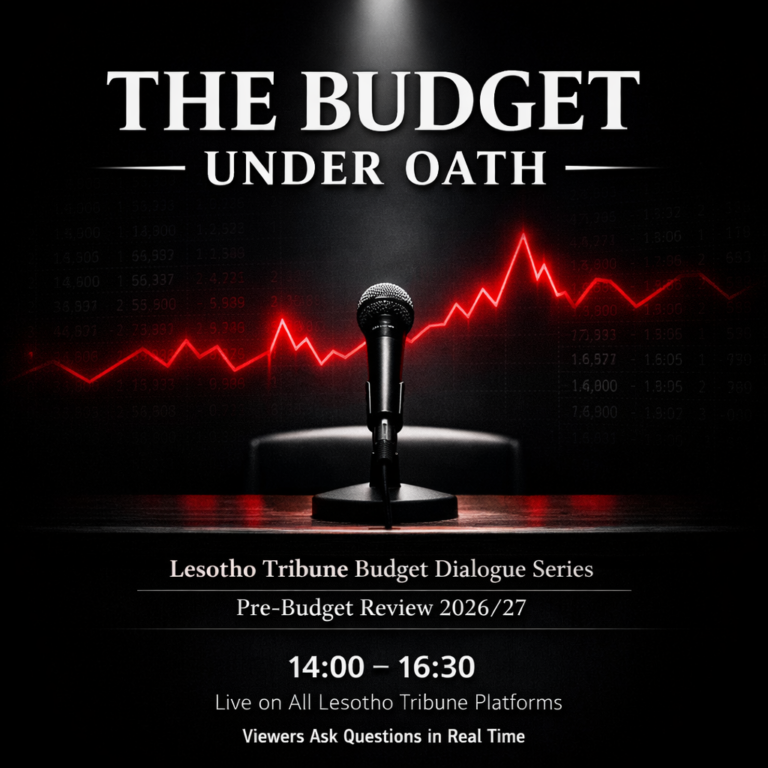
Following our public nomination process, the following political parties have been invited to participate in Lesotho Tribune’s first annual Pre-Budget Review Dialogue ahead of the 2026/27 National Budget:
• Pheello Sehlabaka (DC)
• Moliehi Nkhabu (BNP)
• Molefi Ntṣ̌onyana (YES)
• Mohale Motloang & Realeboha Thube (UAT)
• Bokang Seakhoa (BAP)
🗓 Date & Time: 14:00hrs – 16:30hrs
📡 Live-streamed on all Lesotho Tribune platforms
The dialogue will focus strictly on fiscal priorities, economic realities, and policy substance ahead of the Minister of Finance’s budget presentation.
Viewers will have the opportunity to submit questions in real time during the live broadcast. This is your platform to interrogate policy, test credibility and demand clarity.
This forms part of the Lesotho Tribune Budget Dialogue Series, advancing informed civic participation and accountability.
MASERU — His Majesty King Letsie III has formally appointed Rev. Dr. John Maphephe, Mrs Pontšo ’Mamatlere Matete, and Dr Chelete Monyane as members of the Independent Electoral Commission (IEC), bringing to an end a protracted and contentious appointment process that had been stalled for months by legal challenges.
The appointments were confirmed in Legal Notice No. 4 of 2026, published in the Government Gazette on 23 January 2026, in terms of Section 66(1) of the Constitution of Lesotho, and take effect from the date of publication.
Rev. Dr. Maphephe has been appointed Chairperson, while Mrs Matete and Dr Monyane will serve as Commissioners.
The gazetting of the appointments closes a chapter marked by court intervention, political unease, and growing concern over the operational stability of the IEC ahead of future electoral processes.
A process frozen by litigation
The IEC appointments, ordinarily a routine constitutional exercise following advice from the Council of State, became ensnared in litigation after disgruntled candidates challenged the recruitment process.
As previously reported by Lesotho Tribune, the applicants argued that the selection process was procedurally flawed, raising issues around shortlisting, interviews, and compliance with constitutional and administrative justice principles. The legal challenge resulted in the High Court issuing orders that effectively froze the appointment process, preventing the King from acting on the Council of State’s advice.
The court action had far-reaching consequences. With commissioners’ terms having expired or nearing expiry, political parties and civil society organisations warned that continued delays risked weakening the credibility and readiness of the electoral system.
Court clears the way
In recent weeks, the legal obstacles were removed after the High Court dismissed the challenge and lifted the restraining orders, clearing the way for the constitutional process to resume.
With no further legal impediments, the Council of State’s recommendations were acted upon, culminating in the publication of the Gazette notice.
The Constitution requires that IEC commissioners are formally appointed by the King acting on the advice of the Council of State, and that such appointments only take effect upon publication in the Gazette.
Why this matters
The IEC plays a central role in safeguarding electoral integrity in Lesotho. Prolonged uncertainty around its leadership had raised concerns among political actors, particularly as electoral reforms and future election timelines loom.
With the appointments now legally finalised, attention shifts to whether the Commission can quickly stabilise its operations and restore public confidence following a period of institutional limbo.
TIMELINE: How the IEC Appointments Were Delayed
Mid-2025
• Recruitment process for new IEC commissioners begins following vacancies and expiring terms.
2025 (Second Half)
• Shortlisting and interviews conducted under the supervision of the Council of State.
• Names forwarded in line with constitutional procedure.
Late 2025
• Unsuccessful candidates file court applications challenging the legality and fairness of the recruitment process.
• High Court issues orders halting the appointment process pending determination of the case.
November–December 2025
• Political parties and civil society warn that prolonged delays threaten electoral preparedness and institutional credibility.
January 2026
• High Court dismisses the legal challenge and lifts the restraining orders.
• Council of State advice is acted upon.
23 January 2026
• King Letsie III gazettes the appointment of Rev. Dr. John Maphephe, Mrs Pontšo ’Mamatlere Matete, and Dr Chelete Monyane as IEC commissioners.
The Directorate on Corruption and Economic Offences’ intervention in the National University of Lesotho has come under renewed scrutiny following the arraignment of senior academic Professor George Mosotho on corruption and fraud charges, amid deepening governance disputes over the University’s leadership and decision-making processes.
Professor Mosotho appeared before the Maseru Magistrates’ Court earlier this week, charged with corruption and fraud linked to public funding obtained from the Competitiveness and Financial Inclusion Project (CAFI), a World Bank-financed government programme. The charges allege that he unlawfully abused his position at NUL by failing to declare a conflict of interest in order to secure approximately M129,000 in funding for a company he founded and controlled.
The case unfolds against a backdrop of escalating institutional tension at NUL, where the legality of recent Council decisions and the future leadership of the University have become contested at the highest levels.
Corruption charges against a senior academic
According to the charge sheet, Professor Mosotho, who lectures in analytical and applied chemistry and serves on the University’s Innovation Committee, was privy to confidential information relating to competitive CAFI funding administered through NUL’s Innovation Hub.
It is alleged that he used this information to prepare a proposal under the name Orbitalab, which was later awarded funding. He subsequently registered the business as Orbitals (Pty) Ltd, listing himself as sole shareholder and the only signatory to the company’s bank account.
The state alleges that Professor Mosotho knowingly failed to disclose his interest while participating in committee proceedings and deliberately concealed his role by engaging another individual to present the proposal. He has been released on bail of M15,000, subject to strict conditions, including non-interference with witnesses. The matter has been postponed to next week.
CAFI is a government programme aimed at strengthening the private sector, financed through a US$45-million World Bank loan and a US$7.5-million grant, and scheduled to run from 2022 to 2028.
A contested governance process
The criminal proceedings coincide with a bitter dispute over governance at the University.
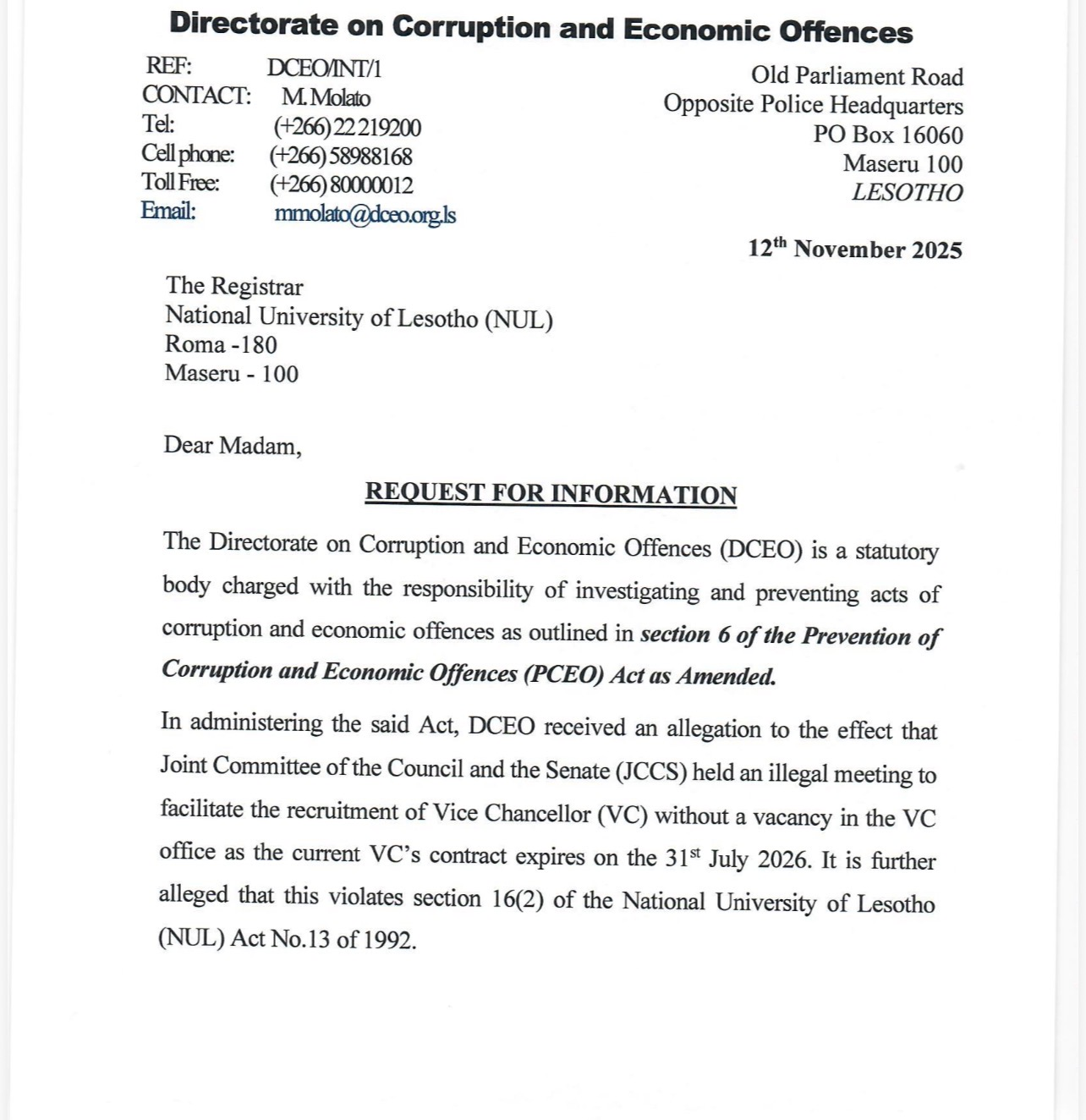
On 22 October 2025, the University Council purported to constitute a Joint Committee of Council and Senate (JCCS) to consider matters relating to the future recruitment of a Vice-Chancellor. That move has since been challenged internally.
In correspondence addressed to the Registrar, the Pro-Vice-Chancellor, Professor Dr Kananelo E. Mosito KC, argued that the Council acted without legal authority. He contended that sections 16(2) and 16(6) of the National University of Lesotho Act can only be triggered once a vacancy in the office of Vice-Chancellor has arisen. No such vacancy exists, as the incumbent Vice-Chancellor’s contract runs until 31 July 2026, while the term of the current Council expires in June 2026.
Professor Mosito described the purported constitution of the JCCS as ultra vires and a nullity in law, warning that it risks producing an illegally constituted committee, a tainted recruitment process, and likely judicial intervention.
DCEO’s role questioned
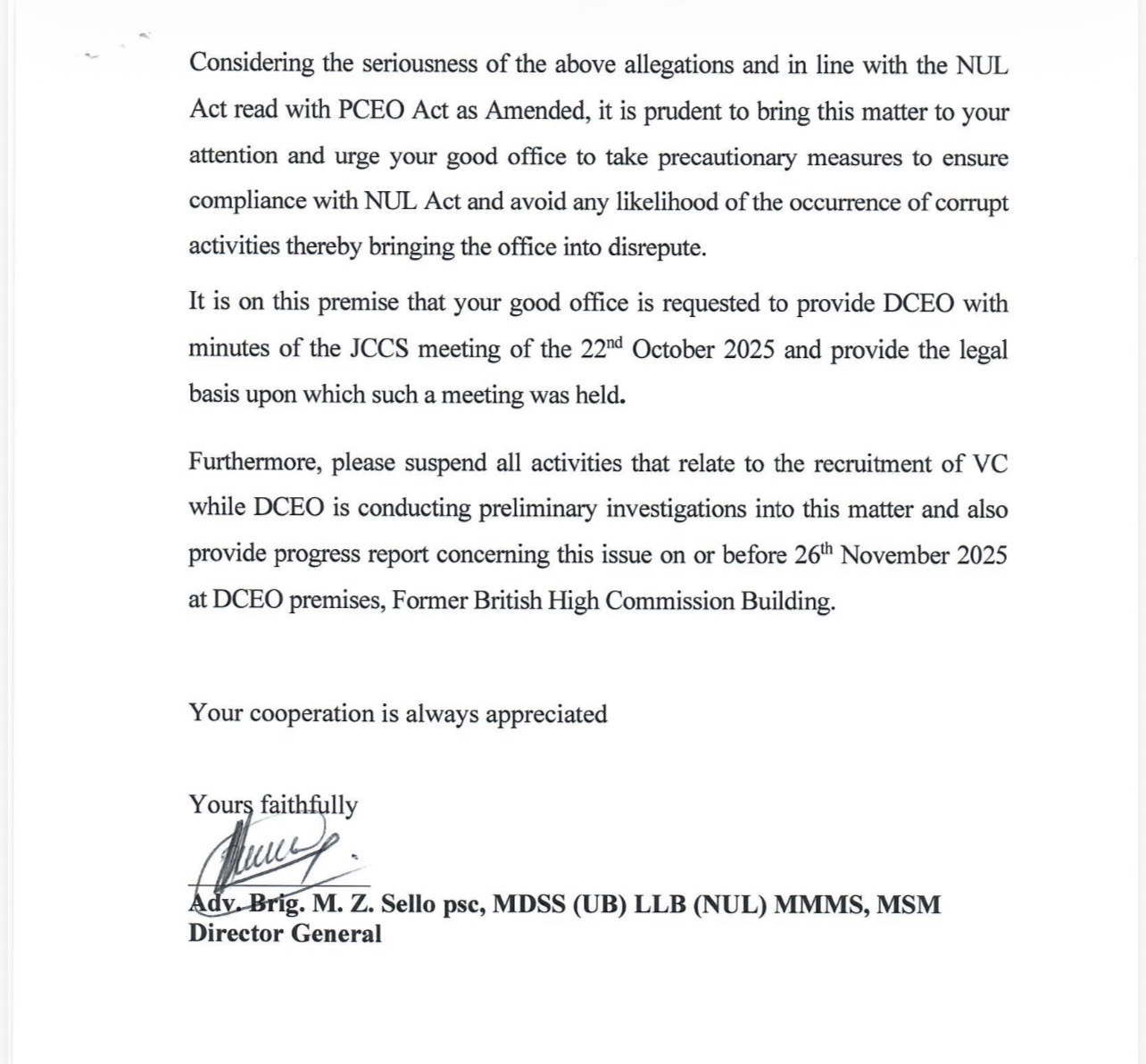
At the same time, the DCEO moved to involve itself in the matter, demanding documentation from NUL and instructing the suspension of all activities relating to the recruitment of a Vice-Chancellor while it conducts what it termed preliminary investigations.
However, when approached by Lesotho Tribune for comment, the DCEO denied knowledge of the letter allegedly authored by the Directorate and addressed to the NUL Registrar that forms the basis of the inquiry into the recruitment process.
The denial has added a further layer of uncertainty to an already complex situation, particularly given the formal tone, directives, and statutory references contained in the correspondence seen by this publication.
Allegations of influence and internal fault lines
Sources within NUL had suggested that the unfolding corruption case against Professor Mosotho could not be viewed in isolation from the broader governance and leadership disputes at the institution, including disagreements surrounding senior appointments.
However, Professor Mosito has categorically rejected any suggestion of his involvement in the events leading to Professor Mosotho’s arrest or prosecution.
In a formal response to Lesotho Tribune, Professor Mosito stated that he did not report Professor Mosotho to the DCEO, had no knowledge of the allegations prior to their appearance on social media, and played no role whatsoever in the investigative or prosecutorial processes.
He further clarified that his involvement with the NUL Innovation Hub is limited to strategic academic oversight and institutional support, and does not extend to investigations, disciplinary action, or law-enforcement functions, which fall outside his mandate.
Addressing claims of a link between the corruption case and the JCCS dispute, Professor Mosito said he was unable to discern any rational or factual connection between the two matters. He emphasised that the JCCS is appointed by Council, not by the Registrar; that Professor Mosotho was not a member of the JCCS; and that he himself was not present at the meeting at which the committee was purportedly constituted.
“The suggestion that I played any role in Professor Mosotho’s plight is therefore factually incorrect and logically unsustainable,” Professor Mosito said, adding that verification could be sought directly from either Professor Mosotho or the DCEO.
Lesotho Tribune notes that Professor Mosotho has not been charged in relation to the Vice-Chancellor recruitment process, and no documentary evidence links him to any alleged interference in that process.
Silence from other key stakeholders
Lesotho Tribune also put detailed questions to the NUL Registrar seeking clarification on the governance dispute, the recruitment process, and the implications of the corruption case for institutional integrity. At the time of publication, the Registrar had not responded.
A broader constitutional concern
What remains unresolved is a fundamental constitutional and governance question: where does the mandate of an anti-corruption agency end, and where do institutional autonomy, administrative law, and judicial oversight begin?
An academic legal mind who requested to remain anonymous opined that not every unlawful administrative act constitutes corruption. Statutory non-compliance is ordinarily addressed through internal remedies or judicial review. Corruption investigations, by contrast, require allegations of abuse of office for personal gain, bribery, or economic offence.
“DCEO involvement in the recruitment process of NUL is shocking, perhaps they have a genius explanation of why and how they think it is within their mandate to be involved,” she concluded.
With a senior academic now facing prosecution for corruption in one context, and the anti-corruption agency appearing to involve itself in a contested recruitment process in another while denying authorship of the correspondence in question, the boundaries between law, governance, and institutional politics have become increasingly blurred.
As the criminal case against Professor Mosotho proceeds, and as questions persist over the legality of recent decisions at NUL, the University finds itself at a critical juncture. Whether this episode strengthens accountability or undermines institutional stability may ultimately depend on clarity of mandate, transparency of process, and adherence to the rule of law.