

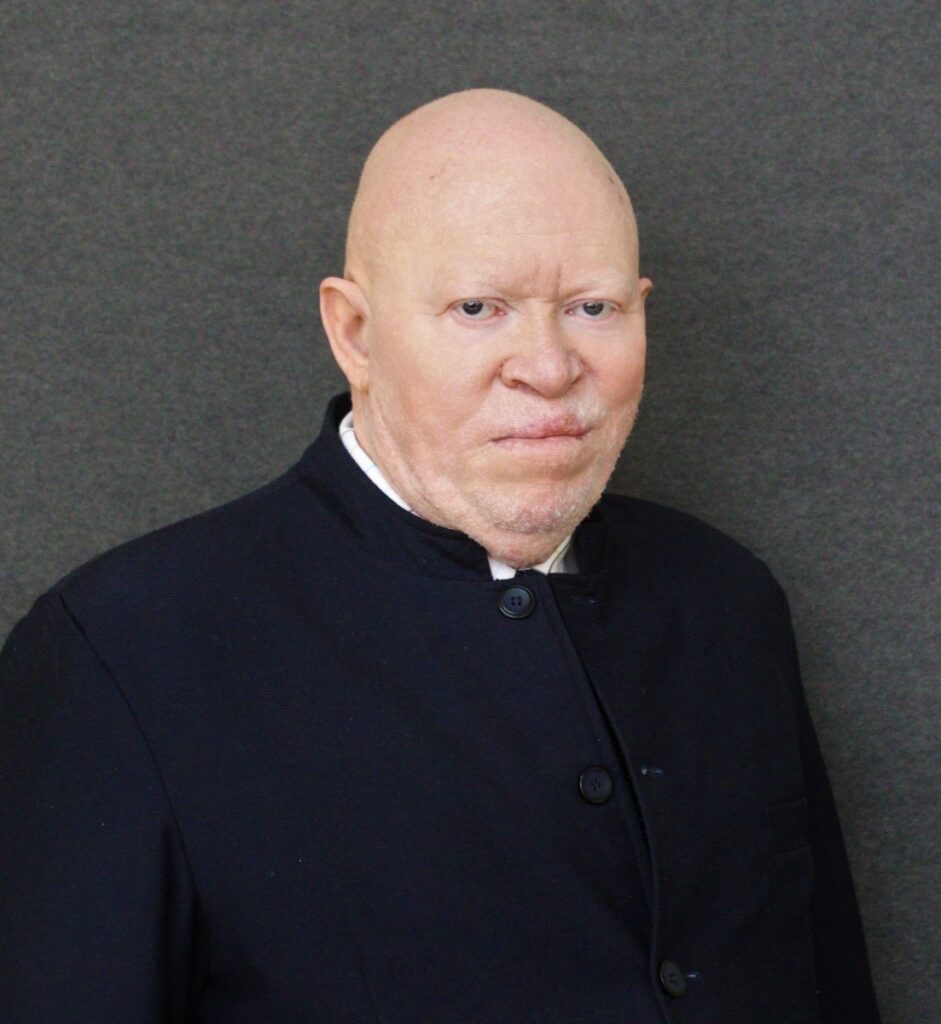
The Directorate on Corruption and Economic Offences’ intervention in the National University of Lesotho has come under renewed scrutiny following the arraignment of senior academic Professor George Mosotho on corruption and fraud charges, amid deepening governance disputes over the University’s leadership and decision-making processes.
Professor Mosotho appeared before the Maseru Magistrates’ Court earlier this week, charged with corruption and fraud linked to public funding obtained from the Competitiveness and Financial Inclusion Project (CAFI), a World Bank-financed government programme. The charges allege that he unlawfully abused his position at NUL by failing to declare a conflict of interest in order to secure approximately M129,000 in funding for a company he founded and controlled.
The case unfolds against a backdrop of escalating institutional tension at NUL, where the legality of recent Council decisions and the future leadership of the University have become contested at the highest levels.
Corruption charges against a senior academic
According to the charge sheet, Professor Mosotho, who lectures in analytical and applied chemistry and serves on the University’s Innovation Committee, was privy to confidential information relating to competitive CAFI funding administered through NUL’s Innovation Hub.
It is alleged that he used this information to prepare a proposal under the name Orbitalab, which was later awarded funding. He subsequently registered the business as Orbitals (Pty) Ltd, listing himself as sole shareholder and the only signatory to the company’s bank account.
The state alleges that Professor Mosotho knowingly failed to disclose his interest while participating in committee proceedings and deliberately concealed his role by engaging another individual to present the proposal. He has been released on bail of M15,000, subject to strict conditions, including non-interference with witnesses. The matter has been postponed to next week.
CAFI is a government programme aimed at strengthening the private sector, financed through a US$45-million World Bank loan and a US$7.5-million grant, and scheduled to run from 2022 to 2028.
A contested governance process
The criminal proceedings coincide with a bitter dispute over governance at the University.
On 22 October 2025, the University Council purported to constitute a Joint Committee of Council and Senate (JCCS) to consider matters relating to the future recruitment of a Vice-Chancellor. That move has since been challenged internally.
In correspondence addressed to the Registrar, the Pro-Vice-Chancellor, Professor Dr Kananelo E. Mosito KC, argued that the Council acted without legal authority. He contended that sections 16(2) and 16(6) of the National University of Lesotho Act can only be triggered once a vacancy in the office of Vice-Chancellor has arisen. No such vacancy exists, as the incumbent Vice-Chancellor’s contract runs until 31 July 2026, while the term of the current Council expires in June 2026.
Professor Mosito described the purported constitution of the JCCS as ultra vires and a nullity in law, warning that it risks producing an illegally constituted committee, a tainted recruitment process, and likely judicial intervention.
DCEO’s role questioned
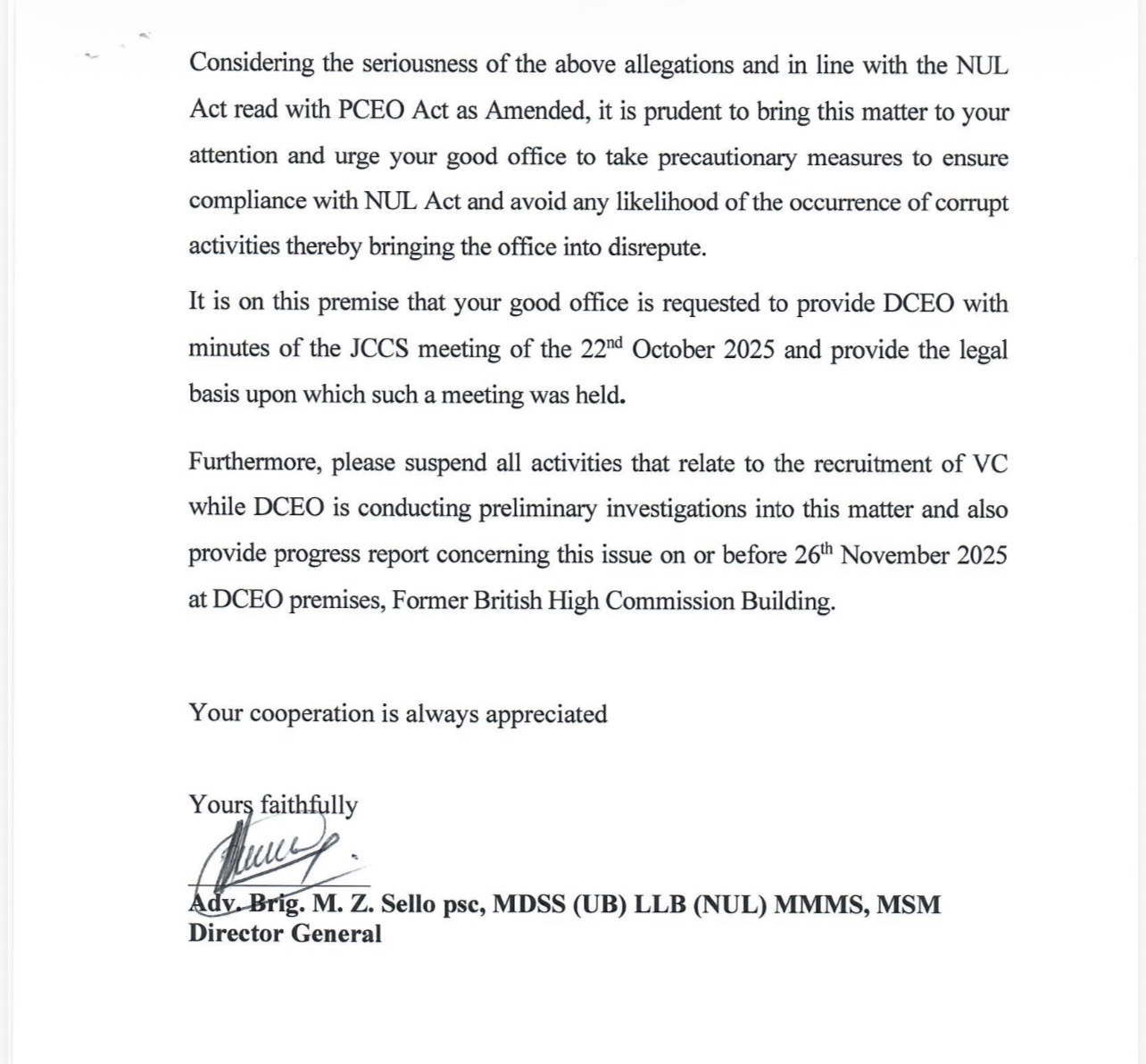
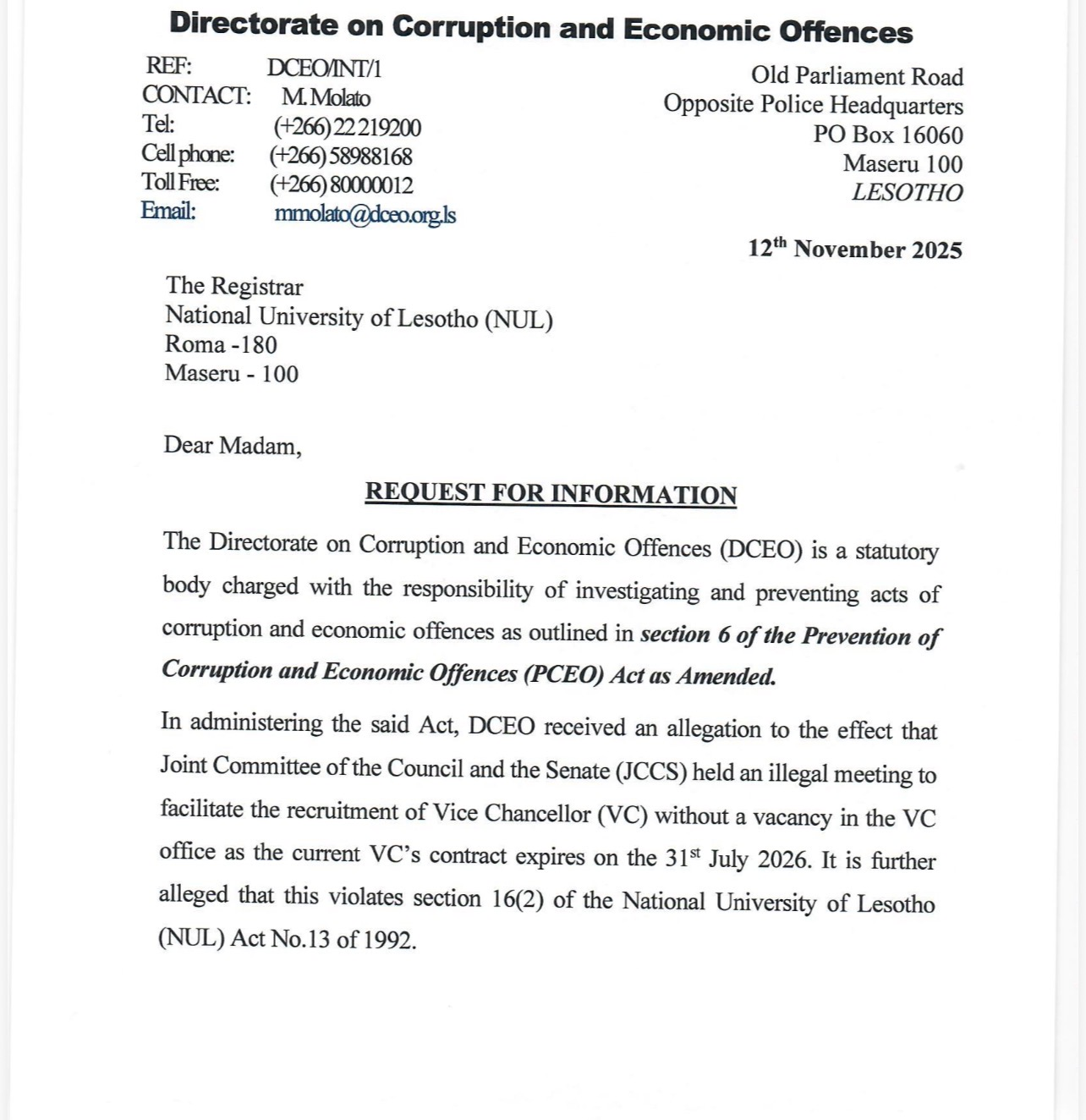
At the same time, the DCEO moved to involve itself in the matter, demanding documentation from NUL and instructing the suspension of all activities relating to the recruitment of a Vice-Chancellor while it conducts what it termed preliminary investigations.
However, when approached by Lesotho Tribune for comment, the DCEO denied knowledge of the letter allegedly authored by the Directorate and addressed to the NUL Registrar that forms the basis of the inquiry into the recruitment process.
The denial has added a further layer of uncertainty to an already complex situation, particularly given the formal tone, directives, and statutory references contained in the correspondence seen by this publication.
Allegations of influence and internal fault lines
Sources within NUL had suggested that the unfolding corruption case against Professor Mosotho could not be viewed in isolation from the broader governance and leadership disputes at the institution, including disagreements surrounding senior appointments.
However, Professor Mosito has categorically rejected any suggestion of his involvement in the events leading to Professor Mosotho’s arrest or prosecution.
In a formal response to Lesotho Tribune, Professor Mosito stated that he did not report Professor Mosotho to the DCEO, had no knowledge of the allegations prior to their appearance on social media, and played no role whatsoever in the investigative or prosecutorial processes.
He further clarified that his involvement with the NUL Innovation Hub is limited to strategic academic oversight and institutional support, and does not extend to investigations, disciplinary action, or law-enforcement functions, which fall outside his mandate.
Addressing claims of a link between the corruption case and the JCCS dispute, Professor Mosito said he was unable to discern any rational or factual connection between the two matters. He emphasised that the JCCS is appointed by Council, not by the Registrar; that Professor Mosotho was not a member of the JCCS; and that he himself was not present at the meeting at which the committee was purportedly constituted.
“The suggestion that I played any role in Professor Mosotho’s plight is therefore factually incorrect and logically unsustainable,” Professor Mosito said, adding that verification could be sought directly from either Professor Mosotho or the DCEO.
Lesotho Tribune notes that Professor Mosotho has not been charged in relation to the Vice-Chancellor recruitment process, and no documentary evidence links him to any alleged interference in that process.
Silence from other key stakeholders
Lesotho Tribune also put detailed questions to the NUL Registrar seeking clarification on the governance dispute, the recruitment process, and the implications of the corruption case for institutional integrity. At the time of publication, the Registrar had not responded.
A broader constitutional concern
What remains unresolved is a fundamental constitutional and governance question: where does the mandate of an anti-corruption agency end, and where do institutional autonomy, administrative law, and judicial oversight begin?
An academic legal mind who requested to remain anonymous opined that not every unlawful administrative act constitutes corruption. Statutory non-compliance is ordinarily addressed through internal remedies or judicial review. Corruption investigations, by contrast, require allegations of abuse of office for personal gain, bribery, or economic offence.
“DCEO involvement in the recruitment process of NUL is shocking, perhaps they have a genius explanation of why and how they think it is within their mandate to be involved,” she concluded.
With a senior academic now facing prosecution for corruption in one context, and the anti-corruption agency appearing to involve itself in a contested recruitment process in another while denying authorship of the correspondence in question, the boundaries between law, governance, and institutional politics have become increasingly blurred.
As the criminal case against Professor Mosotho proceeds, and as questions persist over the legality of recent decisions at NUL, the University finds itself at a critical juncture. Whether this episode strengthens accountability or undermines institutional stability may ultimately depend on clarity of mandate, transparency of process, and adherence to the rule of law.
Read both letters on www.lesothotribune.co.ls