


Top Lesotho assistant referee, Souru Phats’oane, officiated at second last 16 encounter match between Mali and Tunisia which was exhilarating, fraught with yellow and red cards and the first match at the 2025 Africa Cup of Nations (AFCON) to go for a penalty shootout.
It was epic to witness Tunisia reliving the January 1977 encounter when it became the first nation to go for a penalty shootout in the World Cup qualifying match, with the difference being Mali instead of Morocco and the tournament being AFCON and not World Cup. Nevertheless the game was played in Morocco.
Mali was reduced to ten men as early as in the 26th minute of the first half when their player, Woyo Coulibaly was sent off with a red card, forcing Mali to soldier on and limping with one man short but steadily fought hard, despite Tunisia in control of the ball possession exceeding 72%.
Tunisia took the lead in the 88th minute through Firas Chaouat, who headed in a cross from Elias Saad.
But Mali responded quickly. In added time, Yassine Meriah conceded a penalty with a handball, and Lassine Sinayoko converted from the spot in the 90+6 minute to level the score.
South African referee, Abongile Tom assisted by his compatriot, Zakhele Siwela and Lesotho’s Souru Phats’oane took the game to extra time after the stalemate of 1-1.
The extra time also ended with no change on the scoresheet, forcing Tom and his entourage of referees to take the game to the penalty shootout – the first ever since AFCON 2025 began in Morocco last month.
Mali’s feisty goalkeeper, Djigui Diarra, became hero of the night and player of the match as he saved two lethal penalties, technically goading his nation to the quarterfinals of the tournament where they are going to face the mighty Senegal.
The match ended 3-2 in the penalty shootout, with Mali through to the quarterfinals despite not having won any single game during the 90 minutes play at the ongoing AFCON tournament in Morocco.
Phats’oane officiates in a historic AFCON match

Hospitals Cleaners Haven’t Been Paid in Months
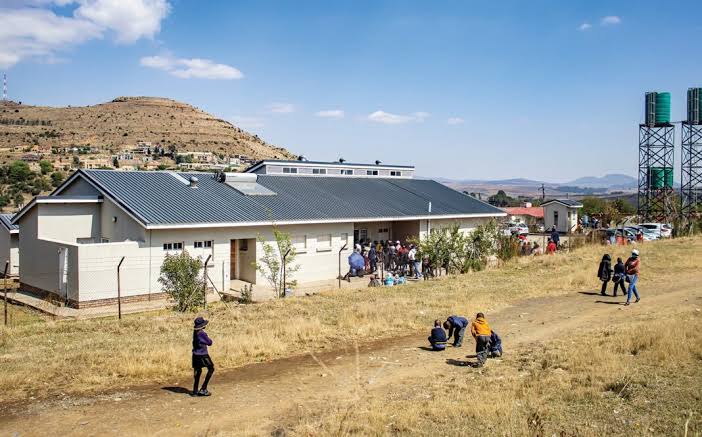
In March 2025, Beyond Laundry & Housekeeping, a Maseru-based cleaning services company, secured a high-profile Ministry of Health tender to provide critical cleaning services at Mokhotlong and Thaba-Tseka hospitals.
Less than a year later, what was presented as a milestone in improving hospital standards has deteriorated into a crisis marked by unpaid wages, unsafe working conditions, and mounting desperation among frontline workers.
Employees told Lesotho Tribune they have not received salaries since September 2025. While they were initially warned of possible payment delays due to a complex funding chain involving the Lesotho Millennium Development Agency (LMDA), the Ministry of Health, and the Ministry of Finance, they say they never anticipated a prolonged and complete breakdown in remuneration.
“We signed legally binding contracts. We trusted the process,” one worker said. “We never imagined we would be pushed into a corner like this.”
The financial distress is compounded by low wages. Workers say they earn M2,600 per month, roughly M400 less than their predecessors. They further allege that promised bereavement benefits, meant to support employees during family losses, have never materialised.
More troubling are allegations of unsafe working conditions in high-risk hospital environments. Employees report persistent shortages of basic protective equipment, including masks, rubber gloves, and detergents. In some cases, they claim they have been forced to borrow supplies from hospital staff or, most alarmingly, reuse disposable rubber gloves while cleaning clinical areas.
“You cannot clean a hospital without protection,” another worker said. “We are exposed every day.”
Staff also accuse management of negligence, alleging that communication is minimal and that updates on salary payments are only provided after repeated and aggressive follow-ups.
When questioned about the delays, workers allege they were told the current salary structure was largely a temporary arrangement intended to help the company secure the tender. While not management’s exact wording, employees say the implication was that their pay conditions were secondary to passing the procurement process.
Contacted for comment, Beyond Laundry & Housekeeping Contract Manager Thapelo Mokhethi acknowledged what he described as “lengthy” salary delays but denied any knowledge of shortages in protective equipment. He maintained that management remains in constant communication with the LMDA to track the release of funds, though he conceded that he could not provide a definitive timeline for when workers would be paid.
The contract forms part of the Health Maintenance – Project Implementing Unit (HM-PIU), launched by the Ministry of Health in July 2024 to improve hospital infrastructure and service standards.
Instead, nearly ten months after the tender was awarded, the project has left cleaning staff facing an impossible choice: protect their livelihoods or protect their lives.
Following his initial response, Mokhethi became unavailable for further comment.
Editorial note
The Ministry of Health, the Health Maintenance – Project Implementing Unit, and the Ministry of Finance were approached for comment at the time of publication.
Excuses! Lesotho’s Only Growing Industry
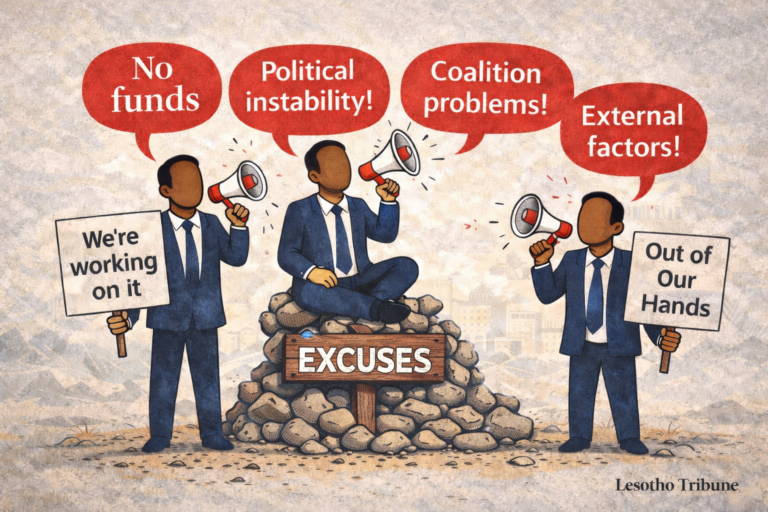
There is a quiet envy creeping into conversations across Lesotho. Not the loud, resentful kind, but the uncomfortable kind that comes from watching peers move on while you remain stuck explaining why tomorrow never quite arrives.
Across Africa in 2025, several countries have begun telling stories that sound suspiciously like progress. Not perfection. Not miracles. Just movement.
Zimbabwe, of all places, posted a 9.64 percent economic growth rate in the third quarter of 2025, according to figures reported by Lesotho Tribune.
That number alone should make us pause. Zimbabwe has spent years as a regional warning sign, invoked whenever African economies were discussed in the past tense. Yet here it is, growing faster than many of its neighbours, including Lesotho.
The reasons are not mysterious. Even the World Bank attributes Zimbabwe’s rebound to targeted regulatory reforms, recovery in agriculture and mining, and deliberate efforts to make the business environment workable, not perfect, just workable.
Elsewhere, Rwanda continues to post strong growth, anchored in an approach that emphasises measurement and implementation. The National Institute of Statistics of Rwanda’s GDP publications reflect an economy that is still expanding at a pace many countries would envy.
Kenya, for all its political noise, continues to signal intent through growth expectations and financing. Reuters reported that Kenya expects faster growth in 2025 and signed a yen-denominated loan with Japan, a reminder that some governments keep pushing the machinery of development even while arguing loudly on the surface.
This is not to romanticise these countries. Each has deep problems. But they share something Lesotho increasingly lacks. Momentum.
Back home, the numbers tell a far less flattering story. Growth projections hover around one percent, sometimes dipping below. That is not a temporary slowdown. It is stagnation with a calendar.
Lesotho is not short of plans. It is not short of strategies, policy documents, or vision statements. What it is short of is leadership capacity that can convert intent into execution. The ability to decide, implement, and stay the course even when it is politically inconvenient.
Here, development conversations tend to stall at blame. Coalition politics. External shocks. South Africa. Global uncertainty. All valid factors. But none sufficient to explain why year after year, nothing really moves.
Countries that are now growing did not escape constraints. They worked around them. They simplified rules. They picked sectors. They sent signals to investors that the state might be imperfect, but it was at least predictable.
In Lesotho, predictability has become a luxury. Policy reversals are common. Appointments raise more questions than confidence. Institutions limp instead of lead. And corruption, as recent public polling suggests, is increasingly seen not as a side problem, but as the root of everything else.
This is where the envy becomes sharper.
Young Basotho watch peers in Kigali, Nairobi, even Harare, finding work, starting firms, exporting services. Meanwhile, here, the most reliable growth sector seems to be excuses.
It would be unfair to say Lesotho has no capable people. It has many. What it lacks is leadership that treats development as an urgent, measurable task rather than a slogan recycled every election cycle.
Development is not mystical. It is boring, repetitive, and unforgiving. It rewards consistency. It punishes drift.
Other African countries, even those with heavier baggage than ours, have accepted this reality. Lesotho, for now, seems content to debate it.
And that may be the most worrying signal of all.
Minister Warns of Lumpy Skin Disease Outbreak as Cases Emerge Nationwide
Maseru
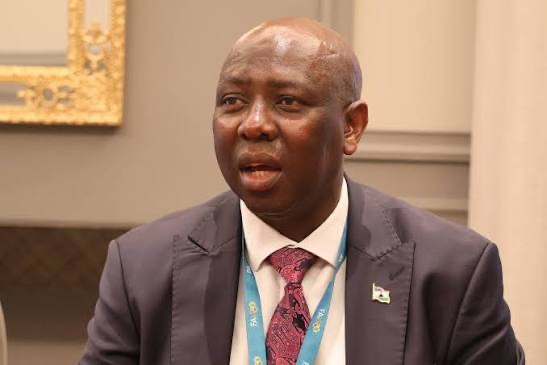
The Minister of Agriculture, Food Security and Nutrition, Mr Thabo Mofosi, has warned of an outbreak of lumpy skin disease, which has been reported in parts of Leribe, Maseru, Botha-Bothe, Mafeteng and Quthing.
In a statement, Mofosi said lumpy skin disease primarily affects cattle and water buffalo, and is caused by a viral infection. He explained that the disease is mainly spread by mosquitoes, which transmit the virus from infected animals to healthy ones, although direct contact can also result in infection, albeit at a lower risk.
The minister noted that the current season, characterised by heat and increased moisture, creates favourable conditions for mosquito breeding, accelerating the spread of livestock diseases. He outlined common symptoms of lumpy skin disease, including skin nodules, excessive salivation, fever, and swelling, among others.
Mofosi said there is no specific cure for the disease, as it is viral in nature. However, affected animals can be treated with supportive medication aimed at boosting the immune system and preventing secondary infections.
He urged farmers to immediately isolate infected cattle, keep them in shaded environments, provide adequate food and water, and refrain from using them for any form of labour.
Farmers were also advised to report suspected cases to Ministry offices or private veterinary clinics as soon as symptoms are observed. Mofosi clarified that treatment for lumpy skin disease is provided at standard veterinary fees, as the Ministry currently subsidises only rabies-related interventions.
“My Ministry intends to work jointly with other stakeholders to combat this disease and will remain alert,” Mofosi said.
Meanwhile, the Ministry is continuing efforts to prevent the spread of foot-and-mouth disease, which was recently reported in South Africa. As a precautionary measure, Lesotho has banned the importation of livestock and unprocessed meat from South Africa.
———————————————————-/
What is it?
Lumpy skin disease is a viral infection that mainly affects cattle and water buffalo. It spreads rapidly during warm and wet seasons due to increased mosquito activity.
Common symptoms to watch for
Farmers should immediately check animals for:
• Hard lumps or nodules on the skin
• High fever
• Excessive salivation
• Swelling around the neck, legs, or udder
• Loss of appetite
• Weakness or reluctance to move
How does it spread?
• Mosquito bites from infected animals
• Other biting insects
• Direct contact between animals (less common)
What farmers must do immediately
If you suspect lumpy skin disease:
• Isolate infected cattle from the rest of the herd
• Keep animals in a shaded area
• Provide clean water and sufficient feed
• Do not use infected animals for ploughing or work
• Report cases immediately to:
• Ministry of Agriculture offices
• Private veterinary clinics
Why corruption, not poverty, now defines Lesotho’s deepest fear
There are years when a country worries about prices. Other years, about jobs. And then there are years when the anxiety shifts deeper, when citizens stop arguing about outcomes and begin questioning the system itself.
For Lesotho, 2025 appears to have been one of those years.
A series of reader polls conducted by Lesotho Tribune in late December, across X, lesothotribune.co.ls and Facebook, do not read like a protest. They read more like a diagnosis. The sample size is small, yes, but it is internally consistentand it points in one direction. What worried Basotho most was not hunger, inflation, or even unemployment. It was corruption by government.
A hierarchy of fear
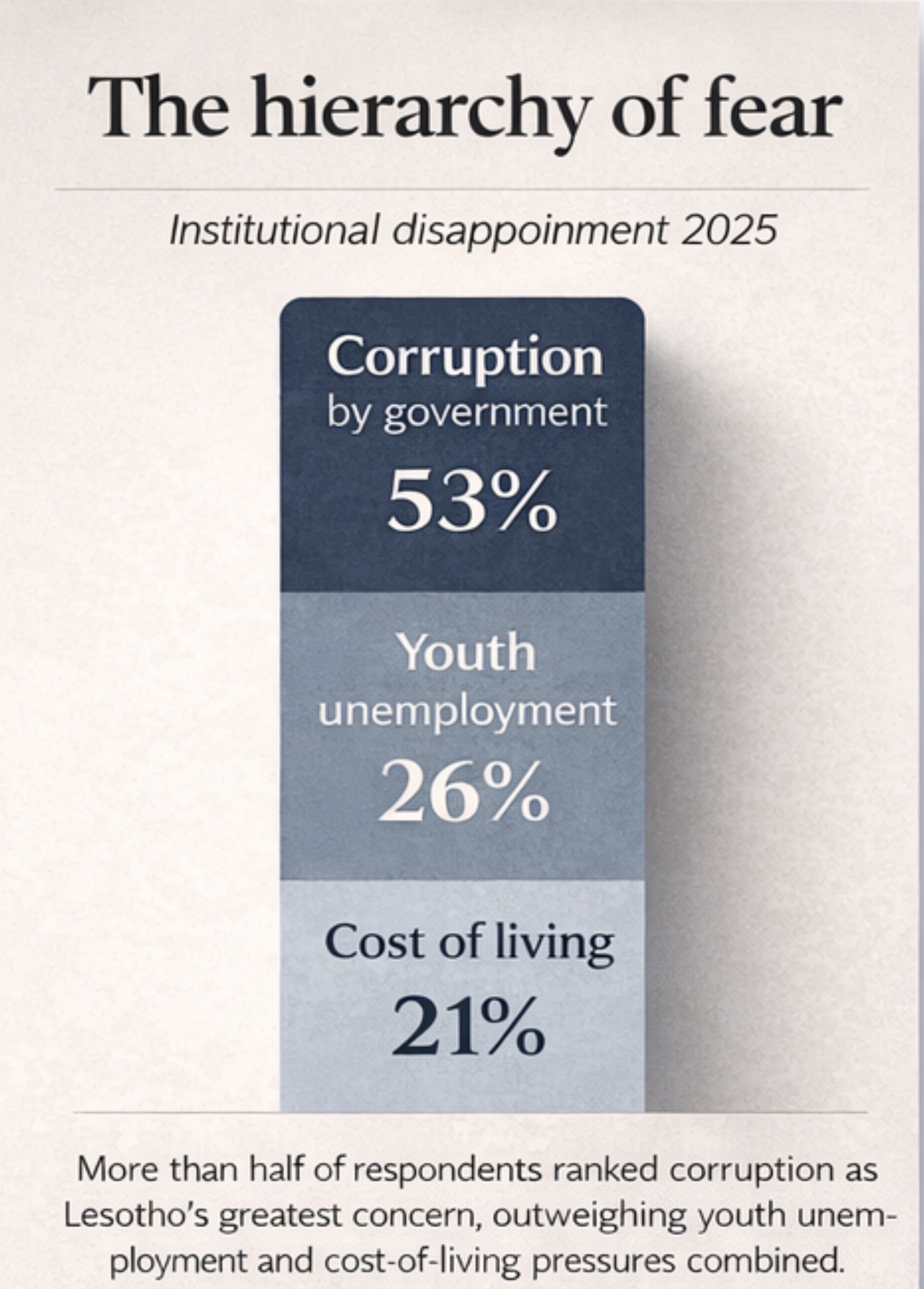
Figure 1 captures the hierarchy starkly. Asked what worried them most about Lesotho’s future, 53 percent of respondents chose corruption, compared with 26 percent who chose youth unemployment and 21 percent who pointed to the cost of living.
This is not a marginal lead. It is a commanding one.
From a data-analysis standpoint, such a gap is telling. When one variable so clearly dominates others, it usually means respondents are not thinking in isolated categories. They are ranking causes, not symptoms.
“Basotho are no longer just counting prices. They are questioning the system that produces them.”
In effect, the public appears to be saying this: we can survive high prices, and we can endure job scarcity for a while, but a state that cannot be trusted eventually collapses under its own weight.
When corruption becomes the lens
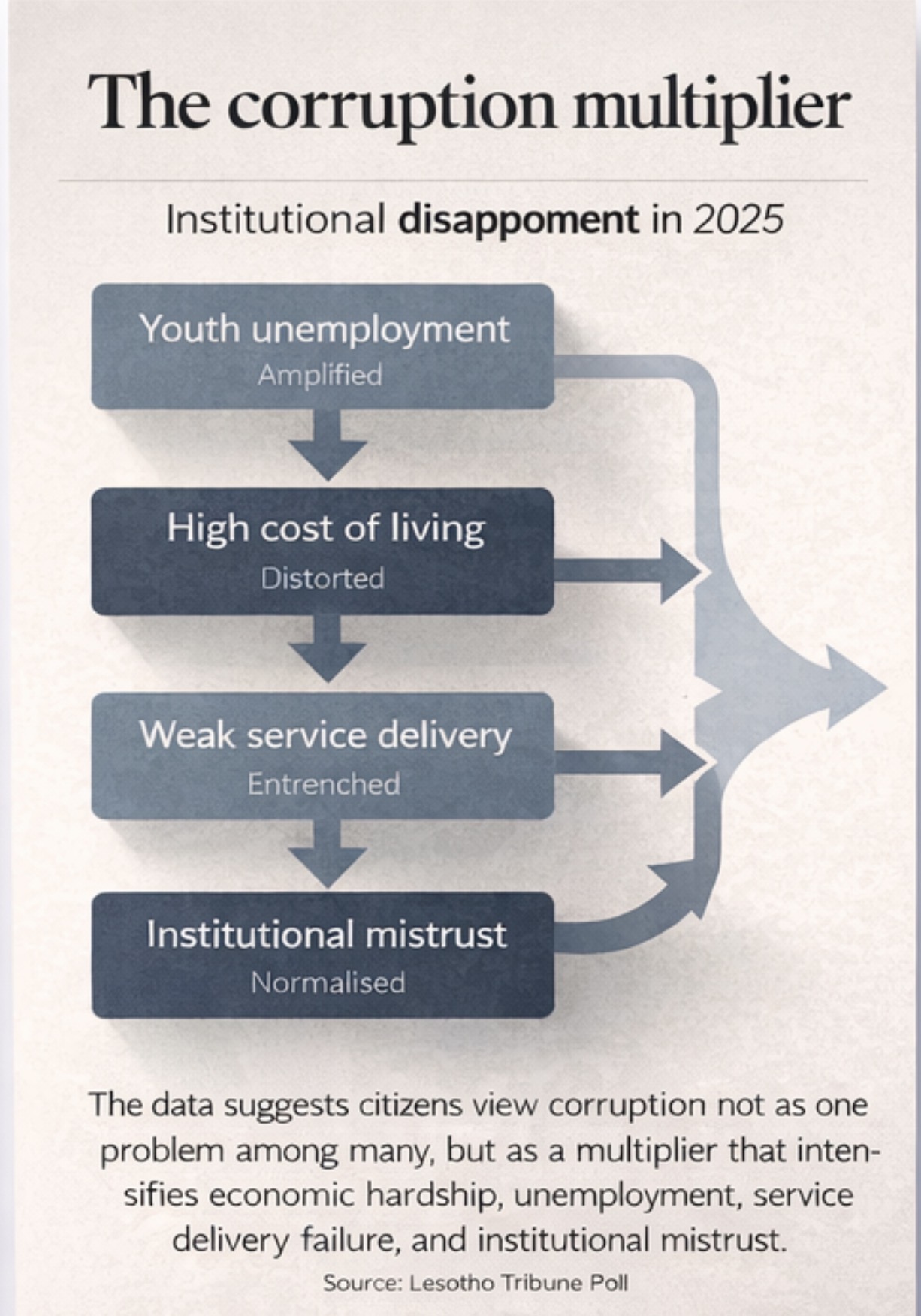
This interpretation is reinforced by Figure 2, which conceptualises corruption as an upstream risk. In systems analysis, upstream variables are those that shape everything downstream. If they fail, no amount of downstream intervention fully compensates.
Viewed this way, corruption is not competing with youth unemployment or the cost of living. It is framing them.
Inflation becomes more painful when public procurement is distorted. Youth unemployment becomes permanent when opportunity is mediated by patronage. Even well-funded programmes fail when institutions lack credibility.
Data callout:
53% of respondents ranked corruption above all other concerns about Lesotho’s future.
Source: Lesotho Tribune poll, December 2025
The data suggests that many Basotho now see corruption as the silent tax that inflates every other problem.
Disappointment has an address
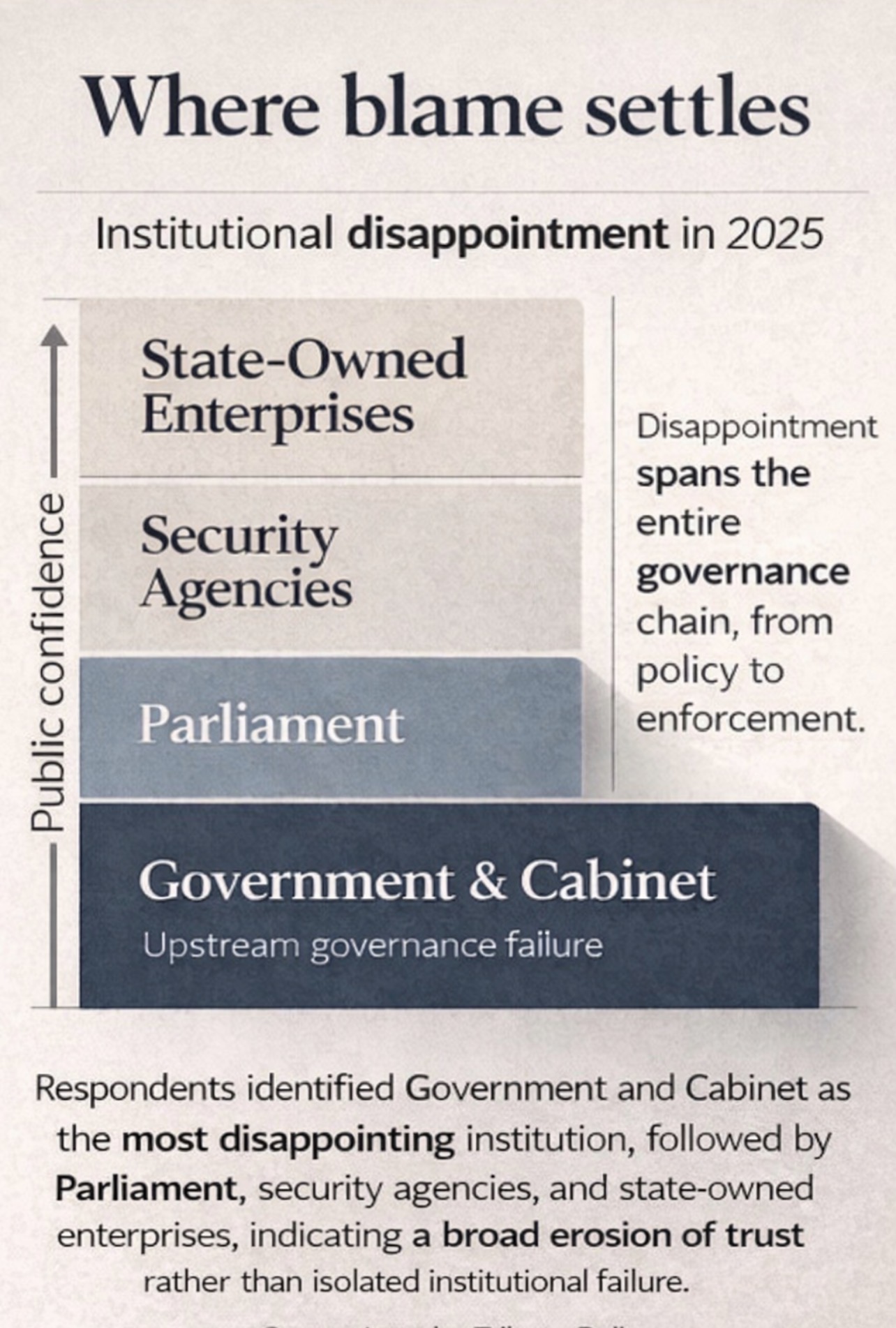
If Figure 1 tells us what people fear, Figure 3 tells us where they think responsibility lies.
In a separate poll asking which institution disappointed them most in 2025, Government and Cabinettopped the list. Parliament followed. Then security agencies. Then state-owned enterprises.
This ordering is analytically important. It spans the entire governance chain: policy formulation, oversight, enforcement, and execution.
“When disappointment spreads across all institutions, it stops being a personnel issue and becomes a structural one.”
From a governance perspective, this pattern signals a collapse of horizontal accountability. Citizens do not believe one institution is effectively restraining another. Instead, they see a closed circuit of power, weak oversight, and limited consequences.
The quiet downgrade of Parliament
Parliament’s position in Figure 2 deserves special attention. In theory, it is the institution meant to absorb public frustration and translate it into accountability. In practice, respondents appear to view it as part of the problem rather than a counterweight to it.
This is significant because once legislative oversight loses credibility, public trust rarely migrates elsewhere. It simply dissipates.
Security agencies and state-owned enterprises trailing Parliament suggests a public perception that enforcement and delivery failures are downstream of political failure, not independent of it.
Youth unemployment: the crisis everyone expects
Youth unemployment ranking second in Figure 1 may seem unsurprising, but its placement below corruption is revealing. At 26 percent, it remains a serious concern, but it no longer defines the national mood.
Economists sometimes refer to this as problem normalisation. When a crisis persists long enough without resolution, it ceases to shock. It becomes expected.
Youth unemployment accounted for 26% of responses, suggesting concern remains high, but not decisive.
The danger here is not complacency. It is resignation. When citizens no longer believe institutions are capable of solving a problem, they stop ranking it as urgent.
Why the cost of living ranked lowest
Perhaps the most counterintuitive finding in Figure 1 is the cost of living coming last. In a year marked by rising prices and household stress, this seems odd.
But again, Figure 3 offers the explanation. Cost-of-living pressures are being interpreted as consequences rather than causes. They are visible, painful, and immediate, but they are also seen as politically mediated.
If corruption persists, respondents appear to believe, no price relief will last.
Small sample size, strong signal
It is worth repeating that these are not nationally representative surveys. The sample sizes are modest. But data journalism is not only about scale. It is about coherence.
Across platforms, across questions, and across institutional targets, the signal is consistent. Corruption dominates concern. Institutions disappoint broadly. Economic anxieties are reframed through governance failure.
“This is not protest data. It is diagnostic data.”
What the data is really saying
Read together, Figures 1, 2, and 3 tell a story of a country no longer debating policy choices, but questioning institutional legitimacy.
Basotho are not simply asking for better outcomes. They are asking whether the system producing those outcomes can still be trusted.
That is a more dangerous question than any budget deficit or unemployment rate.
As Lesotho enters a new year, the data leaves little ambiguity. The country’s greatest challenge is no longer economic capacity, but credibility. And until that is restored, every other reform risks being swallowed by the same upstream failure.
Source: Lesotho Tribune reader polls, December 2025
Lesotho’s Rugby 7’s Make a Statement in South Africa
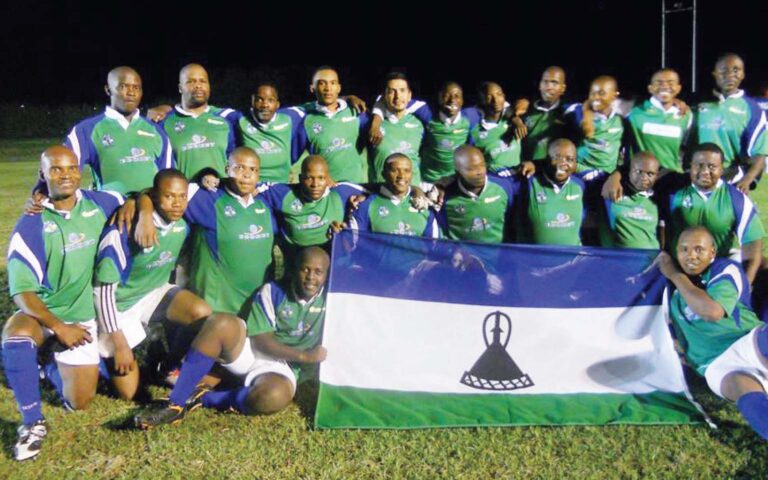
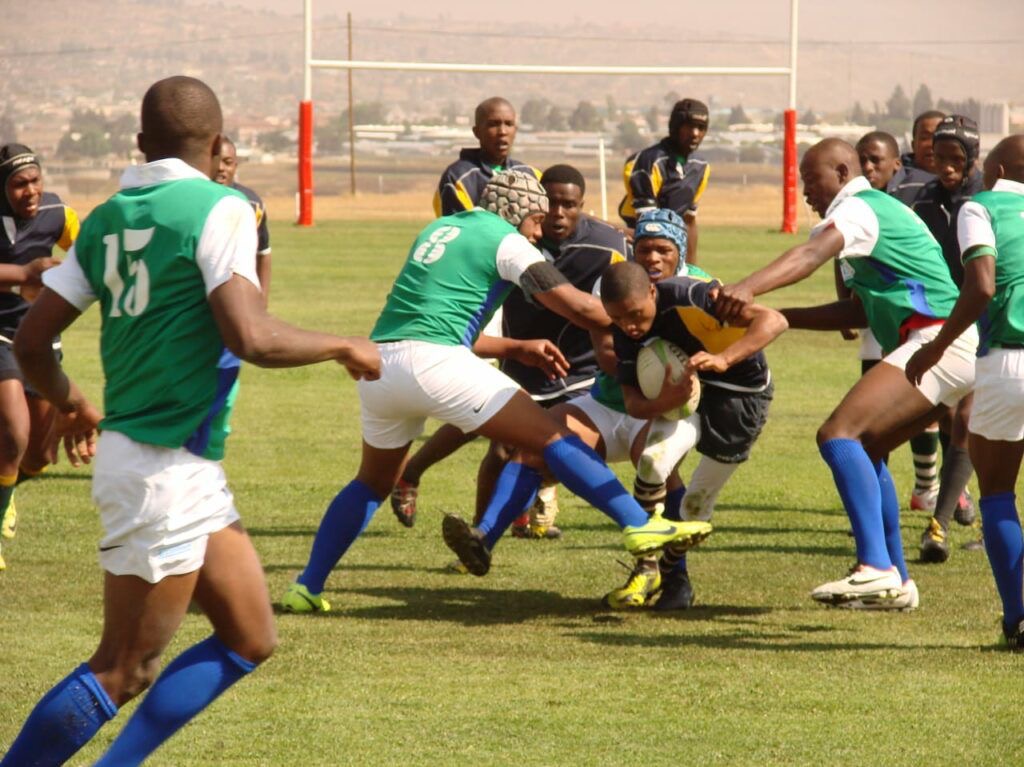
Lesotho Rugby 7s have announced their growing presence on the regional stage with a standout performance at the Khan’sicala Rugby 7s Festival in South Africa, where both our national teams claimed gold and silver medals in a highly competitive tournament.
The women’s team once again proved their class by successfully defending their title, overcoming Mozambique’s side in the final to secure the gold medal. Their composed and very dominant display confirmed their status as one of the most consistent teams at the festival. Not to be outdone, the men’s team delivered a strong campaign of their own, finishing second place overall and taking home the silver medal after a series of hard-fought matches.
Officials from the Federation of Lesotho Rugby (FLR) showed lots of praise for both teams, highlighting their discipline, commitment, and increasing improvement. The performances were seen as a reflection of the Federation’s investment in player development and long-term planning.
Off the field, the FLR continues to strengthen its operational capacity. The Federation utilized M107,000 from a World Rugby Grant to purchase key event-support equipment, including tents, toilets, a public address (PA) system, and a trailer. These resources are expected to enhance the hosting of rugby events and provide somewhat a better logistical support for national teams.
In this celebratory moment for the Federation, the FLR president officially presented national team regalia to newly appointed technical director Ronald Doyle, marking the start of a new chapter in Lesotho rugby’s technical leadership.
With their momentum building, rugby officials have expressed confidence that Lesotho’s 7s teams are on a promising path toward qualifying for the Olympic Games. The results in South Africa were described as another important milestone in that journey.
The Federation also announced that the newly acquired equipment will be available for hire to other national federations and sports associations, in order to support sport development while generating additional revenue.
Lesotho Rugby 7s continue to collect silverware and strengthen their foundations, and their message is clear: the nation’s rugby ambitions are no longer just potential, they are contionuosly taking shape on the field.