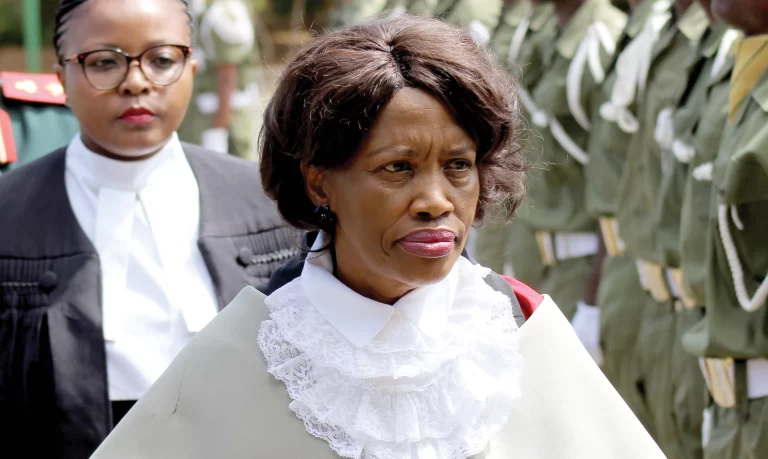
Maseru — The Registrar of the High Court has today, 7 November 2025, issued High Court Circular No. 10 of 2025 notifying the suspension of Justice Maseforo Mahase from exercising her judicial functions.
According to the circular signed by Adv. M.P. Sekoai, the suspension took effect on Tuesday, 4 November 2025. The notice has been circulated to key state institutions including the Attorney General, the Director General of the DCEO, the Commissioner of Police, the Law Society of Lesotho, members of the media, and the general public.
The circular does not specify the reasons for the suspension. Justice Mahase, a senior member of the High Court bench and former Acting Chief Justice, has previously presided over several politically sensitive cases.
The Lesotho Tribune is reaching out to the Judicial Service Commission and the Ministry of Justice and Law for comment on the circumstances surrounding the suspension.
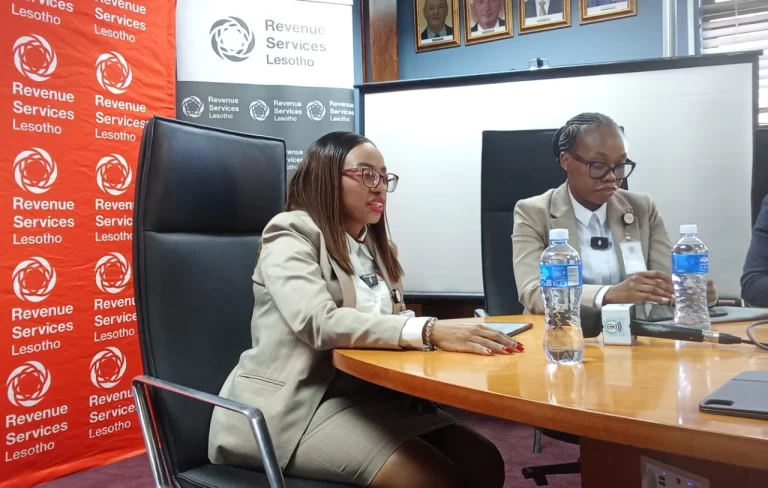
Maseru — In what appears to be a major governance crisis, the Revenue Services Lesotho (RSL) has reportedly terminated Commissioner-General Mathabo Mokoko from her post, following a heated public dispute with the Retšelisitsoe Matlanyane, Minister of Finance and Development Planning. The board of directors of RSL is said to have taken action, although no official statement has yet published the dismissal.
The Feud:
For months, Mokoko has been in conflict with Minister Matlanyane over what she describes as “unlawful directives” issued by the Minister to the RSL. According to legal correspondence filed by Mokoko’s lawyers, she was repeatedly asked to:
disclose the names of taxpayers who applied for VAT refunds;
issue tax clearance certificates to businesses that were not compliant with their obligations;
act on requests made orally or via informal channels rather than formal governance protocols.
In response, the RSL Board publicly confirmed that the dispute between Mokoko and the Minister had escalated, and that the board was “seized with the matter” and working to mediate. The board chair, Advocate Lindiwe Sephomolo KC, stated that they are “taking steps … to assess the potential implications this conflict could have on the country”.
The Reported Dismissal:
According to internal sources in RSL and government circles whose identities cannot yet be revealed, the board has voted to terminate Mokoko’s contract effective immediately, citing breakdown of working relations and governance risk. Efforts to obtain a formal press release from the board or the Ministry of Finance were unsuccessful by press time.
Why This Matters:
The RSL is a cornerstone of Lesotho’s public revenue system. If the independence of that institution is compromised by political interference or internal breakdowns, the consequences could ripple through public finances, investor confidence and the country’s compliance with external partner requirements. One name on the line: the Minister of Finance who oversees the RSL. Another: the board whose decision now sets a precedent for institutional governance.
What We’re Watching:
Will the board officially confirm the dismissal and provide reasons or reference a contractual clause?
Will Mokoko appeal the decision or seek a legal challenge citing unfair dismissal?
Will Minister Matlanyane respond publicly to the accusations of unlawful directives and the ultimate board action?
What will Parliament’s Economic Cluster Committee — which has already criticised the situation for undermining good governance — do next?
In Conclusion:
The reported removal of Mathabo Mokoko from the Commissioner-General role at RSL after her public row with the Finance Minister signals more than a change in personnel. It points to a test of governance, institutional autonomy and political accountability in Lesotho’s tax administration.
Maseru – A revolt is brewing inside the Revolution for Prosperity (RFP) as backbench MPs have boycotted parliamentary sittings since Monday, demanding that Prime Minister Sam Matekane fire what they describe as “corrupt ministers bleeding the party and the nation.”
The group of MPs, who make up the government’s restless backbench, accuse six cabinet members of corruption and abuse of office. Those named include Matjato Moteane, Nthati Moorosi, Motlatsi Maqelepo, Ntoi Rapapa, Retselisitsoe Matlanyane, and Lebona Lephema.
Sources close to the dissenting MPs told Lesotho Tribune that the boycott is part of a broader effort to “reclaim the RFP’s founding values” which, they say, have been eroded by self-enrichment and arrogance in Matekane’s cabinet. “We are not against the Prime Minister, we are defending the integrity of the movement he founded,” one MP said.
The standoff escalated today when the backbenchers convened a meeting demanding Matekane’s presence to discuss the crisis. However, instead of attending, the Prime Minister reportedly sent a letter warning the MPs to return to Parliament immediately and cautioning them against “conduct unbecoming of members of the ruling party.”
see attached letter below
The MPs have dismissed the letter as intimidation. They insist they will not resume parliamentary business until Matekane takes decisive action against what they call “a clique of corrupt ministers shielded by the Prime Minister’s silence.”
The rebellion marks one of the most serious internal challenges to Matekane’s leadership since RFP came to power. It exposes growing frustration within the party over allegations of never seen corruption, ministers awarding themselves government contracts and nepotism in key positions.
For now, the backbenchers say their boycott will continue indefinitely. “This is not a protest against government,” another MP said. “It is a protest to bring back the soul of RFP.”
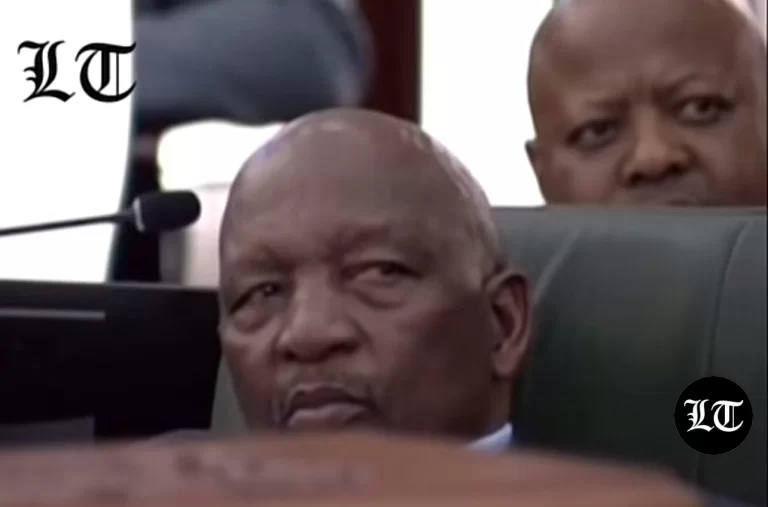
Today parliament didn’t proceed because there was no quorum as the RFP MPs defied Matekane’s orders. See picture below;
who will blink first? Let us know in the comment section below
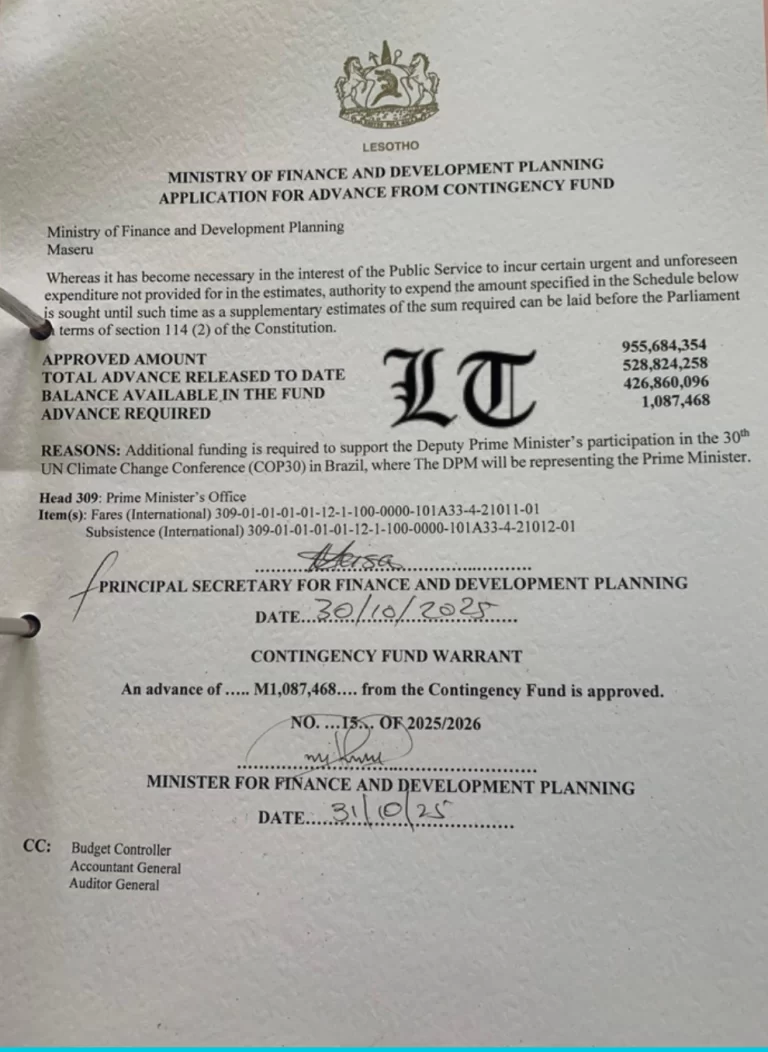
Maseru – The Ministry of Finance and Development Planning has approved an advance of M1,087,468from the national Contingency Fund to finance Deputy Prime Minister (DPM) Justice Nthomeng Majara’s participation in the upcoming UN Climate Change Conference (COP30) in Brazil.
According to official documents seen by Lesotho Tribune, the approval was signed by the Principal Secretary for Finance and Development Planning on 30 October 2025, and later confirmed by the Minister of Finance on 31 October 2025. The document cites the need for “additional funding to support the Deputy Prime Minister’s participation in COP30, where she will be representing the Prime Minister.”
The contingency fund, established under Section 114(2) of Lesotho’s Constitution, is designed for urgent and unforeseen expenditure not provided for in the estimates. The approved amount for the fund stands at M955,684,354, with M528,824,258 already released to date, leaving a balance of M426,860,096 before this latest allocation.
The warrant, numbered 155 of 2025/2026, authorizes the expenditure under the Prime Minister’s Office, specifically under the vote for “Subsistence (International)”.
The Ministry has not yet issued a public statement on the advance or the total cost of Lesotho’s delegation to COP30.
Since taking office four years ago, Prime Minister Sam Matekane’s administration has spoken endlessly about transparency and accountability. Yet for three consecutive financial years, not a single audit report has been tabled before Parliament, something unprecedented since the dawn of democracy.
Sources at the Office of the Auditor General confirmed to Lesotho Tribune that the reports for 2022/23, 2023/24 and 2024/25 were duly submitted to the Minister of Finance, Dr Retselisitsoe Matlanyane. Despite this, Parliament has never seen them. Efforts to obtain a comment from Dr Matlanyane were unsuccessful.
The delay has alarmed governance advocates who say it strikes at the heart of constitutional oversight. The Auditor General’s reports are the backbone of public accountability. Without them, legislators and the public are left guessing how government spends taxpayers’ money.
Basotho National Party (BNP) leader Machesetsa Mofomobe accused the Matekane administration of concealing uncomfortable truths about procurement and public finances. He said withholding the reports shields officials from scrutiny and betrays the promise of change that brought the Revolution for Prosperity party to power.
Section 2’s Kananelo Boloetse shared the same frustration. Speaking to Lesotho Tribune, Boloetse said his movement considers the situation unconstitutional and unacceptable.
“Yes, we are fully aware that the audits for those financial years have not yet been tabled before Parliament,” he said. “This situation is deeply concerning because it undermines constitutional accountability and transparency. The Constitution requires that public funds be audited and reported to Parliament so that the representatives of the people can exercise meaningful oversight.”
He added that Parliament was complicit in violating its own duty by approving new budgets while unaware of how previous allocations were spent.
“We intend to block Parliament from passing the next national budget and the Appropriation Act until the outstanding audit reports are tabled and debated,” Boloetse warned. “The people deserve to know how their money is being managed before any new allocations are approved.”
The law obliges the Minister of Finance to table audit reports once received from the Auditor General. These reports form the foundation for the Public Accounts Committee to interrogate ministries and state agencies. By withholding them, the government has silenced one of democracy’s most critical checks.
Whatever the reason for the delay, silence is no longer defensible. If the audits expose mismanagement, the public deserves disclosure. If the delay is procedural, the government must explain it. Accountability cannot exist in secrecy.
To date, the Matekane administration has spent more than M3.5 billion without parliamentary approval; a worrying sign that the missing audits may reveal the worst record of corruption and maladministration in Lesotho’s history.
Maseru — On Friday 31 October 2025, the Revenue Services Lesotho (RSL) reportedly entered the premises of the Maseru City Council (MCC) at Maseru West and removed yellow-plant equipment valued at over M20 million, according to multiple independent sources. The move followed a tax-collection process initiated by RSL against MCC for outstanding liabilities.
RSL’s spokesperson, Thabang Loko, declined comment, stating: “We are obligated by law not to discuss taxpayers’ affairs, therefore RSL will not comment on this.” MCC likewise did not issue a statement in response.
A Broader Enforcement Drive
This incident sits within a broader pattern of aggressive enforcement by RSL this year. Two recent high-profile cases illustrate the trend:
• The Lesotho Housing and Land Development Corporation (LHLDC), a state-owned enterprise, is subject to a court order obtained by RSL for unpaid taxes amounting to M35,722,995.38. The order authorises seizure of movable and if necessary immovable assets located in central Maseru.
• The Loti Brick (Pty) Ltd company also faces a tax liability in the region of M7.4 millionfollowing a court order for attachment of its property.
Together, these show that RSL is willing to enforce tax claims not only against private firms but also public entities and parastatals.
What the MCC Seizure Means
The removal of over M20 million in plant equipment from MCC raises several urgent questions:
• What is the exact amount of MCC’s outstanding tax liability, and what period does it cover?
• What process did RSL follow: Was there a demand notice, a court order, a period for negotiation or settlement?
• How will MCC maintain its operations and service delivery if key capital equipment has been removed?
• Does this signal that even local government entities can expect direct asset attachment if they fall behind on tax obligations?
Implications for Surrounding Institutions
For local authorities and state-owned enterprises, the message is clear: RSL appears to be ramping up enforcement. Entities that may have considered themselves insulated from tax action may need to reassess. The fact that LHLDC and Loti Brick are now subject to formal attachment orders suggests that the net is widening.
From a governance perspective, these actions underscore the importance of regular compliance with tax obligations and the risks of delays or defaults. Local government bodies in particular should review their internal controls, debt management practices, and engage proactively with RSL if they anticipate difficulty meeting obligations.
Next Steps
We will monitor the situation for:
• A formal response from MCC about its tax position and the nature of the seized equipment;
• Confirmation from RSL regarding the legal basis for the seizure (e.g., whether a court judgment or warrant of execution was in place);
• Any follow-up actions by MCC—such as appeal, repayment plan, or public disclosure of the liability;
• Whether other local authorities or municipalities face similar enforcement by RSL in the near-term.
For now, the story highlights that in Lesotho’s tax regime enforcement is no longer something that happens quietly in the background, it is visible, significant, and potentially disruptive for even publicly-owned or municipal organisations.
Here is the truth that keeps returning, no matter how loudly a government insists otherwise. Democracy wears down repression. It is patient. It is stubborn. It arrives with court papers, union placards, and the small courage of citizens who show up in daylight and ask to be heard.
Three years after taking office, the Matekane administration has run into that truth. Workers tried to march over job losses and the police said no. Unions then appealed to the minister and prepared to go to court. Within days, municipal authorities allowed a procession in Maseru. The sequence is not a triumph of benevolence. It is a reminder that rights outlast the political weather. Reports show unions threatened litigation after a denied permit, while the protest effort broadened through workers’ associations and civil groups. Shortly after, the Maseru City Council granted permission for a procession. That progression matters. It shows why power eventually bends to rules that are older and larger than any cabinet.
The Constitution sits at the centre of this story. It protects the freedom of peaceful assembly and expression. Those are not favours that leaders hand out on good days. They are guarantees that leaders must respect on bad days, especially when criticism stings. The text is clear. Freedom of expression is protected. Freedom of peaceful assembly is protected. Any restriction must be narrow, lawful, and necessary for things like public safety or order. That is the law in Lesotho, not a suggestion.
There is also an ordinary statute that draws the lines on processions. It requires notice and gives police limited powers to refuse, but only on exceptional grounds tied to real risks to peace or safety. Our courts have said so in plain terms. If you block a march, you must show compelling reasons, not vague discomfort with dissent. That standard is why permits denied on thin reasoning tend to crumble when challenged. The law forces the state to justify itself. That is how democracy wears down shortcuts.
Set this against the timeline of power. Sam Matekane took the oath on 28 October 2022 and formed a coalition government in early November. New leaders arrive with promises, energy, and a theory of control. Then the institutions quietly ask the same hard questions. Did you follow the Constitution. Did you follow the statute. Can you show proportional justification. Governments that ignore those questions discover that unions, courts, and councils can answer for them. That is not instability. That is the immune system of a constitutional order.
Some will try to spin the late permission as magnanimity. It is not. It is compliance. Others will claim that marches threaten order. The law already balances that risk. It allows restrictions, but it demands evidence. The burden sits with the state, not with citizens who want to walk in their own capital. When officials act as if a permit is a favour, they run into litigation and headlines. When they obey the Constitution, people protest, hand over memoranda, and go home. The streets stay open. The republic breathes.
There is an instructive lesson for the administration. You cannot win a contest against rights that are written down, litigated, and practiced by a public that refuses to be quiet. You can delay. You can posture. You can throw up roadblocks. In the end the text reasserts itself, the courts insist on reasons, and the unions find a legal route. That slow pressure is what turned a denial into a procession this week. That same pressure will keep returning every time the state forgets who owns the public square.
Democracy is not a vibe. It is paperwork, statutes, and constitutional clauses that force governments to explain themselves. It is also people who keep showing up until the explanation is either given or ordered by a judge. After three years in power, the Matekane government has been reminded of that. Those who believe they can outlast democracy should look again. The record of th
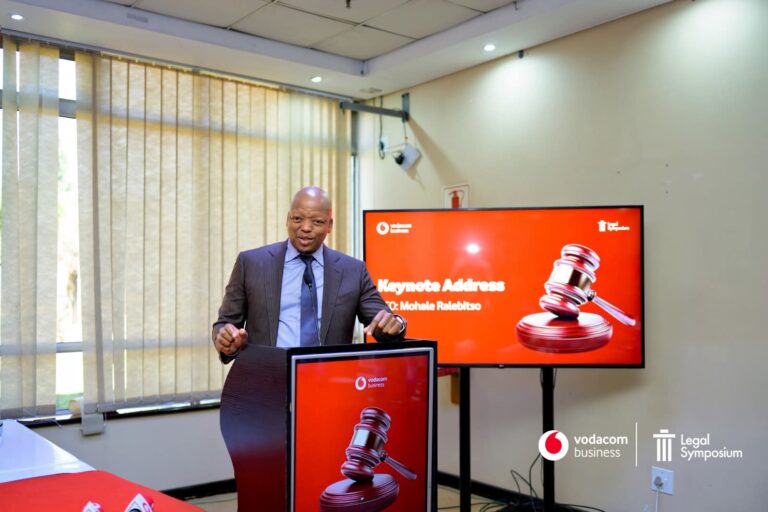
Under the theme “Leading the future- our shared role in legal evolution, the Vodacom Legal Symposium and Technology brought together legal professionals, regulators and technology experts to address critical topics including technology and law, stakeholder engagement as a cornerstone for policy development and the role of alternative dispute resolution.
For the telecommunications company, this symposium is a strategic move to navigate challenges, build trust and showcase its role in the country’s digital future.
It acted as a provider of direct dialogue with stakeholders on critical, evolving issues such as data privacy, cybersecurity and financial regulations, helping the company mitigate risk and stay compliant.
Rethabile Hoohlo, the EHOD Legal and Compliance at Vodacom Lesotho, said as a telecommunications company, their focus extends beyond conventional success as they are intentional about including a deep commitment in terms of cultivating a culture that actively engages all their stakeholders.
The symposium, a milestone in the company’s legal department’s view, aimed at cultivating fund leadership while driving discussions on critical policy enhancement and technological developments that will define a shared future going forward.
Hoohlo set an alarming tone in a room half-filled with legal practitioners when she emphasised that Lesotho’s legal profession was very old yet it now intersects with humanity’s newest and most dynamic creation- digital technology.
To move with the times, Hoohlo encouraged relevance, highlighting the need for a robust and supportive legal framework.
According to the telecommunications legal expert, the Social Electronic Transactions and Electronic Comments Bill of 2013, which was revised in 2020, is one of the few important legislations to consider if the goal is to accept change and ignore the risk of irrelevance.
The symposium’s discussions were shaped around the adoption of innovative tools, AI-driven discovery and smart contracts to digital case-managing systems; changes that are entrusted to enhance efficiency, ensure transparency and expand access to justice.
“To resist this evolution is to risk failure. To embrace it, on the other hand, is to redefine the very proposition of physical compassion in a digital economy,” Hoohlo said.
The formulation of law and policy, in Hoohlo’s opinion, can no longer be a siloed exercise and the velocity of technological change demands a new model of collaborative governance. As a result, she urged the championing of inclusive dialogue that will encourage robust alliances between the government, the private sector and social awareness.
Mohale Ralebitso, the telecommunications company CEO, added to these sentiments, saying generations to come are already at a high risk of being chipped by the stream of technology, thus emphasising the need to change.
He made an example of AI, saying lawyers and people who are in the protection of intellectual property know the challenge the robot is posing as there are bots used to consolidate, re-digest and re-cut things.
He reminded law practitioners to be mindful of the necessity to maintain integrity as they adapt and adopt the use of AI to engage matters of the law as that is what people today are doing in their work.
“This is important because we have to, with your knowledge, plug in the young people into being able to engage the challenges of our time, but to do so in a manner that respects that there are frameworks to observe,” Ralebitso reminded.
He, however, said if lawyers are going to be at the convergence of technology and what the law requires of them, they should ensure they are active architects of research’s future and not merely the people who are the handbrakes in it.
The President of the Law Society of Lesotho, a representative of the legal fraternity in the country, Advocate Lintle Tuke, commended Vodacom Lesotho for the symposium, applauding it for not just being a meeting of minds but a gathering of custodians.
The thoughtful gesture, Tuke said, was a humble reminder that technology and law are not rivals, “in fact, they are dancing partners.”
He assured the company that, as the legal fraternity of Lesotho, they were ready to partner up with other stakeholders to build a stronger framework for data protection and cyber resilience.
He reminded lawyers present of their importance to society, that when society moves into chaos, they are the first line of defence, “the bedrock upon which justice, accountability and responsibility can thrive.”
“So as we lead the future and embrace technology, may we also protect that which Dick the Butcher feared the most; a profession that defends justice even when it is inconvenient,” Advocate Tuke exclaimed.
Newly elected Lesotho Football Association (LEFA) president Lijane Nthunya has vowed to deliver in a new era of progress, accountability, and professionalism in the country’s football. Speaking during his first press conference on Wednesday, 29 October, at Bambatha Tšita Sports Arena, Nthunya outlined his plans to professionalise the game, support struggling clubs, and strengthen football development structures across all levels.
Nthunya said the National Executive Committee (NEC) will explore ways to provide financial subventions to Premier League and A-Division clubs while working toward giving the Premier League Management Committee (PLMC) greater autonomy. “Our long-term goal is to move football in Lesotho from semi-professional to professional,” he explained. “Granting the Premier League more independence will allow LEFA to focus on development while assisting clubs that are struggling administratively.”
The new president, who defeated former LeFA president Advocate Salemane Phafane by 27 votes to 24 in last Saturday’s closely contested election, said his administration will prioritise improving existing programmes, such as the Talent Development Scheme (TDS) and the national academy in Leribe. On Friday, Nthunya visited the academy to familiarise himself with its operations and engage with the association’s other various departments.
He also revealed plans to revive domestic competitions such as the Top 8 and Top 4 tournaments, increase the number of competitions in the leagues, including in lower divisions — and create award and recognition systems for players at all levels. “Competitions must give players something to play for,” he said. “That motivation helps raise the standard of football across all levels.”
On women’s football, Nthunya emphasised the need to change social attitudes and build a culture that encourages girls to take part in sport. “We need to work together to change the mindset of Basotho and allow girls to play football,” he said. “That’s how we’ll grow women’s football.”
Infrastructure development was another major focus of Nthunya’s address. He stated that every district should have a facility comparable to the Sebatana Russell and Saxophone Thejane Technical Centres in Mohale’s Hoek and Leribe. He added that District Football Associations (DIFAs) should manage these facilities under LEFA’s supervision. “It is our responsibility to show the government that infrastructure is their responsibility,” Nthunya said firmly. “We must stop playing games in South Africa — and that will only happen when our stadiums are fixed.”
Nthunya confirmed that he will step down from his positions as DIFA Maseru president and Machokha chairman to dedicate his full attention to leading LEFA. Despite the heated election, he said he has already met with former president Phafane and other NEC members to promote unity. “The elections are now behind us,” he said. “We’ve agreed to work together for the good of football.”
Nthunya also acknowledged that Lesotho needs to improve how it markets its football and expressed his desire to build partnerships with leading footballing nations such as England and Spain.
With a clear agenda built on unity, development, and professionalism, Nthunya’s presidency promises to set a new standard of leadership in Lesotho football or, as some may wonder, will it turn out to be just another empty promise?
Maseru — What began as a tense standoff between labour unions and the government over protest permits unfolded into a political power play within the ruling Revolution for Prosperity.
On 29 October 2025, the Maseru City Council (MCC) granted labour unions permission to hold processions targeting the Sam Matekane government. Sources within the development-partner community said external pressure helped sway the administration into issuing the permit. However, the police were yet to issue the final permit as required by law. The MCC approval represented one step closer to legality.
Lesotho’s trade unions had the previous day appealed to the Minister of Police and threatened court action after their earlier request to hold a protest march over job losses was denied. The coalition of unions, representing thousands of textile and garment workers, said they had followed all legal procedures under the Public Meetings and Processions Act of 2010. Despite this, Maseru Police Commissioner Tšeliso Moerane rejected the application.
In a letter dated 23 October, Commissioner Moerane cited “crucial omissions” in the unions’ submission. The police stated that while they respected the right to assemble, they carried a “huge responsibility to protect life and property and promote peace and well-being of the people.”
They outlined four deficiencies: the estimated number of participants, identification of organisers responsible for maintaining order, a permit from the Maseru City Council, and proof of prior arrangement with the Prime Minister’s office. Moerane asked the unions to explain why their “intended procession cannot be refused.”
The MCC’s move was widely seen as a compromise. Development partners, whose funding and conditions emphasise governance and civic freedoms, were said to have quietly leaned on the government. The argument was that Lesotho could not credibly claim to pursue reforms while suppressing the right to assembly. The city council’s decision thus reflected a tactical retreat from total restriction.
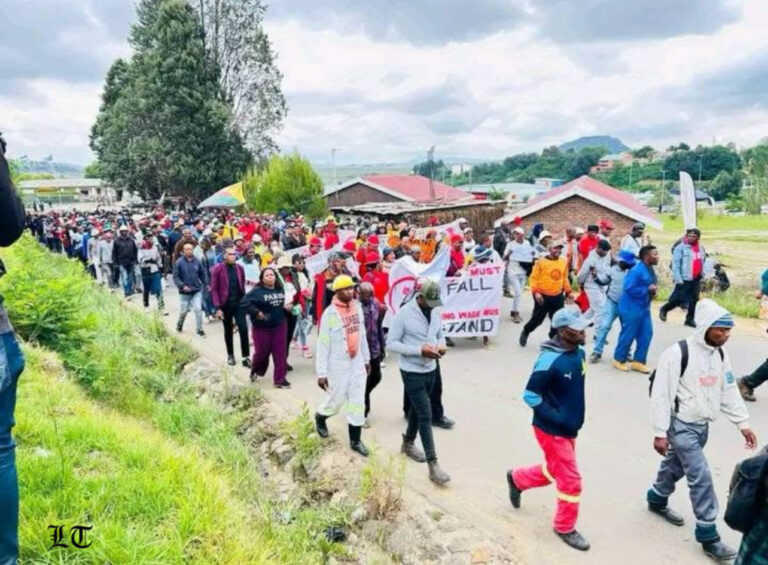
On Friday, the labour procession had taken place in the capital under tight police surveillance. Thousands of workers carrying banners marched peacefully, voicing frustrations over job losses and economic stagnation.
Leader of the Basotho National Party, Hon. Machesetsa Mofomobe voiced his concerns about the behaviour of the Lesotho Defense Force (LDF) who had held road blocks searching both motorists and passengers who were attending the march. Mofomobe called this intimidation by LDF and put the blame squarely on LDF Commander Mojalefa Letsoela.
EFTU leader Tsepang Makakole said they were grateful to the Minister of Police, Lebona Lephema, for his intervention. “Apart from the pressure from development partners, we would also like to thank Minister Lephema who ensured that we secured the permit,” Makakole said.
Government sources revealed that Lephema, who heads both the police and local government ministries, went against Prime Minister Matekane’s wishes. The Prime Minister was reportedly opposed to granting the unions the right to protest.
Insiders within the RFP told Lesotho Tribune that the move has widened internal rifts within the party. A subtle power struggle is said to be unfolding over succession planning. Lephema is reportedly unhappy with Matekane’s preferred choice of successor.
“Lebona is flexing his muscle trying to undermine the PM. We will deal with him properly,” said a state house insider who spoke anonymously.
Adding to the tension, Matekane was scheduled to receive China-donated agricultural implements on the same day as the protest. Sources within the party said the Prime Minister ignored the unions’ memorandum, sending a minister from his office to receive it instead.
“Ntate is busy. He will not waste his time by attending that march. Those are politicians, not labour unions,” said one RFP insider not authorised to speak to the media.
Friday’s procession marked the first protest under Matekane’s administration and a rare public show of defiance by organised labour. It also exposed widening cracks inside the ruling party, where loyalty to the Prime Minister appears to be tested by internal ambition and political muscle-flexing.
Once upon a time, Lesotho’s manufacturing belt was alive. Around 50 529 people worked in factories in 2020. Back in 2016, it was 46 000. A net gain of almost 6 000 jobs in just three years. Even during the worst months of Covid-19, the LNDC boasted of retaining close to 48 000 factory jobs.
So what happened? Where did the jobs go?
If your answer starts with “Donald Trump,” please stop and go fly a kite. Trump only took office in 2025. Our job losses began long before that. The truth is harder to swallow. We did this to ourselves.
Factories closed. Orders dried up. But the reasons were local too. Our costs rose. Our power flickered. Our infrastructure aged. When a brand in New York or Tokyo looks for suppliers, they compare more than wages. They compare reliability. And Lesotho’s record is no longer convincing.
Global demand changed after the pandemic. Supply chains shifted. Countries like Ethiopia, Kenya, and Vietnam undercut us on price and efficiency. We relied on AGOA access but never built beyond it. We thought preferential trade terms were permanent. They were not.
Inside the country, we failed to upgrade. We trained workers only after hiring them. We imported every input; zippers, thread, packaging and still called it “manufacturing.” We never built proper linkages. When borders tightened, everything stopped.
And while we comforted ourselves with retention numbers, the reality on the ground was shrinking. Some factories downsized shifts. Others paid half wages. The LNDC counted jobs that barely existed.
The painful question is not who took our jobs. It is what we did to lose them.
If Lesotho wants to rebuild, it must stop chasing ghosts. Fix the power grid. Fix the data. Build local supply chains. Train before hiring. Diversify markets. And stop pretending that old AGOA-era growth will come back by itself.