



MASERU — The tabling of Lesotho’s 2026/27 National Budget has triggered an immediate and largely negative public reaction, with a new Lesotho Tribune Sentiment Tracker showing that seven in ten Basotho are either disappointed or believe the budget represents “the same old story.”
The findings, based on reader responses and verified public commentary, highlight a widening gap between fiscal policy and public expectations in an economy grappling with unemployment, weak private sector growth, and declining household purchasing power.
Public mood tilts sharply negative
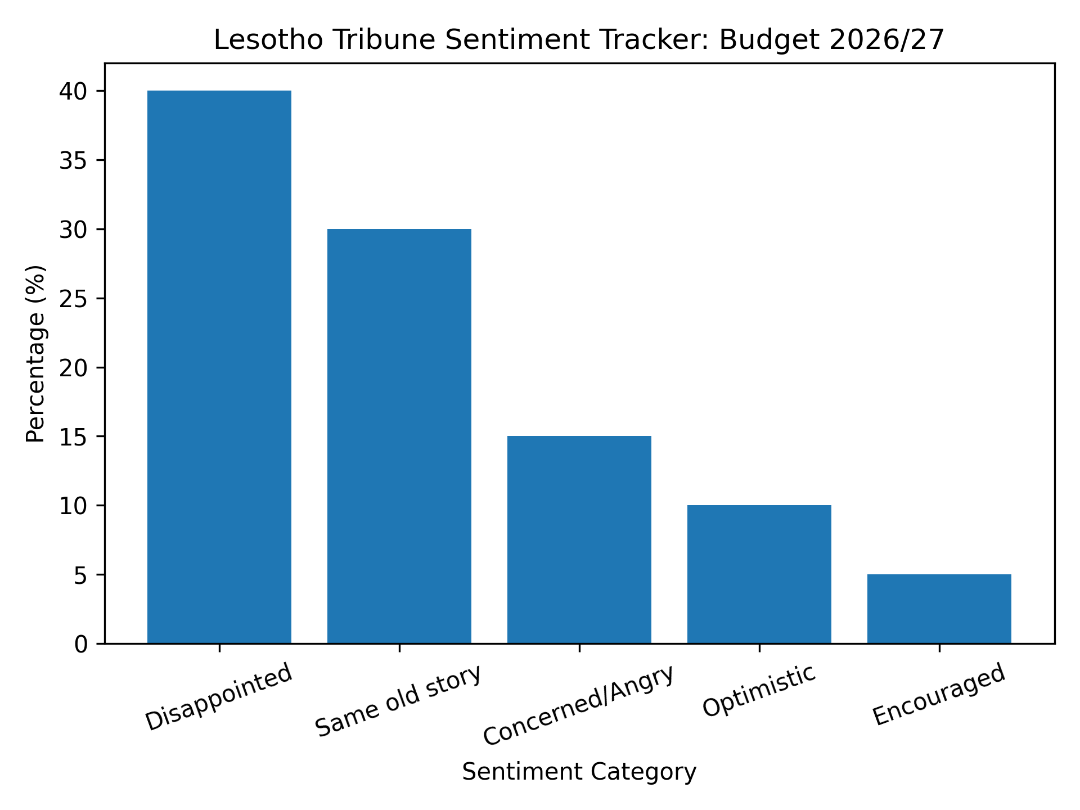
According to the Lesotho Tribune Sentiment Tracker analysis:
• 40 percent of readers expressed outright disappointment
• 30 percent said the budget represents “the same old story”
• 15 percent expressed concern or anger
• Only 15 percent combined expressed optimism or encouragement
This places the overall sentiment firmly in negative territory.
For many citizens, the budget failed to address what they consider the country’s most urgent crisis: unemployment.
One reader summarised the frustration in blunt terms:
“Job creation Nop.”
Another pointed to deeper structural concerns:
“Lesotho’s biggest problems: Massive youth unemployment, weak private sector, low industrialisation, too much dependency on government jobs.”
Salary increase fails to inspire confidence
Government’s decision to approve a 2 percent salary increase for civil servants also drew widespread criticism.
While authorities framed the increase as fiscally responsible, many workers viewed it as inadequate in the face of rising living costs.
One reader recalled earlier political promises:
“During his election campaign PM Matekane said civil servants salaries will be equivalent to international salaries.”
Another questioned the fairness of public sector adjustments:
“What is funny is that they never increase parliamentary salaries with 2%.”
The reaction suggests that, while technically an increase, the adjustment has done little to shift public perception of economic stagnation.
Budget figures seen as disconnected from lived reality
Several readers expressed confusion over how such a large national budget translates into everyday economic hardship.
“I see nine billion Maloti but our day-to-day living cost keeps rising. I can’t even talk of wants,” wrote one commenter.
Others questioned allocation priorities, suggesting that sectors critical to economic expansion were not sufficiently prioritised.
Youth empowerment funding, in particular, was criticised as inadequate relative to the scale of the unemployment crisis.
“So R100k will empower youth? No job creation nothing else related to youth unemployment,” another reader noted.
Institutional reform message fails to resonate
Government has emphasised institutional strengthening and governance reforms as central pillars of the budget.
While some readers welcomed this focus, these views remained in the minority.
“I had to go read on institutional strengthening… this will be a good one,” one reader said cautiously.
However, such optimism was overshadowed by broader scepticism.
What the sentiment reveals about Lesotho’s economy
The Lesotho Tribune Sentiment Tracker suggests the public is not simply reacting to the size of the budget, but to its perceived impact on daily life.
Three conclusions emerge clearly.
First, Basotho want jobs, not just fiscal stability.
Second, modest wage adjustments are unlikely to restore confidence amid rising living costs.
Third, public trust in economic transformation remains fragile.
This presents a political and economic challenge for government.
While fiscal discipline may be necessary, public confidence ultimately depends on visible improvement in employment, incomes, and opportunity.
Sentiment Tracker verdict
Public Confidence: Low
Economic Optimism: Weak
Dominant Public Mood: Disappointed
Expectation of Immediate Improvement: Limited
For now, the numbers may balance on paper.
But in the court of public opinion, the verdict is far less favourable.