


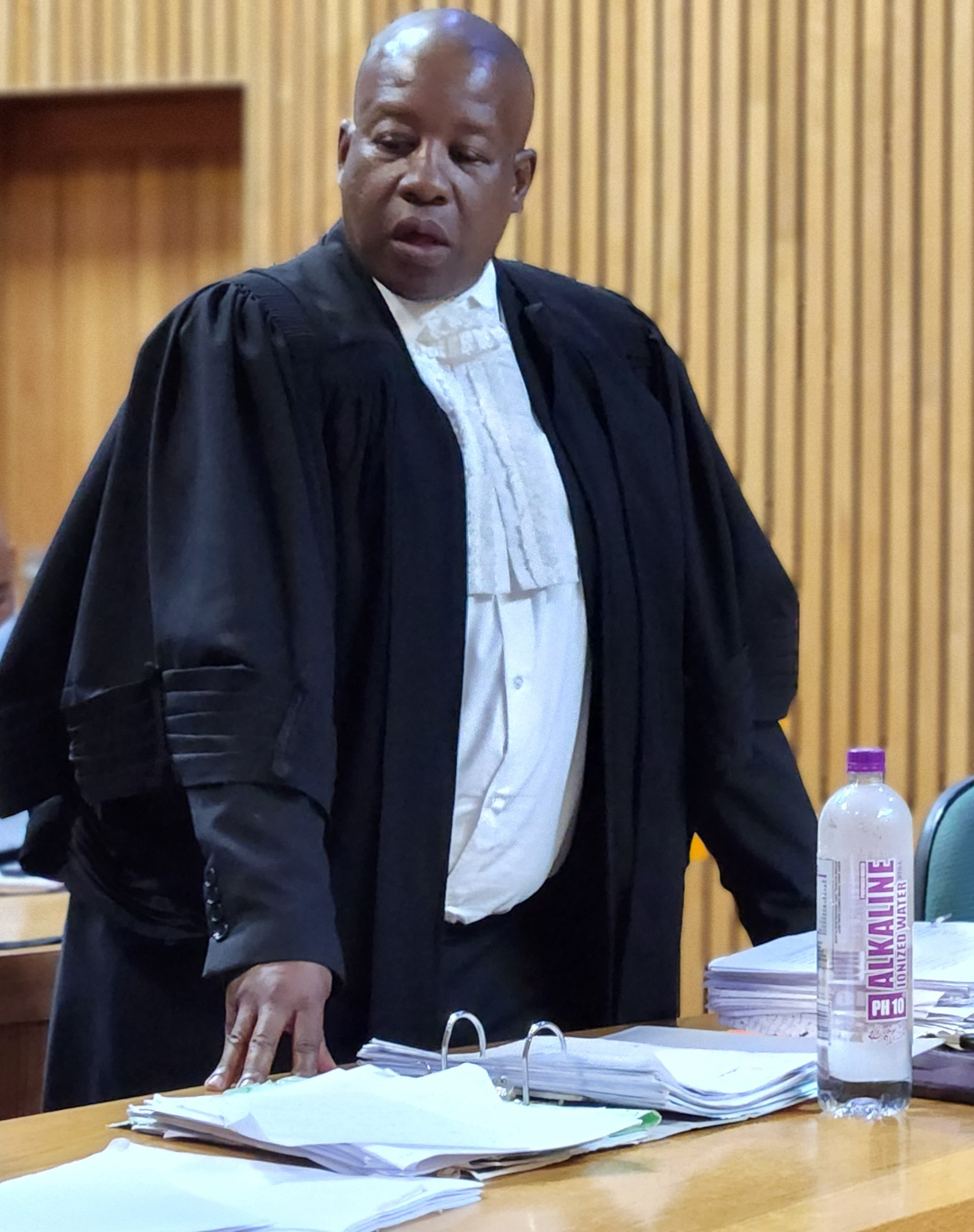
A defence lawyer in Lesotho’s long-running treason trial has defended army tactics used during the 2014 raids on police stations, describing the operation as a carefully planned effort to minimise casualties, while the state witness on the stand dismissed the strategy as an act of cowardice.
By Tholoana Lesenya
One of the defence lawyers in the ongoing treason trial linked to the 2014 security operations has defended the strategy used by members of the army during raids on police stations, saying the operation was carefully planned to avoid bloodshed.
Advocate Lepeli Molapo made the remarks this week during cross-examination of Sergeant Shaabe Thamae, the eighth state witness in the high-profile case before the High Court.
Sergeant Thamae was among police officers stationed at the Police Headquarters on the night when Sub-Inspector Mokheseng Ramahloko was allegedly shot and killed during the military operation carried out on 29 and 30 August 2014.
During proceedings, Adv. Molapo argued that the military strategy used during the raids was a sound one because it relied on surprise attacks at night, when police stations were less active and members of the public were absent.
According to the lawyer, the aim of the operation was to reduce resistance, avoid injuries and prevent unnecessary deaths. He told the court that police stations where firearms were kept were targeted at night because fewer officers were on duty during those hours and ordinary citizens would not be caught in dangerous situations.
“The operation went smoothly at the targeted police stations.”
Adv. Lepeli Molapo, defence counsel
Adv. Molapo further argued that the success of the strategy was evident in the fact that no deaths or serious injuries were reported at the other police stations that were raided. The fatal shooting occurred only at the Police Headquarters.
However, Sergeant Thamae strongly rejected the lawyer’s characterisation, describing the military approach as cowardice.
The witness said the army should have known through its intelligence structures that firearms at police stations were stored in secure safes controlled by senior officers who were not even on night duty. He argued there was no need for the operation to be conducted in secret, under cover of darkness.
According to Sergeant Thamae, if the army had genuinely believed there was a security threat involving the police, proper legal and professional procedures should have been followed rather than launching armed raids.
He also rejected allegations that police officers intended to distribute firearms unlawfully to members of the public, explaining that the duty of the police is to confiscate illegal weapons from civilians, not to hand them out.
“If a police officer gives guns to members of the public, that officer would be breaking the law and action should be taken against them,” Sergeant Thamae told the court.
Earlier in the cross-examination, Adv. Molapo revealed that army intelligence had allegedly received information suggesting that some police officers intended to arm certain civilians in order to create instability in the country. The alleged plan was believed to be aimed at threatening coalition partners who were part of the government at the time.
Adv. Molapo said senior army commanders then issued instructions to prevent what they believed could become an insurgency, and that the order was lawful because one of the core duties of the army is to protect the government, the country and the nation from threats.
The court heard that the operation formed part of wider tensions between the army and police during the political instability that affected Lesotho in 2014.
The accused
| Name | Position / Affiliation |
|---|---|
| Mothetjoa Metsing | Leader, Lesotho Congress for Democracy (LCD); former Deputy Prime Minister |
| Selibe Mochoboroane | Leader, Movement for Economic Change (MEC); current Minister of Agriculture, Food Security and Nutrition |
| Tlali Kamoli | Former army commander |
| Litekanyo Nyakane | Army member |
| Motloheloa Ntsane | Army member |
| Leutsoa Motsieloa | Army member |
The accused face several charges including treason, murder, attempted murder, aggravated assault and acts that allegedly created risk of injury or death. All have pleaded not guilty.
The charges include the murder of Sub-Inspector Ramahloko and the attempted murder of Letsekang Mothibeli. Additional charges include aggravated assault against Sergeant Mahanetsa, Lance Sergeant Thabisa Kopa, Lance Sergeant Thamae, Police Constable Mokete Litulo and Police Constable Mone.
Some charges, specifically targeting Kamoli, Nyakane, Metsing and Mochoboroane, include treason, attempted murder of Police Constable Moeketsi and assault of Sub-Inspector Joel.
The offences were allegedly committed between 29 and 30 August 2014. The prosecution alleges that the accused acted together with a shared and common purpose. The charge sheet also mentions the late Tefo Hashatsi and Bulane Sechele, together with Tumo Lekhooa and other individuals still unknown to the prosecution.
Court details
| Presiding judge | Justice ‘Maliepollo Makhetha |
| Venue | High Court, Maseru |
| Prosecution | Advocates Motene Rafoneke and Rethabile Setlojoane |
| Defence | Advocates Motiea Teele KC, Letuka Molati, Lepeli Molapo, Kabelo Letuka and Napo Mafaesa |
The trial continues.