


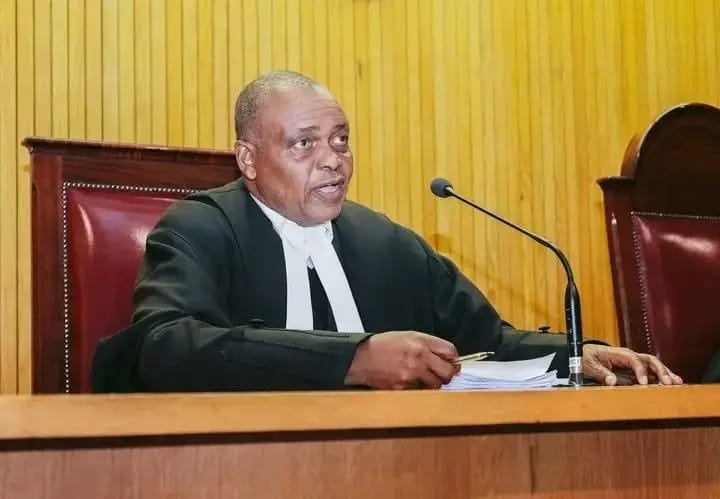
After nearly a decade behind bars awaiting trial, two members of the Lesotho Defence Force (LDF) accused of the attempted murder of veteran journalist Lloyd Mutungamiri have been granted bail by the High Court in a ruling that has reignited debate about prolonged pre-trial detention and delays within the criminal justice system.
Brigadier Rapele Mphaki and Lance Corporal Maribe Nathane were granted bail by Justice Molefi Makara after successfully petitioning the court, arguing that the prolonged delay in the prosecution of their case was not of their own making and amounted to exceptional circumstances warranting their release.
The two are among four charged with the attempted murder of Mutungamiri, former editor of Lesotho Times and Sunday Express newspapers. Their co-accused are Khutlang Mochesane and Nyatso Tsoeunyane.
In their bail application, Mphaki and Nathane told the court that they had been incarcerated for close to 10 years without the matter being finalised despite their consistent availability to stand trial. They further submitted that the continued delay has been exacerbated by the uncertainty surrounding the continuation of the case following the suspension of the presiding magistrate.
Court records show that Senior Resident Magistrate Murenzi, who had been seized with the matter at the magistrate’s court, was suspended by the Judicial Service Commission (JSC) over allegations of misconduct.
Following his suspension, the JSC directed that all case files that were before him be locked pending further processes. As a result, several cases, including this high-profile attempted murder matter, stalled indefinitely.
In a strongly reasoned judgment, Justice Makara held that the petitioners had established a prima facie case for admission to bail. He noted that the accused persons had endured an unusually long period of pre-trial incarceration, which, in itself, constituted exceptional circumstances under the law.
“The fact that the accused have been waiting in custody for almost 10 years for their case to be concluded cannot be ignored by this court,” Justice Makara said.
“Such a delay, through no fault of their own, offends the interests of justice.”
The court further found that the State had failed to place any countervailing evidence before it to demonstrate that releasing the accused on bail would jeopardise the administration of justice.
“There has been no counter evidence provided for the court to entertain any perceptible fear that the petitioners will defeat the ends of justice in any manner,” the judge ruled.
Addressing concerns often raised in cases involving members of the armed forces, Justice Makara cautioned against blanket assumptions about the character and conduct of soldiers.
“There is a perception that members of the army are potentially dangerous people,” he observed. “That kind of image is not healthy and each case must be assessed on its own merits.”
The court consequently ordered that each of the petitioners be released on bail under strict conditions. Mphaki and Nathane were each directed to pay bail in the amount of M2, 000 and to secure a surety of M10, 000.
Justice Makara emphasised that compliance with the bail conditions was not optional and warned that any breach would attract serious consequences, including possible revocation of bail.
The charges against the accused arise from an incident alleged to have occurred on July 9, 2016, at or near Ha Thamae in Maseru.
According to the charge sheet, the four accused persons allegedly acted in concert or with common purpose when they shot Mutungamiri, inflicting serious and potentially life-threatening injuries.
They are charged with contravening section 22(1) read together with section 109 of the Penal Code Act No. 6 of 2010, provisions which relate to attempted murder and common purpose.
The shooting of Mutungamiri, a prominent journalist known for his investigative reporting and critical commentary, sent shockwaves through the media fraternity and broader society at the time, raising concerns about press freedom and the safety of journalists in Lesotho.